Last updated: July 17, 2026 · Data reviewed quarterly
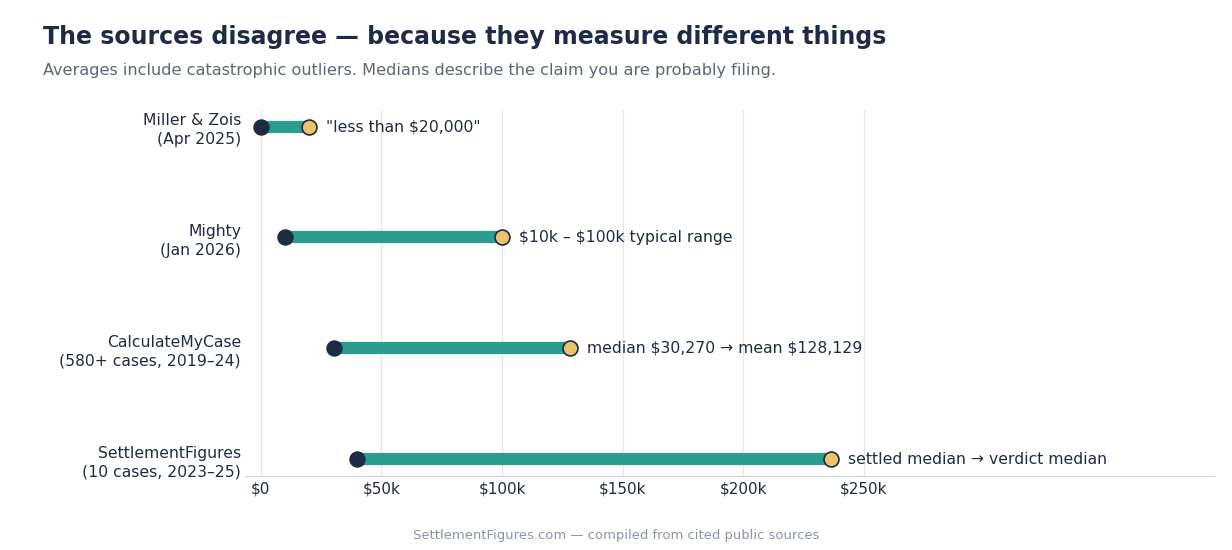
When an uninsured driver hurts you, your claim goes to your own insurance company — and the real payout is far smaller than the headline averages suggest. Across 580+ case records logged by Thomson Reuters between 2019 and 2024, CalculateMyCase puts the median uninsured motorist settlement at $30,270, against a mean of $128,129. Miller & Zois, reviewing its own caseload in April 2025, reports the typical underinsured motorist payout is under $20,000. That gap is not a contradiction. Averages are dragged upward by a handful of catastrophic cases; the median describes the claim you are probably filing.
| Source — and what it actually counts | Typical figure |
|---|---|
| CalculateMyCase — 580+ UM/UIM case records logged by Thomson Reuters, 2019–2024 | Median $30,270 · mean $128,129 |
| Miller & Zois (Lawsuit Information Center), April 2025 — its own UIM caseload | Typically under $20,000 |
| Mighty, January 2026 — typical UIM claim range | $10,000 – $100,000; $250,000+ in severe cases |
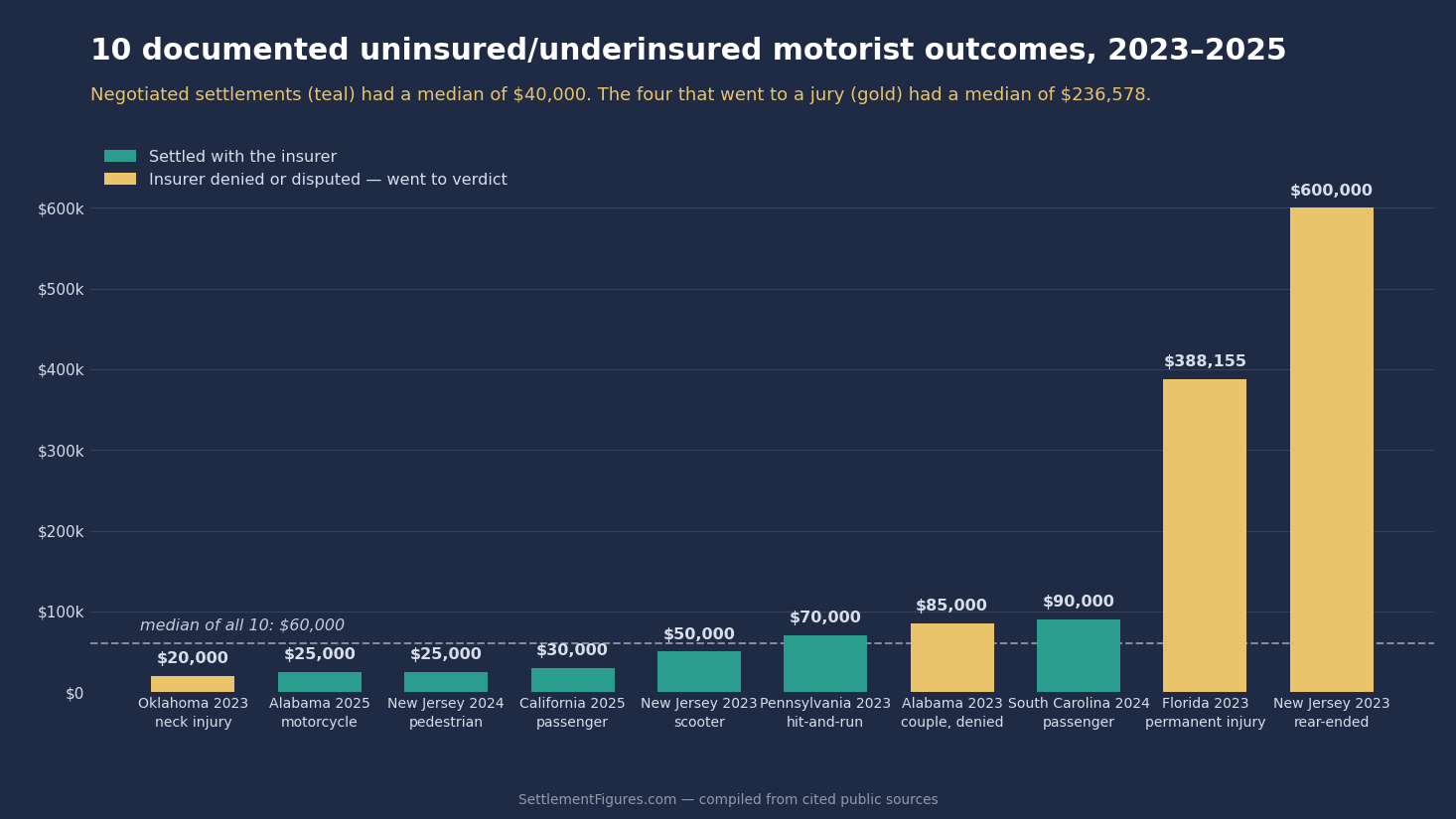
| SettlementFigures — our compilation of the 10 documented UM/UIM outcomes above, 2023–2025 | Median $60,000 · settled median $40,000 · verdict median $236,578 |
What the law actually says
Two facts frame every uninsured motorist claim. First, 49 states and the District of Columbia require drivers to carry liability insurance, with New Hampshire the lone exception — and even there, a financial responsibility law applies, per the NAIC (updated July 2025). Second, people drive without it anyway. The Insurance Research Council found 15.4% of drivers were uninsured in 2023 — better than one in seven — and that one in three (33.4%) were either uninsured or underinsured, a 10-point jump since 2017. The NAIC cites the same IRC study.
Your odds depend heavily on geography. IRC data puts Mississippi highest at 28.2%, followed by New Mexico (24.1%) and DC (23.1%). Maine is lowest at 5.7%, then Utah (6.2%) and Idaho (6.4%).
Whether you carry UM coverage is a separate question. Roughly 20 states and DC require it, according to both WalletHub and Mighty — though their state lists differ slightly, which is itself a warning to check your own declarations page rather than any article. Elsewhere insurers must generally offer the coverage and you have to decline it in writing, a rule the Texas Department of Insurance states plainly on its consumer page. If you never signed a rejection, you may have coverage you have forgotten about.
Your options after an uninsured driver hits you
| Your situation | What covers you | What to know |
|---|---|---|
| At-fault driver has no insurance | UM bodily injury (UMBI) + UM property damage (UMPD) | You file against your own insurer, not theirs |
| At-fault driver has too little | UIM | You generally must exhaust their limits first, in writing |
| Hit-and-run, driver never found | UM — a hit-and-run driver counts as uninsured | Report to police immediately; most policies require it (Maryland Insurance Administration) |
| Your car is totaled | UMPD, or collision coverage | Texas and Maryland both fix the UMPD deductible at $250 by law |
| You were a pedestrian or cyclist | UM under your own auto policy | Coverage often follows the person, not the vehicle |
| Insurer denies or lowballs | Arbitration, then possibly a bad-faith claim | 4 of the 10 documented cases above went to verdict — median $236,578 |
The property damage side is worth separating from the injury side. If the crash totaled your car, the valuation fight that follows is its own negotiation with its own leverage — the same one covered in our guide to negotiating a total loss payout, and it runs on the insurer’s comps report regardless of who was uninsured.
Red flags in how your claim is handled
“You were partly at fault, so we’re denying it.” Whether that is true depends entirely on your state. Maryland is unusually harsh: its Insurance Administration states that UM coverage applies only where the other driver is 100% at fault, and any contribution on your part bars recovery. Most states instead use comparative negligence, which reduces your payout by your share rather than erasing it — the rule that shapes payouts in Texas car accident settlements, for example. Get the actual rule for your state before accepting a denial.
Pressure to settle before treatment ends. You cannot value an injury you are still being treated for. The Oklahoma claimant in our chart sought $98,500 for neck injuries and a jury awarded $20,000 — soft-tissue neck claims are contested hard everywhere, the same valuation fight that plays out in neck injury workers’ comp settlements.
A denial with no written explanation. Ask for it in writing, every time — a written denial is what you appeal, and our guide to appealing a denied insurance claim covers the escalation path. Documentation is what separates a paid claim from a denied one, in the same way it decides whether you can prove a slip and fall.
Your insurer is now your opponent. This is structurally true of every UM claim and it surprises people. The company you have paid for years is the company deciding what your injury is worth. Of the four cases above where the insurer denied or disputed, State Farm, Allstate and Progressive were all defendants — and all four ended above the settled median.
Where to get help
Your state insurance department regulates the company handling your claim, and complaints are free. That is the lever most people never pull.
Free official help & resources
- Find your state insurance department: NAIC directory — every state, with complaint lines
- File a complaint about your insurer: NAIC consumer hub
- Texas: TDI uninsured motorist guide — call 800-252-3439
- Maryland: Maryland Insurance Administration — call 1-800-492-6116 (toll free)
- Free legal questions answered by volunteer attorneys: ABA Free Legal Answers
- Legal aid near you: Legal Services Corporation
- Rent, food or medical bills while you recover: dial 211 or visit 211.org
Frequently asked questions
What is the average uninsured motorist settlement amount?
CalculateMyCase reports a mean of $128,129 and a median of $30,270 across 580+ Thomson Reuters case records from 2019–2024. Miller & Zois puts typical UIM payouts under $20,000. Use the median: the mean is inflated by catastrophic cases that look nothing like most claims.
How long does an uninsured motorist claim take?
Weeks to several months for a straightforward claim. Miller & Zois notes that pure uninsured claims tend to move fastest, because there is no second insurer involved. Underinsured claims take longer — you must resolve the at-fault driver’s policy first. Disputed claims heading to arbitration or trial can run past a year.
Will filing an uninsured motorist claim increase my insurance rates?
It generally should not, since the crash was not your fault, and some states bar increases for not-at-fault claims. But insurers do review claims history at renewal, and practice varies by state and company. Check your policy, and check your state department’s rules if your premium moves.
Do I have to pay a deductible on an uninsured motorist claim?
For injuries (UMBI), usually no. For property damage (UMPD), usually yes. Texas and Maryland both set that deductible at $250 by law. Elsewhere it commonly runs $200–$500 — your declarations page will say.
Are hit-and-run accidents covered by uninsured motorist coverage?
Yes. An unidentified hit-and-run driver counts as uninsured, so UM coverage applies — one of the settlements above was a $70,000 Pennsylvania hit-and-run involving a cyclist. The catch is timing: the Maryland Insurance Administration warns that most policies require a prompt police report, and some set a specific deadline. Our full guide to insurance options and payouts after a hit and run walks through the deadlines and coverage choices.
Can you file an underinsured motorist claim if you were partially at fault?
In most states yes, with your payout cut by your share of fault — 30% at fault on $100,000 in damages means roughly $70,000. Modified comparative negligence states cut you off entirely at 50% or 51%. Contributory negligence states, Maryland among them, bar recovery over any fault at all.
☕ This research is reader-supported. No law firm pays us. If this guide saved you time or money, you can buy the research team a coffee — it keeps the data free and updated.
This article is for informational purposes only and is not legal advice. Settlement values vary significantly by case and by state. Consult a licensed attorney in your state before making decisions about your claim.
