Last updated: July 20, 2026 · Data reviewed quarterly
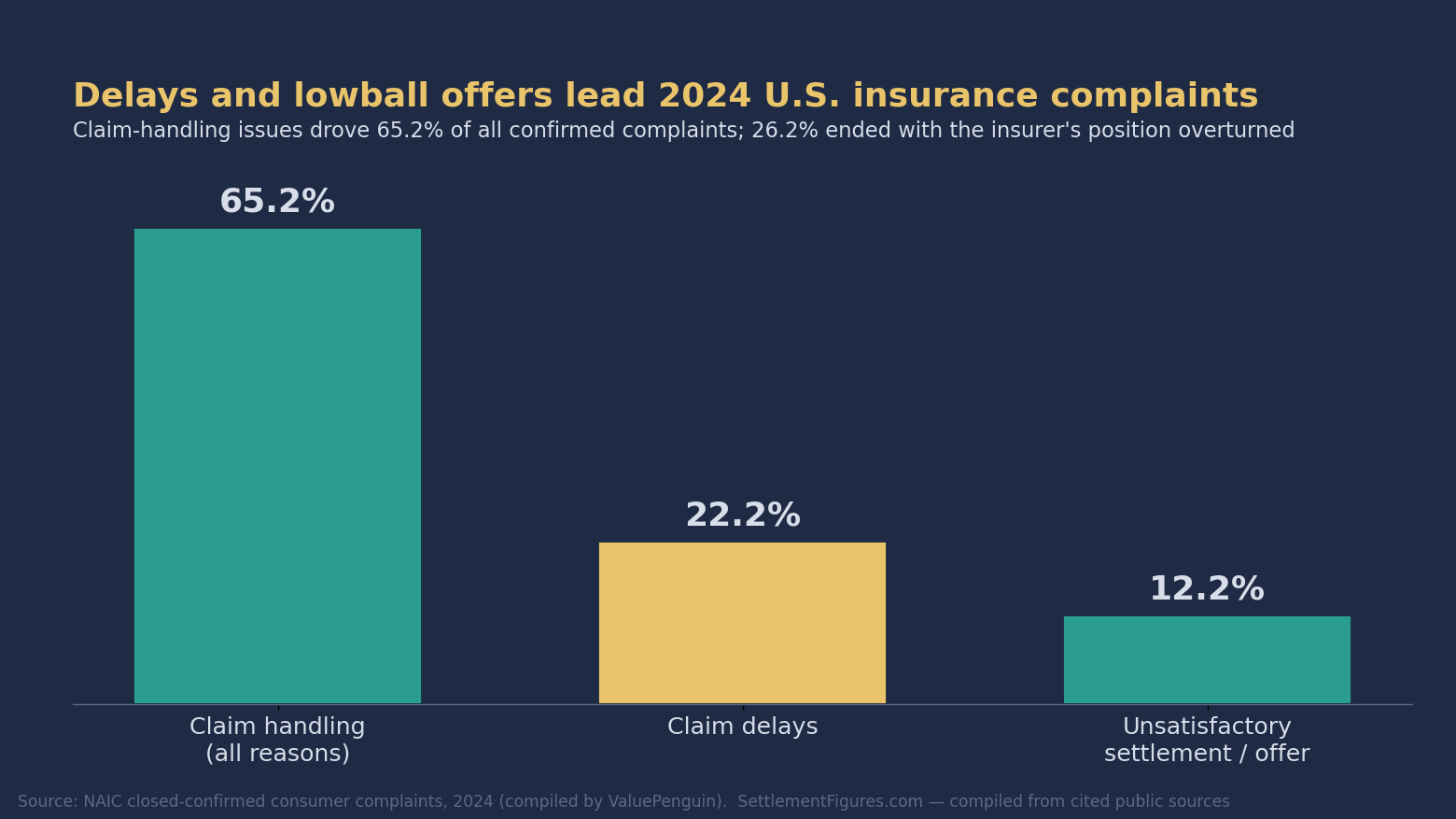
Bad faith is what the law calls it when your insurer treats a valid claim unreasonably — dragging it out, lowballing the payout, or denying it without a real reason. It is more common than most people think: claim-handling problems drove 65.2% of all confirmed U.S. insurance complaints in 2024, with delays (22.2%) and unsatisfactory settlements (12.2%) at the top of the list, according to NAIC data compiled by ValuePenguin. When an insurer crosses that line, you can often recover more than the money it originally owed — and you have free ways to push back before you ever call a lawyer.
What a bad-faith claim can recover
A normal claim pays what the policy owes. A bad-faith claim can add several more layers on top, because the insurer breached a separate legal duty. The table below shows the categories most often available, drawn from the sources named beneath it. Actual amounts depend on your state and your facts.
| Type of recovery | What it covers | Typical scope or limit |
|---|---|---|
| Policy benefits owed | The amount wrongly denied or withheld | Full claim value, plus interest |
| Consequential / economic loss | Financial harm the delay caused — lost income, lost business, damaged credit | Case-specific, must be documented |
| Emotional distress | Mental anguish from the mishandling (first-party claims) | Available in many states; varies |
| Attorney’s fees & costs | Your legal costs to force payment | Where a state bad-faith statute allows |
| Punitive damages | Punishment for fraud, malice, or oppression | Rare; usually held near or below 9× compensatory |
What the law actually requires of your insurer
Every insurance policy carries an implied duty of good faith and fair dealing. In plain terms, the company has to treat your interests as seriously as its own bottom line. Bad faith is the breach of that duty — not a mistake or a slow week, but an unreasonable refusal to pay or investigate a claim the policy covers.
There are two flavors. First-party bad faith is when your own insurer mishandles a claim you filed — a homeowners loss, a disability claim, or your own uninsured-motorist claim after a hit-and-run. Third-party bad faith is when a liability insurer refuses a reasonable settlement and exposes its policyholder to a judgment above the policy limits.
Courts across states look for four elements, per legal explainers from LegalClarity and D’Amore Law: a valid claim under the policy; an unreasonable delay or denial; no reasonable basis for that conduct; and real harm that followed. Meet all four and you may have a claim that stands on its own, separate from the underlying loss.
Your options, from free to formal
You do not have to jump straight to a lawsuit. Most policyholders get results by climbing the ladder one rung at a time, and the early rungs cost nothing.
- Put everything in writing. Ask for the specific policy language behind any denial and a written explanation. This is the same documentation that protects any claim — the steps that protect a claim after an accident apply here too.
- Appeal internally. If the claim was denied, file a written appeal with the evidence the insurer says is missing. Many denials are reversed at this stage — start by learning how to appeal a denied insurance claim.
- File a state Department of Insurance complaint. It is free, it creates a regulatory paper trail, and it forces a written response. In 2024, 26.2% of closed complaints ended with the insurer’s position overturned (NAIC, via ValuePenguin).
- Escalate the dollars. A documented, unreasonably low figure — say, a lowball total-loss offer — is itself evidence. Send a demand backed by your numbers.
- Consult coverage counsel. If the pattern continues, an attorney can send a formal bad-faith notice and, if needed, file suit. Fees are often contingency-based.
Red flags that a claim is being handled in bad faith
One slow phone call is not bad faith. A pattern is. Watch for repeated requests for documents you already sent, a denial with no policy language behind it, or an adjuster who goes silent for weeks after promising a decision. Watch for an offer far below your documented repair or medical bills, and for pressure to accept it fast, before you have talked to anyone. Disputes over a diminished-value claim or a total loss often surface these tactics first, because the insurer is betting you will give up.
If you see these signs, save every letter, email, and voicemail with dates. That record is what turns a frustrating claim into a provable one — and the clock to act is set by your state.
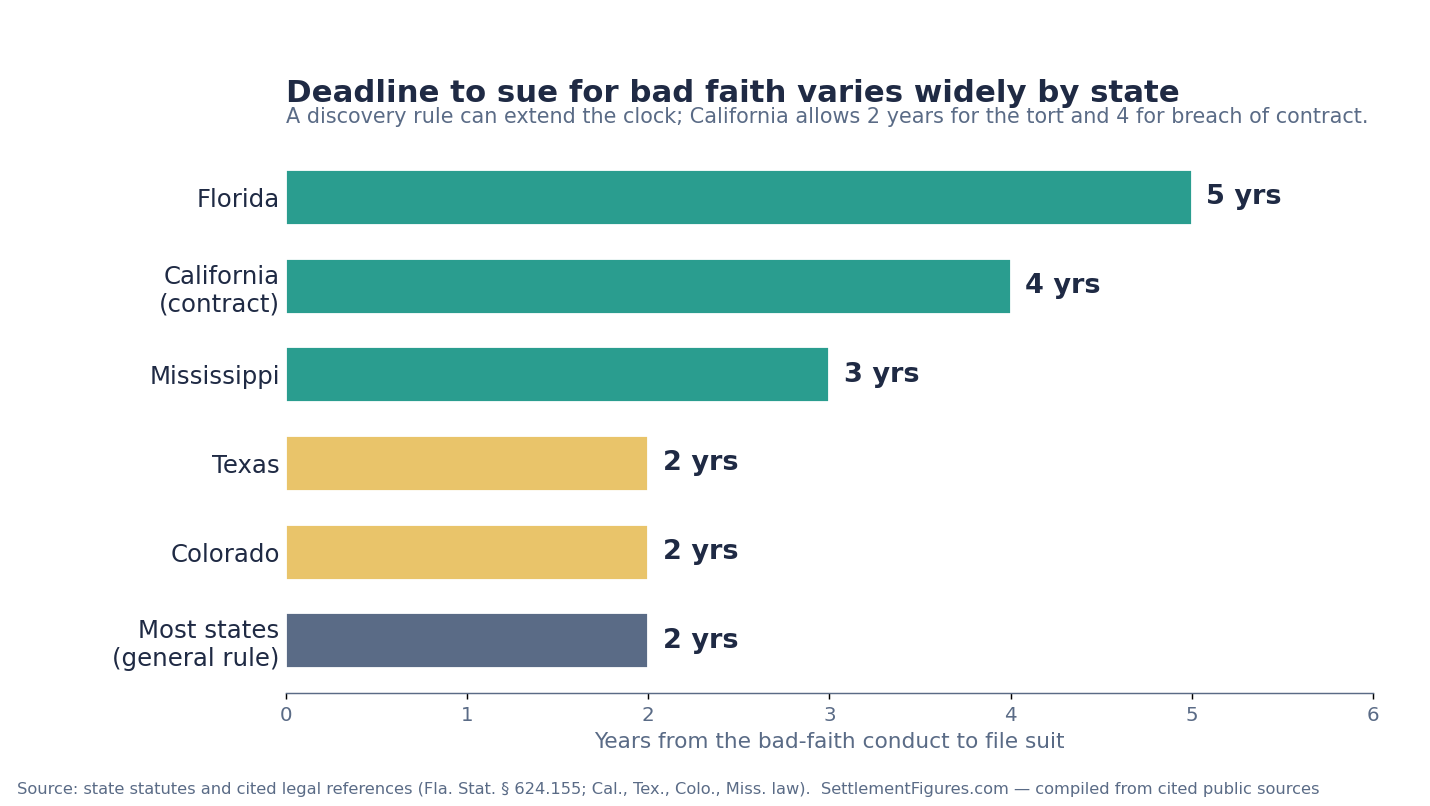
Deadlines swing hard by state. Florida allows five years to sue for bad faith under Fla. Stat. § 624.155; Texas, Colorado, and many others give just two. A discovery rule can delay the start of the clock until you knew, or should have known, about the conduct — but do not count on it. If you think a deadline is close, treat it as urgent.
Where to get free help
Free official help & resources
- Your state Department of Insurance — files and investigates complaints against insurers at no cost. Find yours through the NAIC directory of state insurance departments. Consumer hotlines include California 800-927-4357, Texas 800-252-3439, Florida 877-693-5236, and New York 800-342-3736.
- NAIC — How to File a Complaint: step-by-step consumer guide at content.naic.org/consumer/how-to-file-complaint.
- ABA Free Legal Answers — post a civil legal question and a volunteer attorney answers, free if you qualify: freelegalanswers.org.
- Legal Services Corporation — find a local legal-aid office for low-income help: lsc.gov.
Frequently asked questions
What is bad faith insurance?
It is an insurer’s unreasonable failure to honor its own policy — delaying a valid claim, offering far less than the claim is worth, or denying it without a legitimate basis. Because it breaches the duty of good faith and fair dealing, it can create liability beyond the claim amount itself.
How do you prove an insurance company acted in bad faith?
You show a valid claim, an unreasonable delay or denial, no reasonable basis for it, and resulting harm. Proof comes from the paper trail — written denials, missed deadlines, and internal notes obtained in litigation. Training manuals or scripts that reward delay can be powerful evidence, according to McCormick & Murphy and Morgan & Morgan.
How much can you sue an insurance company for bad faith?
There is no fixed cap. Recovery can include the benefits owed, consequential losses, emotional distress, attorney’s fees, and — for fraud, malice, or oppression — punitive damages. Punitive awards are rare and usually held to a single-digit multiple of compensatory damages under State Farm v. Campbell. Record 2025 verdicts reached $114 million against USAA and $145 million in Colorado, but those are extreme outliers, not typical outcomes.
How long do you have to file a bad faith insurance claim?
Usually two years from the bad-faith conduct, but it varies: Florida allows five years, California four for breach of contract, and Mississippi three. Many states apply a discovery rule that delays the start of the clock. Confirm your state’s deadline early, because missing it ends the claim regardless of its strength.
What is the difference between first-party and third-party bad faith?
First-party bad faith involves your own insurer mishandling a claim you filed. Third-party bad faith involves a liability insurer refusing a reasonable settlement and leaving its policyholder exposed to a judgment above policy limits. The evidence and damages differ, so the distinction matters to how a case is built.
What should you do if your insurance company is acting in bad faith?
Document every contact, ask for denials in writing, and appeal internally. If nothing changes, file a free complaint with your state Department of Insurance, then talk to a coverage attorney before your deadline runs. Keep paying any premiums due so the insurer cannot add a lapse to the dispute.
☕ This research is reader-supported. No law firm pays us. If this guide saved you time or money, you can buy the research team a coffee — it keeps the data free and updated.
This article is for informational purposes only and is not legal advice. Settlement values vary significantly by case and by state. Consult a licensed attorney in your state before making decisions about your claim.
