Last updated: July 22, 2026 · Data reviewed quarterly
Most truck accident claims settle between 12 and 24 months after the crash, and the check itself arrives 30 to 60 days after you sign the release. Brown & Crouppen puts the common band at 6 to 16 months from the accident date. Cases with catastrophic injuries, disputed fault, or several defendants routinely run past two years. The table below shows where most cases land. If a delivery van rather than an 18-wheeler hit you, the same stages apply but the defendants differ — our delivery van accident claims guide covers the Amazon, FedEx and UPS specifics.
| Case profile | Typical time from crash to payout | Reported by |
|---|---|---|
| Uncomplicated case: clear fault, limited injuries, one carrier | A few months to 9 months | Super Lawyers; NST Law |
| Typical 18-wheeler claim | 6 to 16 months | Brown & Crouppen |
| Serious injuries, commercial defendant | 18 to 24 months | TruckingAccident.com |
| Disputed fault or multiple defendants, lawsuit filed | Up to 36 months | TruckingAccident.com; Kermani LLP |
| Release signed to check in hand | 30 to 60 days | TruckingAccident.com; Phillips Law Offices |
The honest version: nobody can tell you your date. What they can tell you is which stage you are in and what has to finish before the next one starts. That is what the rest of this guide does.
The Timeline, Stage by Stage
These stages overlap heavily. Your medical treatment runs at the same time your attorney is chasing the carrier’s records. Add the windows together and you will scare yourself for no reason.
| Stage | Typical window | What has to happen |
|---|---|---|
| Emergency care and evidence preservation | Days 1 to 30 | Treatment documented, police report obtained, scene and vehicle photographed before repair or salvage |
| Spoliation letter to the carrier | Weeks 1 to 8 | Written demand that the trucking company preserve logs, black box data, and maintenance files |
| Investigation of the carrier’s records | Months 1 to 6 | Electronic logging device data, hours-of-service records, driver qualification file, inspection history, reconstruction |
| Medical treatment toward maximum medical improvement | Months 1 to 12+ | Surgery, therapy, and follow-up until doctors can state your long-term limits |
| Demand package built and sent | Months 6 to 9 | Bills, records, wage loss, and a written valuation sent to every insurer on the risk |
| Insurer review and negotiation | Months 8 to 14 | Liability decision, counteroffers, requests for more records |
| Lawsuit filed and discovery | Months 12 to 24 | Depositions of the driver, safety director, and experts; document production |
| Mediation | Months 18 to 26 | A day in front of a neutral, where a large share of cases resolve |
| Settlement signed or verdict returned | Months 18 to 36 | Agreement or trial |
| Liens resolved and check disbursed | 30 to 60 days after signing | Medical, health plan, Medicare or Medicaid repayment negotiated and paid |
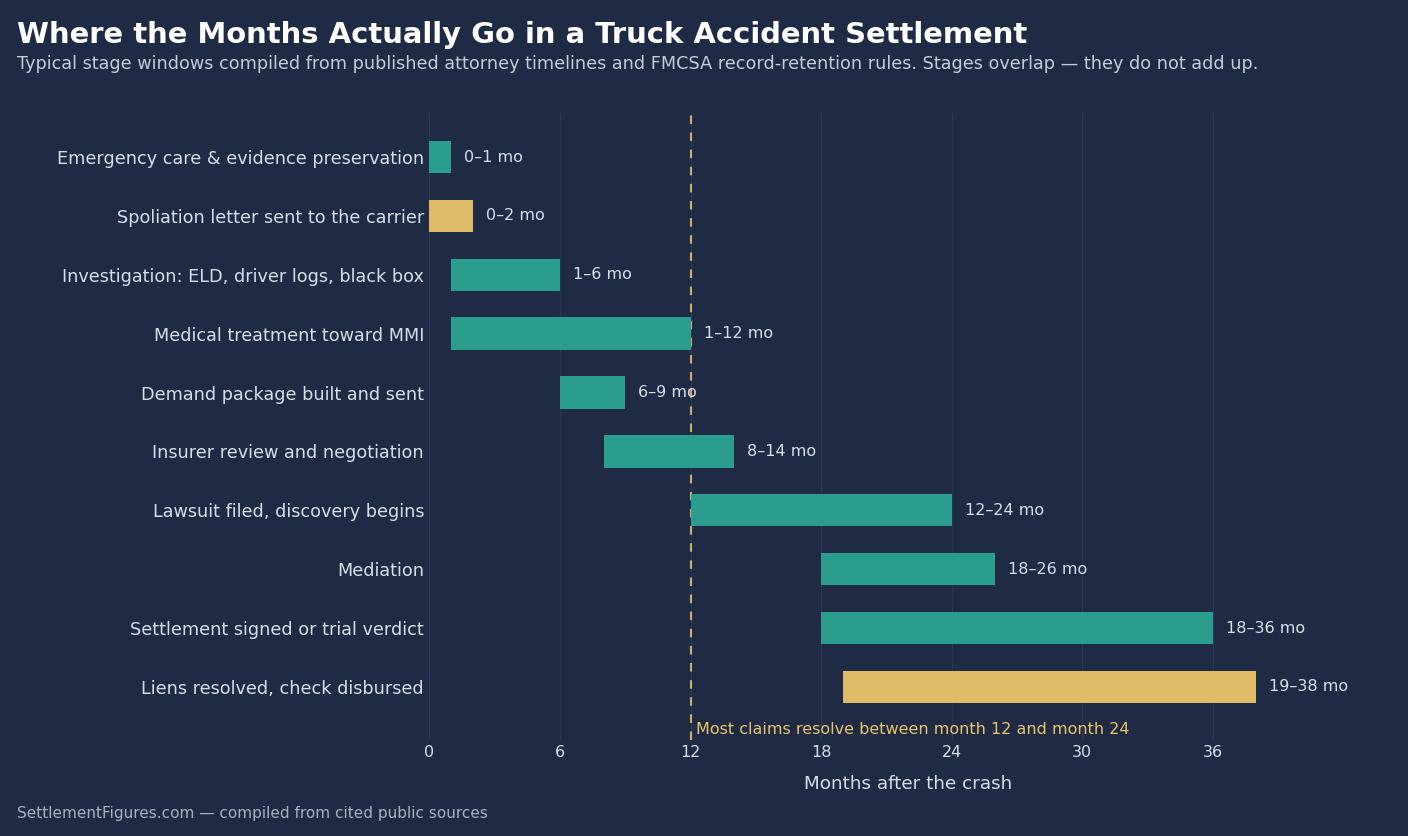
Two stages surprise people. The first is the wait for maximum medical improvement, which is the point where your doctors can say what you will be living with permanently. Brown & Crouppen describes it plainly: you are not back to normal, you are as good as you are reasonably going to get.
Settle before that point and you are guessing at the cost of your own future. Insurers know this, which is why the early offer often arrives while you are still in physical therapy.
The second surprise is the gap between “we have a deal” and money in your account. Once you sign, your attorney has to identify and pay back every party with a legal right to repayment. Health insurers, Medicare, Medicaid, TRICARE, and treating providers who filed liens all take a cut before you do, and each payoff figure has to be requested, verified, and often negotiated down.
What Speeds a Truck Case Up
Getting to the evidence before the retention clock runs out
This is the single biggest lever, and it is entirely front-loaded. Federal rules set how long a motor carrier has to keep the records that decide your case:
- Driver records of duty status: 6 months (49 CFR 395.8)
- Vehicle maintenance and inspection records: 12 months (49 CFR 396.3)
- The carrier’s accident register: 3 years (49 CFR 390.15)
Once a carrier has notice of a claim, the duty to preserve overrides the routine retention schedule. That notice usually arrives as a spoliation letter. Send it in week two and the logs are still there. Send it in month eight and you are arguing about what used to exist.
Courts can respond to destroyed evidence with a spoliation inference, which lets a jury assume the missing data would have hurt the carrier. That is a useful backstop. It is not as good as the data. Our guide to who is liable in a truck accident covers which records point at which defendant.
Consistent treatment with no gaps
Every gap in your medical chart becomes an argument that you recovered and then hurt yourself somewhere else. Keep appointments. If you cannot afford a visit, say so to your provider and get the reason in the file rather than simply disappearing for six weeks.
A demand package the adjuster cannot send back
Brown & Crouppen notes that a soft-tissue rear-end claim may need only about a month of adjuster review, while a multi-vehicle crash with catastrophic injuries can take 90 days or more. Incomplete demands restart that clock. Wage documentation, every bill, every record, one package.
Filing suit before you need to
Counterintuitive, but real. Filing sets a court schedule, and a court schedule creates deadlines the carrier’s lawyers cannot ignore. Kermani LLP observes that some of the largest settlements land just before trial begins, when the defense finally prices the risk of a jury.
What Delays It
More defendants than you expected
A single tractor-trailer can involve the driver, the motor carrier, the trailer owner, the maintenance contractor, the shipper who loaded the freight, and a parts manufacturer. Super Lawyers points out that separate companies often own, lease, and load the same truck.
Each defendant brings its own insurer and its own counsel, and each has an incentive to point at the others. Sorting that out adds months, though it usually adds money too, which is part of why truck settlements run well above car accident settlements.
Bigger policies mean slower decisions
Interstate carriers hauling general freight must carry at least $750,000 in liability coverage under 49 CFR 387.9, and hazmat operations run from $1 million to $5 million depending on the cargo. Compare that to the state minimums a private driver carries and the difference in scrutiny follows naturally.
Six-figure and seven-figure exposure gets reviewed by supervisors, then by committees, then by defense counsel. That is a structural delay, not a personal one, and it is a large part of why these cases run longer than a standard car accident settlement.
Disputed fault and comparative negligence
If the carrier can assign you part of the blame, it reduces or eliminates what it owes, depending on your state’s rule. Building that argument takes the defense time, and they will use all of it.
Wrongful death and probate
When someone dies, an estate has to be opened and a personal representative appointed before a claim can move. Super Lawyers notes that probate involvement plus multiple family members with competing claims reliably extends these cases.
When to Worry
Long is normal. Silence is not. These are the moments worth acting on rather than waiting through.
- Your statute of limitations is inside 12 months. Most states give two or three years for injury claims, but several are shorter, and claims against a government-owned vehicle can require formal notice within months. Confirm your state’s deadline in writing.
- The carrier will not confirm it preserved the evidence. A refusal to acknowledge a spoliation letter is a signal, not a formality.
- Your demand has sat unanswered past 90 days with no explanation. Slow is normal, unexplained is not.
- The offer keeps arriving with a deadline attached. Pressure to sign this week is a negotiating tactic, not a real expiration.
- Nobody has told you the policy limits. You cannot evaluate an offer without knowing the ceiling.
- Your calls go unreturned for weeks at a time. You are entitled to know what stage your case is in.
Unreasonable delay by an insurer can itself become a claim. If the pattern looks like stalling rather than diligence, read our guide to bad faith insurance practices. If the claim was refused outright, the appeal process is a separate track worth understanding.
Free official help & resources
- FMCSA safety violation hotline — 1-888-368-7238. Report unsafe carriers, hours-of-service violations, and harassment. File online at the National Consumer Complaint Database.
- NHTSA Vehicle Safety Hotline — 1-888-327-4236. Report a vehicle or equipment defect at nhtsa.gov.
- IRS Publication 4345 explains which parts of a settlement are taxable. Read it at irs.gov.
- Legal Services Corporation funds free civil legal aid nationwide. Find your local program at lsc.gov.
- ABA Free Legal Answers lets you ask a volunteer attorney a civil legal question in writing at freelegalanswers.org.
- Dial 2-1-1 for local help with rent, food, utilities, and transportation while a claim is pending. Details at 211.org.
Frequently Asked Questions
How long after a truck accident can I expect my settlement check?
Roughly 30 to 60 days after you sign the release, according to TruckingAccident.com, with Phillips Law Offices reporting the same window for personal injury settlements generally. Cases with several liens or a government health plan involved can stretch to 8 to 12 weeks.
Why do truck accident settlements take longer than car accident claims?
Three structural reasons. Federal regulations create a body of records that has to be requested and analyzed. Multiple companies can share liability, each with separate counsel. And commercial policies start at $750,000, so insurers apply a level of review they never apply to a $50,000 auto policy.
What is the average timeline of a truck accident settlement for serious injuries?
TruckingAccident.com puts serious-injury commercial truck cases at 18 to 24 months from accident to final payout, with complex matters extending toward 36 months. Kermani LLP frames it more cautiously: some resolve in a few months, many take a year or longer.
Can I speed up my truck accident settlement without accepting a lowball offer?
Yes, and the levers are mostly administrative. Preserve evidence early, treat consistently, hand over complete wage and medical documentation the first time it is asked for, and respond to record requests within days rather than weeks. None of that requires reducing your number.
Should I accept the first settlement offer from a trucking company’s insurance?
Rarely, and almost never before maximum medical improvement. A first offer made while you are still treating is priced against an unknown future medical bill, and that unknown is your risk, not theirs. Compare any offer against what comparable truck cases pay before responding.
How long does a truck accident claim usually take to settle?
Brown & Crouppen reports 6 to 16 months as the common range from the date of the accident. NST Law describes it as a few months to over a year, and Super Lawyers notes that complicated fact patterns with multiple at-fault parties can push cases into several years.
The Short Version
Expect 12 to 24 months, plus a month or two for the check. Spend the first 60 days on evidence and treatment, because that is the only window where your own actions meaningfully move the calendar. After that, most of the waiting is structural and the right response is documentation, not pressure.
☕ This research is reader-supported. No law firm pays us. If this guide saved you time or money, you can buy the research team a coffee — it keeps the data free and updated.
This article is for informational purposes only and is not legal advice. Settlement values vary significantly by case and by state. Consult a licensed attorney in your state before making decisions about your claim.
