Last updated: July 22, 2026 · Data reviewed quarterly
Published truck accident settlement figures cluster around an average of $103,654 and a median of $30,000 — both figures reported by Brown & Crouppen and compiled in ConsumerShield’s July 2026 survey of law firm data. That gap between average and median is the most useful number on this page, and we explain it below. Moderate-injury cases commonly resolve between $100,000 and $500,000, and severe-injury or wrongful-death cases regularly exceed $1 million. Delivery fleets are their own segment — see our guide to delivery van accident claims for how Amazon, FedEx and UPS cases differ.
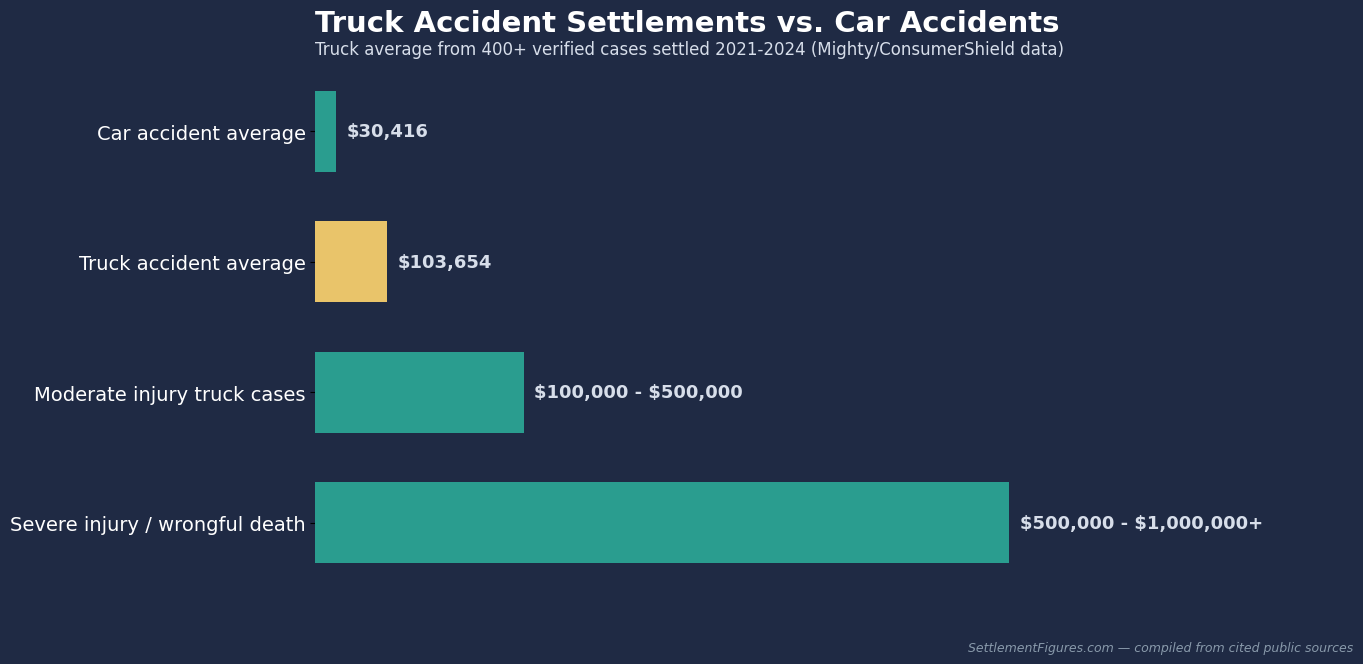
The numbers, side by side
| Case profile | Typical settlement |
|---|---|
| Car accident (average, context) | $30,416 — our car data |
| Truck accident (reported average) | $103,654 |
| Truck accident (reported median) | $30,000 |
| Moderate injuries (fractures, surgery) | $100,000 – $500,000 |
| Severe / permanent injuries | $500,000 – $1,000,000+ |
| Wrongful death | frequently $1,000,000+ |
Why the average and the median disagree
An average of $103,654 next to a median of $30,000 tells you the distribution is lopsided. Most truck claims are ordinary. A small number of catastrophic and fatal cases pull the average up by a factor of three.
If your injuries are soft-tissue and you recovered in a few months, the median is the honest benchmark for your case. If you are facing surgery, permanent restriction, or a death in the family, the average understates what comparable cases have resolved for.
What individual firms report
No public database publishes truck settlement outcomes. What exists is what law firms choose to disclose. ConsumerShield surveyed six firms in July 2026 and the spread is worth seeing in full, because it shows how much the “average” depends on who is counting.
| Source | Stated figures |
|---|---|
| Brown & Crouppen | Average $103,654; median $30,000 |
| Strom Law Firm | Non-fatal average $195,258; fatal average $3,605,000 |
| Meirowitz & Wasserberg | $100,000 to $500,000+; some exceed $1 million |
| Finch McCranie | Minor $10,000–$50,000; moderate $50,000–$100,000; severe $100,000 to millions |
| The Law Place | Non-fatal $40,000–$200,000; fatal $100,000 to $1 million+ |
| Kermani LLP | Minor $25,000–$100,000; severe non-fatal $100,000+ |
Treat all of these as directional. Firms that handle catastrophic cases report higher numbers because they take higher-value cases, not because their clients get better outcomes on identical facts.
Why trucks pay 3x more (it is not sympathy — it is structure)
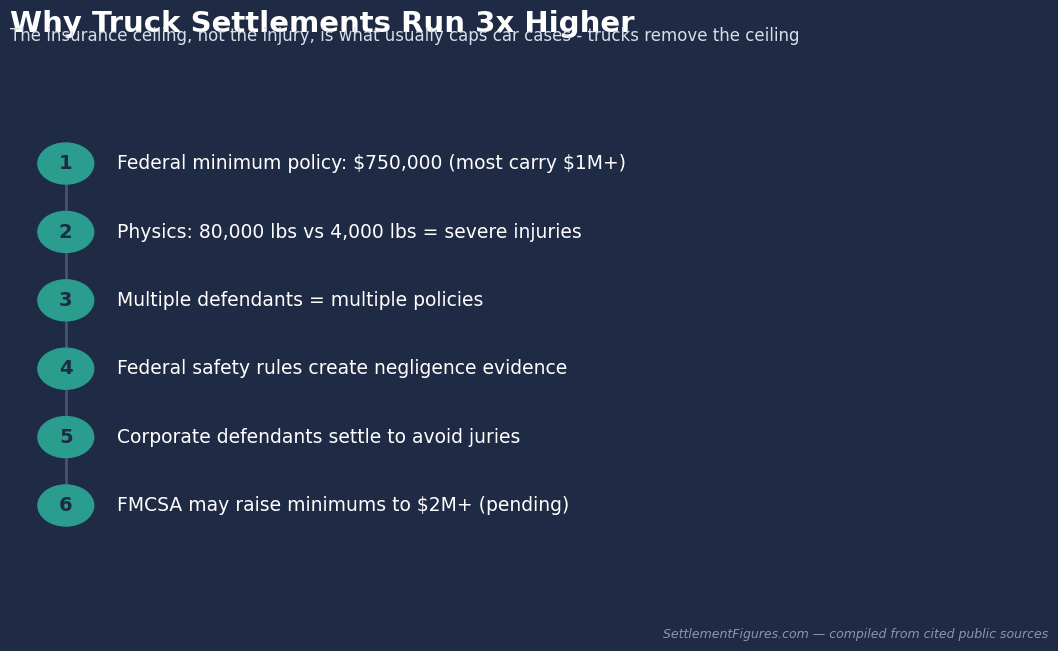
The insurance ceiling disappears. Car cases are usually capped by a $25,000 to $100,000 personal policy. Interstate carriers hauling general freight must carry a federal minimum of $750,000 under 49 CFR 387.9, and hazmat operations run from $1 million to $5 million depending on the cargo. Most large fleets carry well above the floor because shippers and brokers require it.
Physics. An 80,000-pound tractor-trailer against a 4,000-pound car produces injuries that scale into permanent-impairment territory, and damages scale with severity.
Regulation creates evidence. Hours-of-service limits, electronic logging devices, drug-testing rules, and maintenance mandates mean negligence leaves a documentary trail that does not exist in an ordinary two-car crash. Federal rules require carriers to keep driver duty records for six months (49 CFR 395.8) and maintenance records for twelve (49 CFR 396.3), which is why the first weeks matter so much.
The corporate defendant difference
You are not negotiating with an adjuster protecting a $50,000 policy. You are litigating against a motor carrier, its insurer, and often a rapid-response defense team that reached the crash scene before the tow truck.
They fight harder early and settle bigger later, because a jury verdict against a trucking company carries punitive risk. That dynamic is exactly why identifying every liable party changes the outcome, and why evidence preservation in week one matters more than anything a lawyer does in month twelve.
What a truck settlement actually compensates
The same categories as any injury claim — medical specials, future care, lost earnings, pain and suffering — but each multiplied by severity, and often stacked across multiple defendants’ policies.
Future care is where truck cases separate from car cases. A spinal fusion, a lifetime of attendant care, or a permanent loss of earning capacity produces a number that no personal auto policy can absorb, which is what pulls these settlements into six and seven figures.
Timelines run longer to match. Brown & Crouppen reports 6 to 16 months as the common band, and serious-injury cases routinely run 18 to 24 months. Our stage-by-stage truck settlement timeline shows where those months actually go, and car settlement timelines give the comparison.
What pulls the number down
Shared fault. If the carrier can assign you a percentage of blame, your recovery drops by that percentage in most states, and in a handful of states crossing 50 or 51 percent eliminates it entirely. Expect the defense to look hard at your speed, your lane position, and whether you were braking.
A real policy ceiling. Federal minimums are a floor, not a promise. A small owner-operator running at $750,000 with three claimants is a different case from a national fleet carrying layered excess coverage. Ask for disclosure of all applicable policies before valuing anything.
Treatment gaps and prior injuries. A documented pre-existing condition in the same body part gives the adjuster a causation argument. It rarely kills a claim, but it reliably compresses the number unless your records draw a clean before-and-after line.
Liens. What you take home is the settlement minus attorney fees, case costs, and every provider or health plan with a right of repayment. Two claims with identical gross values can produce very different checks.
Free official help & resources
- Check the carrier’s safety record (free, public): FMCSA Safety Measurement System — ai.fmcsa.dot.gov/SMS
- Report unsafe carriers: FMCSA hotline 1-888-368-7238 · fmcsa.dot.gov
- Report a vehicle defect: NHTSA hotline 1-888-327-4236 · nhtsa.gov
- Is your settlement taxable? IRS Publication 4345 — irs.gov
- Free legal aid: LSC.gov · ABA Free Legal Answers
Frequently Asked Questions
How much are most truck accident settlements?
Most land near the median rather than the average. Brown & Crouppen reports a median of $30,000 against an average of $103,654. Minor-injury cases commonly resolve in the $10,000 to $50,000 range according to Finch McCranie, while severe cases start around $100,000 and climb from there.
What is the average settlement for a fatal truck accident?
Strom Law Firm reports an average of $3,605,000 for fatal cases against $195,258 for non-fatal ones. The Law Place puts fatal cases at $100,000 to over $1 million. The spread is wide because wrongful death value depends on the decedent’s age, earnings, and dependents.
Should I take the carrier’s early offer?
Early six-figure offers on serious injuries usually signal that exposure is far higher. Value is unknowable before maximum medical improvement — the same logic that governs workers’ comp cases.
The truck driver was an “independent contractor.” Does that kill the case?
Rarely. Federal regulations make carriers responsible for vehicles operating under their DOT authority regardless of the employment label on the paperwork.
Do I need a truck-specific attorney?
For serious injuries, yes. FMCSA regulations, ELD forensics, and multi-defendant strategy are specialty tools. For minor property claims, standard processes work: see our minor claims guide.
☕ This research is reader-supported. No law firm pays us. If this guide saved you time or money, you can buy the research team a coffee — it keeps the data free and updated.
This article is for informational purposes only and is not legal advice. Settlement values vary significantly by case and by state. Consult a licensed attorney in your state before making decisions about your claim.
