Last updated: July 30, 2026 · Data reviewed quarterly
Across every workers’ compensation claim in the NCCI database, the average claim cost is $47,316 for injuries occurring in 2022–2023, valued as of October 2025 (National Safety Council Injury Facts, using NCCI data). But that single number hides almost everything that matters: what your claim pays depends on the body part, the cause, whether you needed surgery, and whether any disability is permanent.
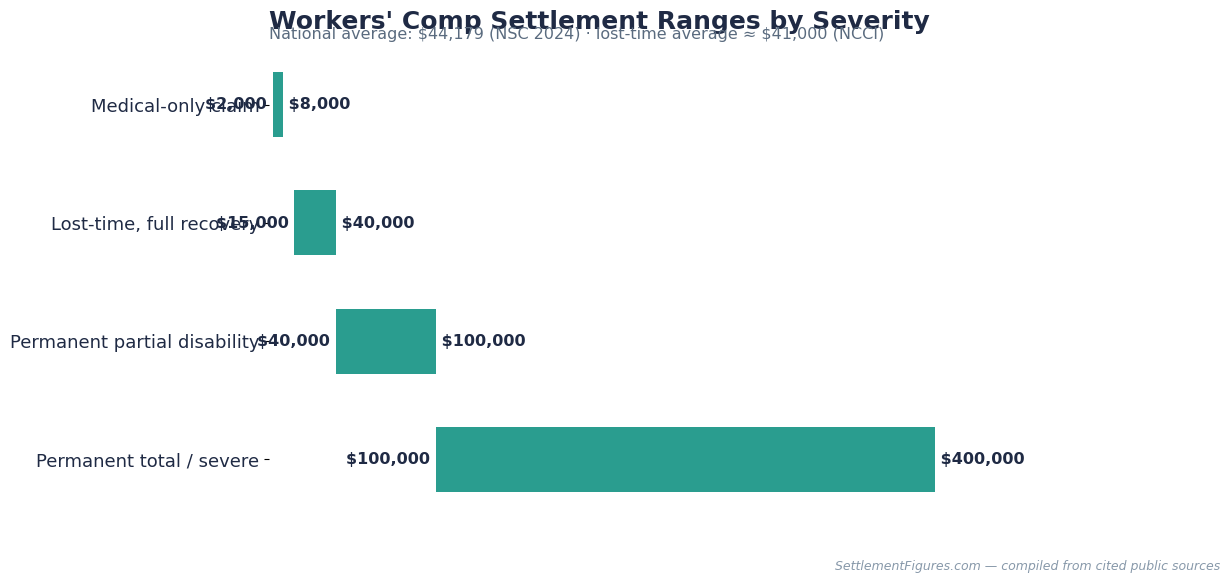
Settlement ranges by severity
Before the body-part data, one distinction that trips up almost everyone: a claim cost and a settlement check are not the same number. The NCCI figures below combine medical care paid to your providers with indemnity paid to you. A settlement is separate money offered to close the file.
| Claim type | Typical range | Notes |
|---|---|---|
| Medical-only (no lost time) | $2,000 – $8,000 | Roughly average $3,000; most claims are this type |
| Lost-time, full recovery | $15,000 – $40,000 | Wage replacement + medical |
| Permanent partial disability (PPD) | $40,000 – $100,000 | Driven by impairment rating — how ratings work |
| Permanent total / catastrophic | $100,000 – $400,000+ | Often structured or lifetime benefits |
By body part (NCCI, 2022-2023 injuries)
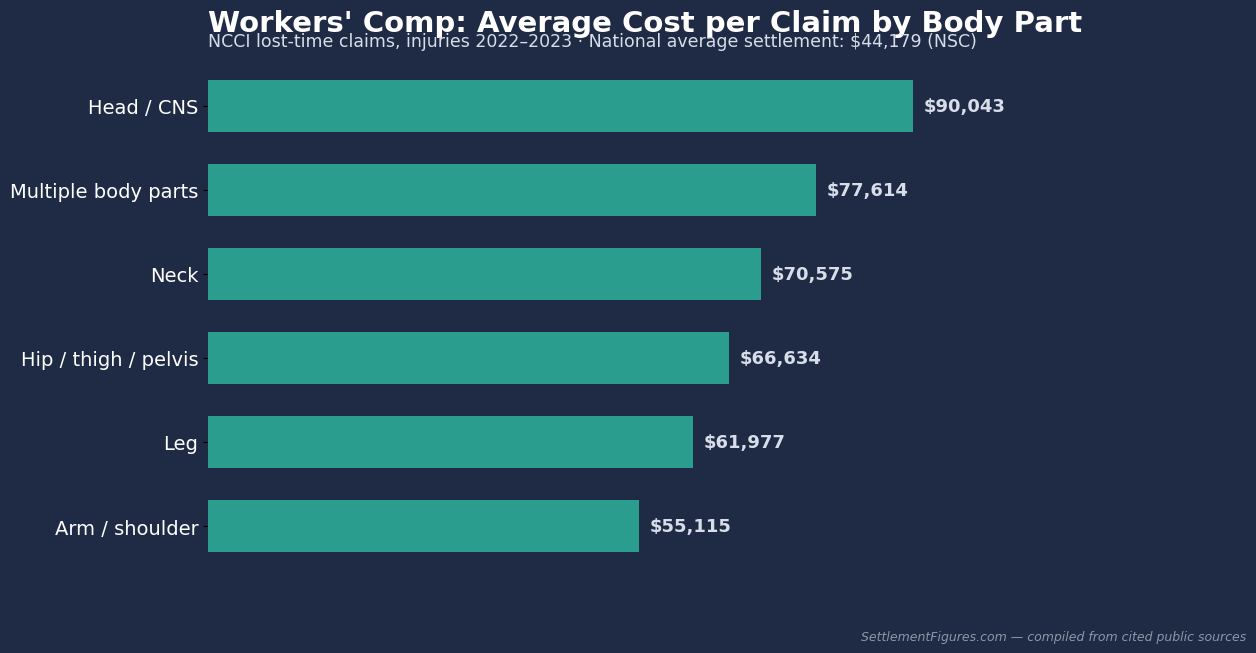
Six body-part categories cost more than the $47,316 all-claims average. Everything else — including the hand, wrist and foot — costs less.
| Part of body | Average claim cost |
|---|---|
| Head or central nervous system | $90,043 |
| Multiple body parts | $77,614 |
| Neck | $70,575 |
| Hip, thigh or pelvis | $66,634 |
| Leg | $61,977 |
| Arm or shoulder | $55,115 |
| All claims, every body part | $47,316 |
| Hand, wrist or finger | $26,284 |
Sensory losses sit even lower on the scale but follow their own week-based schedules — our guide to hearing loss workers’ comp claims shows how ear impairment converts into weeks of pay.
The hand and wrist number surprises people, because a hand that cannot grip ends careers. The explanation is that hand surgery is cheap next to a spinal fusion, so the medical side stays small — and adjusters anchor on the bills. Full breakdown in our guide to hand and wrist settlements, including why carpal tunnel averages $38,366 while a fracture runs $62,240.
Deep dives on the other high-cost regions: shoulder settlements, neck settlements, knee settlements and back settlements.
By cause of injury
How you got hurt predicts cost almost as well as what you hurt. NSC reports that motor-vehicle crashes produce the most expensive lost-time claims at $91,433 on average — roughly double the all-claims figure. Burns follow at $64,973, falls and slips at $54,499, and being caught in or between objects at $47,749. Every other cause lands below average.
That gap matters for a practical reason: a crash on the clock often involves a third party, and a third-party lawsuit can recover damages comp never pays.
By nature of injury
Sorted by the type of harm rather than the location, amputation is the most expensive category in the NCCI data at $125,058 per claim. Other trauma averages $68,231, fracture, crush or dislocation $66,467, and burns $64,019.
The pattern across all three views is consistent: permanence drives cost. A soft-tissue strain that resolves is cheap. An injury that leaves measurable, permanent loss of function is not, because it triggers a disability award on top of medical and wage benefits.
Why your state changes the number
National averages are a starting point, not a forecast, because permanent disability is paid under state law and the formulas diverge sharply. In most states each body part carries a statutory number of weeks. New York’s Workers’ Compensation Law §15(3) values an arm at 312 weeks, a hand at 244 and a thumb at 75; your award is that figure multiplied by your impairment percentage and your weekly rate.
Four large states — California, Florida, Nevada and Texas — have no schedule at all, according to Nolo. They compensate permanent disability through impairment ratings or wage-loss formulas instead, so week counts from a neighboring state tell you nothing about your claim.
Two more state variables move real money: the weekly maximum, which caps the two-thirds wage rate and hits high earners hardest, and whether returning to work reduces your award. New York pays a schedule loss of use award even if you go back to your old job at full pay; wage-loss states may cut benefits the day you return.
What workers’ comp actually pays (and what it never does)
Comp is no-fault: you do not prove your employer did anything wrong. In exchange, it pays medical care, roughly two-thirds of lost wages, and disability awards — but never pain and suffering. If a third party caused your injury (a negligent driver, a defective machine), a separate lawsuit can add what comp excludes: comp vs. lawsuit, explained.
The other structural limit worth knowing before you sign anything: most lump-sum settlements close future medical care permanently. If the injured joint may need another procedure, that clause is the most expensive line in the agreement.
Settlement timing
Cases settle around Maximum Medical Improvement — the point where doctors expect no further recovery, and the impairment rating that drives the money can finally be assigned. Averages run about 16 months, with half of cases resolving in the 13-24 month band. Full detail in our timeline guide. Fired or pressured during the process? Know your rights. Not filed yet? Start with the filing steps and deadlines.
Free official help & resources
- Your state workers’ comp board — sets the schedule and benefit caps that decide your award. New York’s, for example, answers at (877) 632-4996 with free language assistance (wcb.ny.gov)
- Federal employees: U.S. Department of Labor, OWCP — dol.gov/agencies/owcp
- Unsafe workplace: OSHA complaint line 1-800-321-6742 or osha.gov/workers/file-complaint (anonymous OK)
- SSDI interaction: comp can offset Social Security Disability — 1-800-772-1213 or the SSA offset publication (PDF)
- Taxes: IRS Publication 525 states the rule on why comp benefits are generally untaxed
- Free legal aid: LSC.gov — income-based, every state; volunteer attorneys at freelegalanswers.org
- Fired after filing? EEOC 1-800-669-4000; workplace rights portal worker.gov
Frequently Asked Questions
What is the average workers’ comp settlement?
The average claim cost across all injuries is $47,316 in the NCCI data reported by the National Safety Council, covering injuries from 2022–2023. Treat it as a reference point rather than a prediction: medical-only claims average near $3,000, while catastrophic claims run into six figures.
Is my settlement taxable?
Workers’ comp benefits paid under a state or federal comp act are generally excluded from taxable income (IRS Publication 525). The main exception involves the portion that offsets Social Security disability payments. Confirm with a tax professional.
Lump sum or structured payments?
Lump sums close the claim, often including future medical — read that clause carefully. Structured payments keep medical open in many states. The right answer depends on how likely you are to need more treatment.
Can I settle while still treating?
You can, but you are selling the unknown. Most experienced representatives wait for MMI so the impairment rating — and therefore the money — is known rather than guessed.
How much does workers’ comp pay per week?
Most states pay about two-thirds of your average weekly wage, subject to a state maximum that resets annually. That cap is why two workers with the same injury and different salaries can end up with similar checks.
Do I need a lawyer for a workers’ comp claim?
Not for an accepted medical-only claim with no permanent impairment. It changes when the insurer disputes causation, when its doctor rates your impairment far below your own physician’s, or when a settlement would close future medical care.
☕ This research is reader-supported. No law firm pays us. If this guide saved you time or money, you can buy the research team a coffee — it keeps the data free and updated.
This article is for informational purposes only and is not legal advice. Settlement values vary significantly by case and by state. Consult a licensed attorney in your state before making decisions about your claim.
