Last updated: August 12, 2026 · Data reviewed quarterly
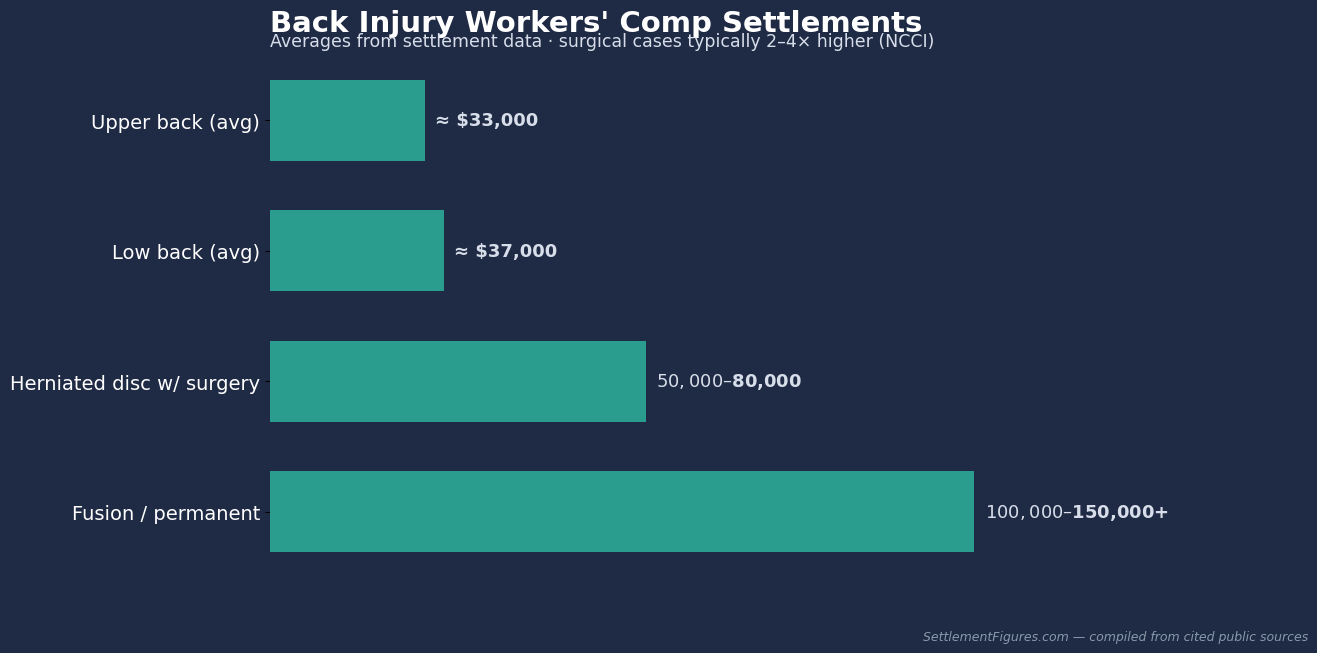
Back injuries are the most common serious workplace injury — and the most fought-over. Typical settlements run near $33,000 for upper-back and $37,000 for low-back claims, per NCCI data cited by Forbes Advisor, and the National Safety Council’s lower-back average lands close by at $39,328, as reported by Atticus. A herniated disc that ends in surgery changes the math completely, with fusion cases often reaching $100,000–$150,000+ in firm-reported case data.
Ranges by diagnosis
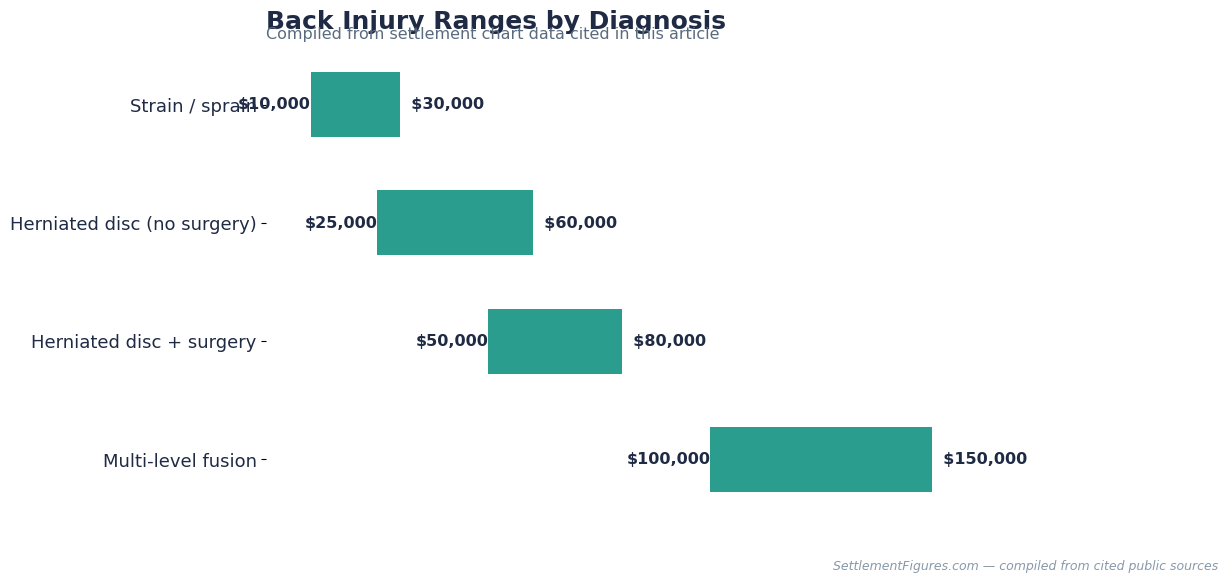
Diagnosis is the strongest single predictor of value because it sets the treatment path, the time off work, and the final impairment rating all at once. Read the bands below as starting points for negotiation, not promises — a strain with a long wage-loss tail can beat a quick surgical case in the right state.
| Diagnosis | Typical range | Key driver |
|---|---|---|
| Lumbar strain/sprain | $10,000 – $30,000 | Recovery time, wage loss |
| Herniated disc, no surgery | $25,000 – $60,000 | MRI findings, injections |
| Herniated disc + surgery | $50,000 – $80,000 | Surgical outcome, rating |
| Multi-level fusion / permanent | $100,000 – $150,000+ | Permanent restrictions, future medical |
What the average actually contains
Averages hide the two separate checks inside every back settlement. In the NSC lower-back figure reported by Atticus, the $39,328 total splits into roughly $17,643 for medical care and $21,685 in indemnity — the wage-loss and disability portion. Understanding the split matters because insurers negotiate each side differently.
The medical side is largely arithmetic: bills already paid plus projected treatment. The indemnity side is where cases are won or lost — it turns on your disability rating, your average weekly wage, and whether you can return to your old job. Two workers with identical MRIs can settle $40,000 apart on indemnity alone.
State rules widen the gap further. Benefit caps, maximum weekly rates, and how each state treats permanent restrictions all move the indemnity number, which is why identical injuries produce very different checks across state lines — and why the state where you file is part of the math from day one.
Back claims also sit near the top of the cost table for a reason. Across all body parts, the average workers’ comp claim runs about $47,316 — our breakdown of average workers’ comp settlement amounts shows where the spine ranks against every other injury, and why neck claims average even higher.
Why back claims get fought
Nearly every adult over 30 shows disc degeneration on MRI, and insurers use that to argue your pain is age, not work. The counters that win: a clean symptom timeline (no complaints before the incident), a mechanism that fits (lift, fall, twist), and a treating physician willing to state causation. Build all three from day one.
Expect scrutiny to escalate with the dollar value. Independent medical exams (IMEs) — doctors chosen and paid by the insurer — routinely rate back injuries lower than treating physicians do, and disputed ratings are the single most common reason back settlements stall. If the IME rating lands far below your doctor’s, that gap is a negotiation, not a verdict.
Surveillance is also real in higher-value back cases. Carrying groceries on a day your file says “no lifting over 10 pounds” becomes Exhibit A. The lesson is not paranoia — it is consistency: follow restrictions everywhere, not just at work.
How the rating turns into money
Unlike a hand or a hearing claim, the spine is an “unscheduled” injury in most states — there is no fixed chart of weeks. Instead, a doctor assigns an impairment rating, and the state converts it into weeks of benefits paid at roughly two-thirds of your average weekly wage. A 10% whole-person rating can differ by tens of thousands of dollars between neighboring states.
Because everything downstream multiplies from that rating, the single highest-leverage moment in a back claim is the rating exam. Arrive documented: bring your job description, your restriction history, and a symptom log. The mechanics are covered step by step in our guide to how permanent partial disability ratings set your payout.
What speeds a back case up — and what stalls it
Fast back settlements share three traits: the worker reached maximum medical improvement before negotiating, the rating was undisputed, and wage records were clean. Cases stall when treatment is still open, when the insurer orders an IME to challenge the rating, or when a return-to-work offer is on the table and both sides are waiting to see if the back holds.
The most expensive mistake is settling before the spine declares itself. A disc that seems managed at month three can need surgery at month nine — and a signed full-and-final release does not reopen. Patience through the treatment arc is usually worth more than any negotiation tactic.
The future-medical trap
Back settlements often buy out future medical care. Fusions fail; adjacent segments degenerate. Before accepting a full-and-final number, price realistic future care — injections run $1,000–$3,000 each and revision surgery reaches five figures. Several states let you settle wages while keeping medical open; ask your board. Timing pressure works the same way it does in every claim — our breakdown of how long workers’ comp settlements take shows where back cases typically slow down.
One more structural choice: lump sum versus structured payments. A lump sum closes the file and shifts all future risk to you; structured payments keep money arriving but usually close the medical side too. Neither is automatically better — the right answer depends on whether your spine is stable and whether Medicare interests must be protected in a set-aside.
Free official help & resources
- State board & forms: dol.gov/agencies/owcp
- Cannot return to work? SSDI at ssa.gov/disability — mind the comp offset rules (PDF)
- Free legal aid: LSC.gov · freelegalanswers.org
- Prevention & ergonomics rights: osha.gov/workers · 1-800-321-6742
FAQ
How is a back injury settlement calculated?
Two buckets: medical costs (paid and projected) plus indemnity — your impairment rating converted into weeks of benefits at about two-thirds of your average weekly wage. The rating drives the indemnity side, which is why disputed ratings are where most back negotiations actually happen.
How long does a back injury settlement take?
Most resolve within several months to two years after reaching maximum medical improvement. Surgical and disputed-rating cases sit at the long end; accepted strain claims with clean records settle fastest. The clock runs on treatment more than paperwork.
Do I need surgery to get a real settlement?
No. Non-surgical herniations settle in the $25,000–$60,000 band when MRI findings and treatment records support them. Surgery raises averages because it proves severity and adds cost — not because insurers reward the operation itself. Never pursue treatment you do not medically need.
The adjuster offered $18,000 two weeks after my MRI. Fair?
For a confirmed herniation that sits at the bottom of the no-surgery band before anyone knows if injections work. Slow down until the treatment path is clear.
Can I pick my own doctor?
State-dependent — some allow free choice, others use employer networks initially. Your board’s site states the rule.
I had a prior back issue. Am I out?
No — aggravations are compensable in most states. Disclose honestly; hiding priors destroys cases.
☕ This research is reader-supported. No law firm pays us. If this guide saved you time or money, you can buy the research team a coffee — it keeps the data free and updated.
This article is for informational purposes only and is not legal advice. Settlement values vary significantly by case and by state. Consult a licensed attorney in your state before making decisions about your claim.
