Last updated: July 10, 2026 · Data reviewed quarterly
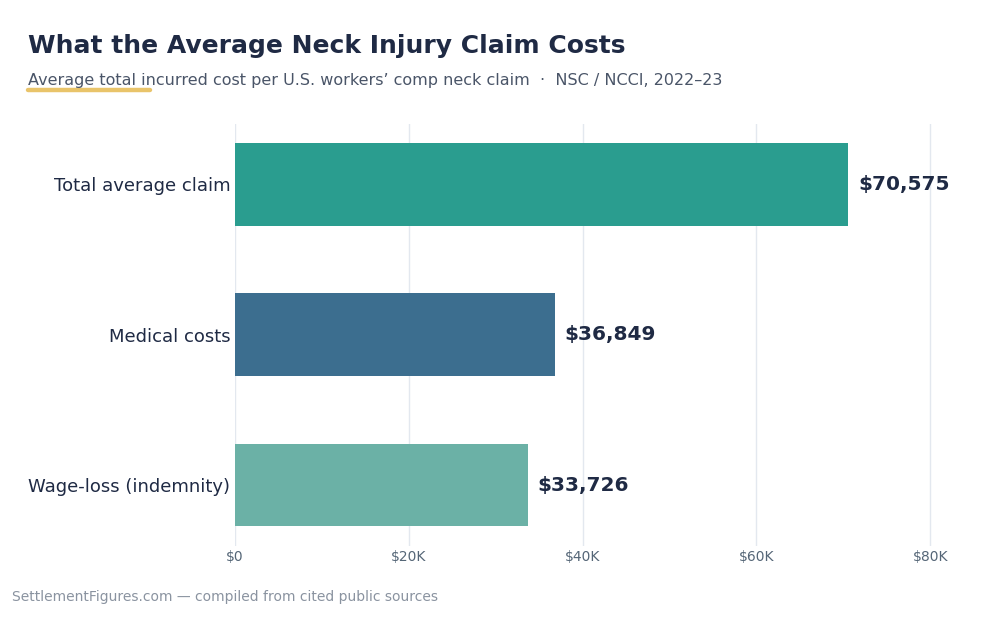
A neck injury at work can pay out across a wide range. Averaged across every U.S. claim, a neck injury costs about $70,600 in combined medical care and lost wages, according to National Safety Council and NCCI data for 2022–2023. A lump-sum settlement is a different number: minor soft-tissue strains often close for $3,000 to $60,000, while a case that needs cervical fusion surgery commonly settles for $150,000 to $300,000. Where your claim lands comes down to your impairment rating, your wages, and the state you were hurt in.
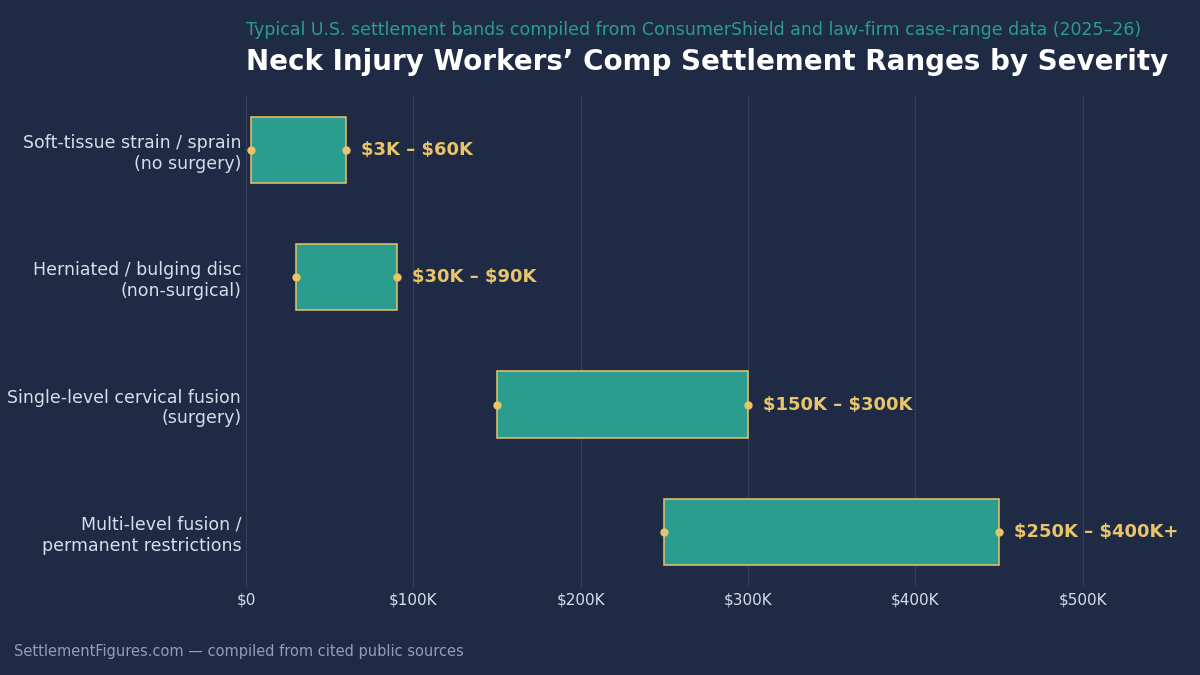
| Neck injury type | Typical workers’ comp settlement range |
|---|---|
| Soft-tissue strain or sprain (no surgery) | $3,000 – $60,000 |
| Herniated or bulging disc (non-surgical) | $30,000 – $90,000 |
| Single-level cervical fusion (surgery) | $150,000 – $300,000 |
| Multi-level fusion or permanent restrictions | $250,000 – $400,000+ |
What Real Neck Injury Settlements Look Like
The gap between a $5,000 strain and a $300,000 fusion is not random. It tracks how much the injury damages your body and your earning power. Two numbers help you set expectations.
The first is the all-claims average. National Safety Council and NCCI data put the average total cost of a workers’ comp neck claim at roughly $70,600 for 2022–2023, split into about $36,800 of medical care and $33,700 of wage-loss benefits. That figure blends thousands of small and large claims together, so it overstates a minor strain and understates a surgical case.
The second is severity. Soft-tissue strains that heal with rest and physical therapy sit at the low end. A herniated disc that responds to injections lands in the middle. A disc that fails conservative care and needs a cervical fusion moves the value into six figures, because the medical bill alone runs high and the injury usually leaves lasting restrictions. For a wider view of how these numbers compare with other body parts, see our guide to average workers’ comp settlement amounts.
One honest caveat: the higher ranges in the table above come mostly from represented and litigated cases that law firms choose to publish. Quiet, unrepresented claims tend to settle lower. Treat the bands as a map of what is possible, not a promise of what you will receive.
It also helps to know where you sit. If your neck healed without surgery, your claim almost certainly falls below the $70,600 average, not above it. If you needed a fusion, you are likely above it. The average is pulled upward by a small number of severe cases, so most workers settle for less than the headline number — a useful reality check before you judge an offer.
How Insurers and State Formulas Set the Number
Workers’ comp does not pay for pain and suffering the way a personal-injury lawsuit does. It pays on a formula. Understanding that formula tells you why an adjuster offers what they offer.
The process starts when your doctor decides you have reached maximum medical improvement, or MMI: the point where more treatment will not meaningfully improve your condition. At MMI, the doctor assigns a permanent impairment rating, a percentage that measures the lasting damage.
Most states then run a version of this calculation: statutory weeks × your impairment rating × your weekly compensation rate. The neck matters here. Many states classify neck, back, and spine injuries as “whole body” rather than a single scheduled part, which carries the highest statutory value because a neck injury can limit almost any kind of work. Our explainer on the permanent partial disability rating and payout walks through how that percentage turns into dollars.
Here is a simplified illustration; your state’s numbers will differ. Say your state assigns 500 weeks to a whole-body injury, your doctor gives a 10% impairment rating, and your weekly compensation rate is $600. The permanent-disability portion works out to 500 × 10% × $600, or $30,000 — before you add funded future medical care or any wage-loss benefits. Swap in a 20% rating and that same line doubles to $60,000. That is why the rating is worth getting right, and why a second opinion can change the whole picture.
A lump-sum settlement then bundles that permanent-disability value with the cost of expected future medical care and any remaining wage benefits, often reduced in exchange for closing the claim.
What Increases a Neck Injury Settlement
A handful of factors reliably push a neck case toward the top of its range:
- Surgery, especially fusion. A neck fusion moves a claim into the $150,000–$300,000 zone because the procedure is expensive and the hardware leaves permanent limits.
- A higher impairment rating. Objective imaging and a clear rating from your doctor raise the formula’s output directly.
- Permanent work restrictions. If you can no longer lift, drive, or look overhead, and you earn less as a result, wage-differential benefits add up.
- Open future medical care. Leaving treatment funded, rather than closing it, adds value for injections, therapy, or a second surgery.
- Failed conservative treatment. A documented trail of therapy and injections before surgery strengthens the case that the damage is real and lasting.
What Decreases a Neck Injury Settlement
The same list runs in reverse. Insurers cut offers when the record gives them room to.
- Pre-existing degeneration. Age-related disc wear lets the carrier argue your neck was already damaged before the accident.
- No objective findings. Pain without matching MRI or X-ray evidence is easy to dispute.
- A fast return to full duty. Going back to your old job at full pay lowers the wage-loss portion.
- Gaps in treatment. Missed appointments and long breaks suggest the injury is minor, whether or not that is true.
- Recorded statements. Early, unguarded answers to an adjuster can be used to shrink the claim.
Neck cases often travel with related injuries. If your accident also hurt your lower back, that claim follows similar rules — compare our figures on back injury workers’ comp settlements.
Do You Need a Lawyer for a Neck Claim?
Not every claim needs an attorney, but the data leans one way. In a national survey reported by Martindale-Nolo, injured workers who hired a lawyer collected an average of $23,500, compared with $18,000 for those who handled the claim alone — roughly 30% more. When a claim had been denied, represented workers recovered about 47% more than unrepresented ones.
Fees are capped in most states, commonly between 10% and 20% of the recovery, and are usually taken only if you win. For a minor strain that the insurer accepts without a fight, you may reasonably handle it yourself. For anything involving surgery, a disputed cause, or a denial, the math tends to favor representation. Our comparison of workers’ comp versus a personal-injury lawsuit can help you see which path fits your situation.
State Differences That Change Your Payout
Workers’ comp is run state by state, and three rules move the number more than any others.
First, how the state treats the neck. States that count it as a “whole body” injury generally allow larger awards than those that squeeze it into a scheduled category. Second, the cap on permanent partial disability, which sets a ceiling on the formula and varies widely. Third, the statute of limitations to file: many states give one to three years from the injury or from the date you knew it was work-related, and missing it can end a claim outright.
Some states also let you take a full lump-sum “compromise and release” that closes medical care, while others keep treatment open. Because timing drives so much of this, read our guide on how long a workers’ comp settlement takes before you accept or reject an offer. When in doubt, your state workers’ comp board — linked in the resources below — is the authoritative source.
Three Things to Check Before You Sign
A settlement closes the door on the claim, so the terms deserve a slow read. Three checks catch most costly mistakes.
First, confirm you are at maximum medical improvement and that your impairment rating reflects your real limits; if your own doctor’s opinion differs from the insurer’s, you can usually seek a second rating. Second, separate the medical terms from the cash: know whether future injections, therapy, or a second surgery stay funded. Third, price the offer against your state’s permanent-disability formula and the ranges above, so you can tell a fair number from a low one. If any of the three is unclear, a free consultation costs nothing and the fee only applies if you recover.
Free official help & resources
- OSHA — report unsafe conditions or retaliation for filing a claim. Call 1-800-321-6742 (osha.gov/workers).
- U.S. Department of Labor — find your state workers’ compensation office at dol.gov/agencies/owcp/links.
- Social Security Administration — apply for SSDI if a neck injury keeps you from working. Call 1-800-772-1213 (ssa.gov).
- Free Legal Answers (American Bar Association) — ask a lawyer a civil legal question at no cost: freelegalanswers.org.
- Legal Services Corporation — locate free local legal aid at LSC.gov/find-legal-aid.
- Dial 2-1-1 — free, confidential referrals for bills, food, and medical help (211.org).
Neck Injury Workers’ Comp Settlements: FAQ
What is the average workers’ comp settlement for a neck injury?
Across all U.S. claims, a neck injury averages about $70,600 in combined medical and wage-loss costs, per National Safety Council and NCCI data. Actual lump-sum settlements vary widely by severity — from a few thousand dollars for a minor strain to well over $150,000 for a surgical case.
How much is a neck injury worth if I need surgery or a cervical fusion?
Cervical fusion cases commonly settle in the $150,000 to $300,000 range, according to published law-firm case data, and multi-level fusions with permanent restrictions can run higher. The exact figure depends on your impairment rating, your wages, and whether future medical care stays open.
Will neck surgery increase my workers’ comp settlement?
Usually, yes — but not automatically. Surgery raises the medical bill and often leaves permanent restrictions, both of which increase value. What actually drives the settlement is the impairment rating and whether you can return to your old job at your old pay.
How long does a neck injury workers’ comp settlement take?
Most cases do not settle until you reach maximum medical improvement, because the impairment rating sets the value. That can take months for a strain or well over a year for a surgical case. Settling too early risks leaving future medical costs unfunded.
Do I need a lawyer for a neck injury workers’ comp claim?
For a minor strain the insurer accepts, you may not. For surgery, a disputed cause, or a denial, representation tends to pay off: surveyed workers with lawyers recovered about 30% more on average, per Martindale-Nolo, and fees are capped in most states.
Can I settle and still get future medical care for my neck?
It depends on how you settle. Some states and agreements let you close cash benefits while keeping medical care open; a full “compromise and release” closes both. If you may need injections or a second surgery, the medical terms matter as much as the dollar amount.
☕ This research is reader-supported. No law firm pays us. If this guide saved you time or money, you can buy the research team a coffee — it keeps the data free and updated.
This article is for informational purposes only and is not legal advice. Settlement values vary significantly by case and by state. Consult a licensed attorney in your state before making decisions about your claim.
