Last updated: July 17, 2026 · Data reviewed quarterly
Slip and fall cases are lost in the first 48 hours — not in court. The owner’s insurer is counting on you having no incident report, no photos and no witnesses. And the money at stake is modest enough that losing it hurts: ConsumerShield put the average slip and fall settlement at about $30,000 in July 2026, derived from the midpoint of ranges reported by two law firms ($15,000–$45,000 from Meirowitz & Wasserberg, $10,000–$50,000 from Brown & Crouppen). Here is the evidence checklist that protects it.
| Source | What it counts | Reported figure |
|---|---|---|
| ConsumerShield, July 2026 | Average, from the midpoint of two firms’ ranges | About $30,000 |
| Meirowitz & Wasserberg (via ConsumerShield) | Typical range reported by the firm | $15,000 – $45,000 |
| Brown & Crouppen (via ConsumerShield) | Typical range reported by the firm | $10,000 – $50,000 |
| JTNY, 2026 (New York) | Moderate cases: fractures without surgery, MRI-documented disc injuries, knee or shoulder injuries resolving with therapy | $30,000 – $75,000 (overall $15,000 – $250,000+) |
| Rad Law Firm, 2026 (Texas) | Texas slip and fall range | $15,000 – $85,000; severe cases $500,000+ |
One factor moves cases more than any other. JTNY identifies surgery as the single biggest driver pushing a fall into six and seven figures — because an operation is objective proof of a serious injury, and objective proof is exactly what an adjuster cannot argue away.
Falls are not a fringe event. The National Safety Council counted more than 8.8 million emergency department visits for fall injuries in 2023, and reports that in 2024, 844 workers died in falls — 17% of all workplace deaths — with nearly 480,000 hurt badly enough to miss work.
The legal target: notice
Falling is not enough. You must show the owner knew or should have known about the hazard and failed to fix or warn about it — what the law calls notice. Nolo draws the line that decides most cases: actual notice means they knew; constructive notice means a reasonably careful owner inspecting the property would have found it.
Constructive notice almost always comes down to duration — how long the hazard sat there. The longer it sat, the worse the owner looks. This is why small details carry weight: a puddle already drying at the edges has been there a while. Footprints and cart tracks through a spill say the same thing. So does a third complaint about the same loose step.
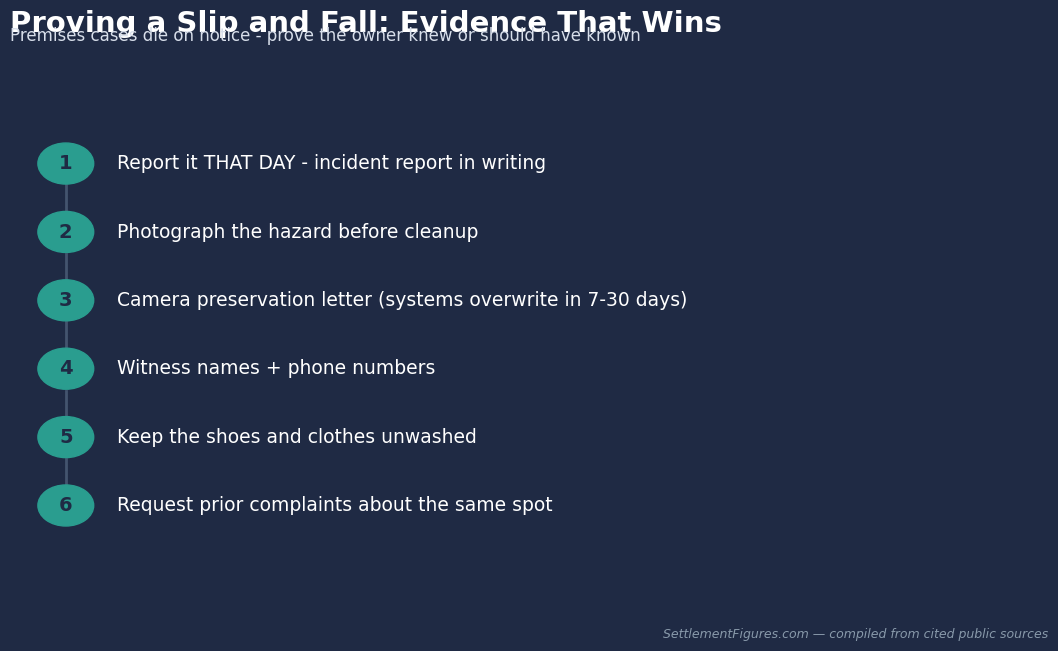
The checklist, in order of urgency
| Evidence | Deadline reality | Why it wins |
|---|---|---|
| Incident report, same day | Before you leave if possible | Locks time, place and hazard on the record |
| Photos/video of the hazard | Before cleanup — minutes | The condition disappears fast |
| Camera preservation letter | 7 – 30 days before overwrite | Footage proves duration = notice |
| Witness contacts | That day | Neutral voices beat your testimony |
| Shoes & clothing, unwashed | Keep bagged | Kills the “improper footwear” defense |
| Prior complaints (discovery) | Later, via records | Repeat hazards prove constructive notice |
| Sweep logs & inspection records | Later, via discovery | Gaps show the hazard should have been found |
Two of those deserve emphasis. Video is the closest thing to a decisive weapon in a premises case, because it can show the spill’s origin, the minutes it sat, and employees walking past it. That is duration, handed to you. But footage overwrites on a loop measured in days — which is why the preservation letter is urgent rather than important.
Sweep logs cut both ways, and defendants know it. A log showing inspections every 30 minutes helps the store. A log with a three-hour gap, or one signed in identical handwriting for a whole shift, helps you. You will not see these without a lawyer requesting them in discovery.
The comparative negligence trap
Their playbook is not “it did not happen” — it is “it was partly your fault”: the phone, the visible cone, the posted sign, your shoes. This is why the recorded-statement questions circle your attention and your footwear. Decline recorded statements until advised.
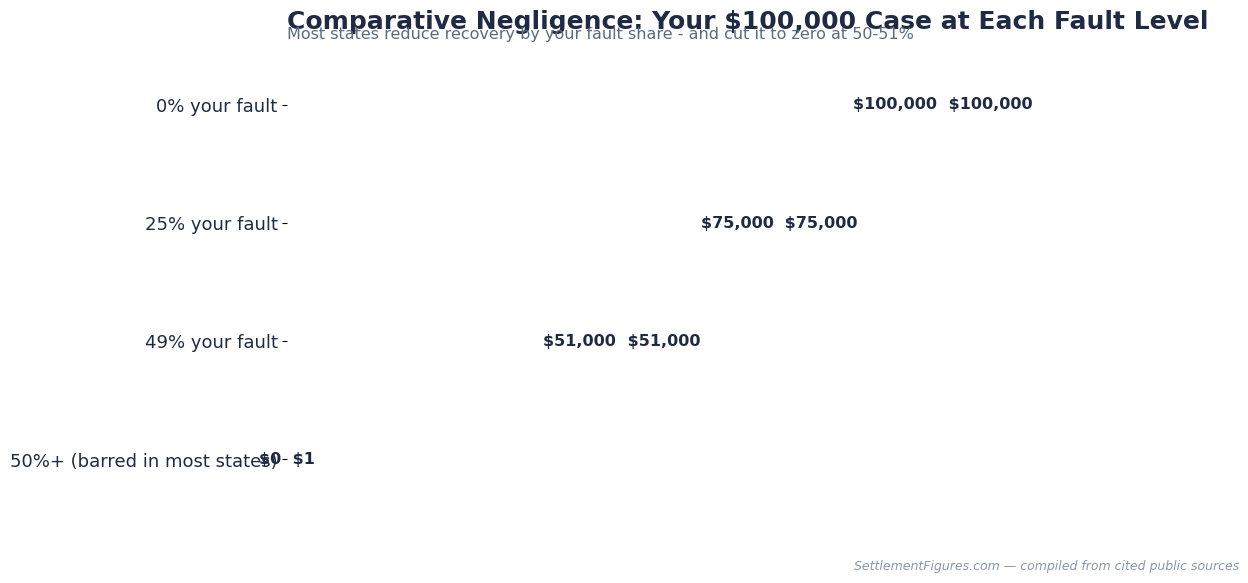
The math depends on your state, and the differences are severe. Under pure comparative negligence you can be 99% at fault and still recover something. Under modified comparative negligence, recovery is cut off entirely at 50% or 51% — Illinois, for instance, bars recovery at 50% or more, per the Illinois Department of Insurance. And four states still apply contributory negligence, where any fault at all — even 1% — bars you completely: Maryland, North Carolina, Alabama and Virginia (ConsumerShield). A $100,000 case at 25% fault pays $75,000 in most states and $0 in those four. It is the same fault arithmetic that decides uninsured motorist claims.
Where you fell changes the fight
Stairways deserve special mention: photograph the handrail, riser heights and lighting, because a building code violation can carry the whole case. Our guide to stairway fall settlements shows what those claims pay and why the code evidence matters.
Retail. Camera coverage and sweep logs exist; preservation letters are decisive. For how a claim against a shop actually proceeds, see our guide on slip and fall claims against stores.
Private homes. Homeowners policies pay, and the dynamics are friendlier — you are usually claiming against an insurer, not a friend.
Government property. Notice deadlines run as short as 60–180 days. This is the most-missed deadline in premises law, and missing it ends the claim regardless of how strong your evidence is.
At work. Your fall routes through workers’ comp instead — no fault fight, but different math and a different process. Start with how to file a workers’ comp claim, and if you landed on a knee or a wrist, the payout logic is closer to knee injury workers’ comp settlements than to a premises claim.
Free official help & resources
- Fell at work? OSHA — call 1-800-321-6742 to report an unsafe condition (you can do it confidentially)
- Fall data & prevention: CDC falls · NSC Injury Facts
- Government property claims: ask your city or county clerk for the “notice of claim” form immediately — the deadline can be 60 days
- Free legal questions answered by volunteer attorneys: ABA Free Legal Answers
- Legal aid near you: Legal Services Corporation
- Insurer misconduct: NAIC state directory
- Rent, food or medical bills while you recover: dial 211 or visit 211.org
Frequently asked questions
How do you prove negligence in a slip and fall case?
You show the owner owed you a duty, a dangerous condition existed, the owner knew or should have known about it, and it caused your injury. Per Nolo, the duty includes periodically inspecting the property and then either fixing the hazard or warning about it. The fight is almost always over the third element — notice.
What is constructive notice in a slip and fall case?
It means the owner should have known, even if nobody told them. You prove it two ways: the hazard sat long enough that a careful owner inspecting the place would have found it, or the same hazard recurred often enough to be foreseeable. Duration is the usual battleground — which is why footage and sweep logs matter more than your account of the fall.
How much are slip and fall settlements?
ConsumerShield’s July 2026 figure is about $30,000 on average, from firm-reported ranges of $10,000–$50,000. JTNY puts moderate New York cases at $30,000–$75,000 and the full spread at $15,000–$250,000+. The variable that moves you up the range most is whether you needed surgery.
The store says cameras “were not recording.”
If footage vanished after your preservation letter, many courts allow a spoliation inference — the jury may assume it showed what you claim. Send it certified mail, date-stamped. Without that letter, an overwrite is just routine.
I was partly on my phone. Dead case?
Reduced, not dead — in most states. Your recovery drops by your fault share, and only ends entirely if you cross your state’s 50–51% bar. The exception is the four contributory negligence states, where any fault ends it. An open hazard with prior complaints still carries most of the blame.
How do I prove my losses?
Medical bills show what treatment cost, pay stubs show what you lost by missing work, and your doctor testifies to what you will still need. Keep receipts for anything the injury forced you to buy — including things like a bathroom grab rail. Non-economic damages for pain and disruption are argued on top of that documented base.
☕ This research is reader-supported. No law firm pays us. If this guide saved you time or money, you can buy the research team a coffee — it keeps the data free and updated.
This article is for informational purposes only and is not legal advice. Settlement values vary significantly by case and by state. Consult a licensed attorney in your state before making decisions about your claim.
