Last updated: July 25, 2026 · Data reviewed quarterly
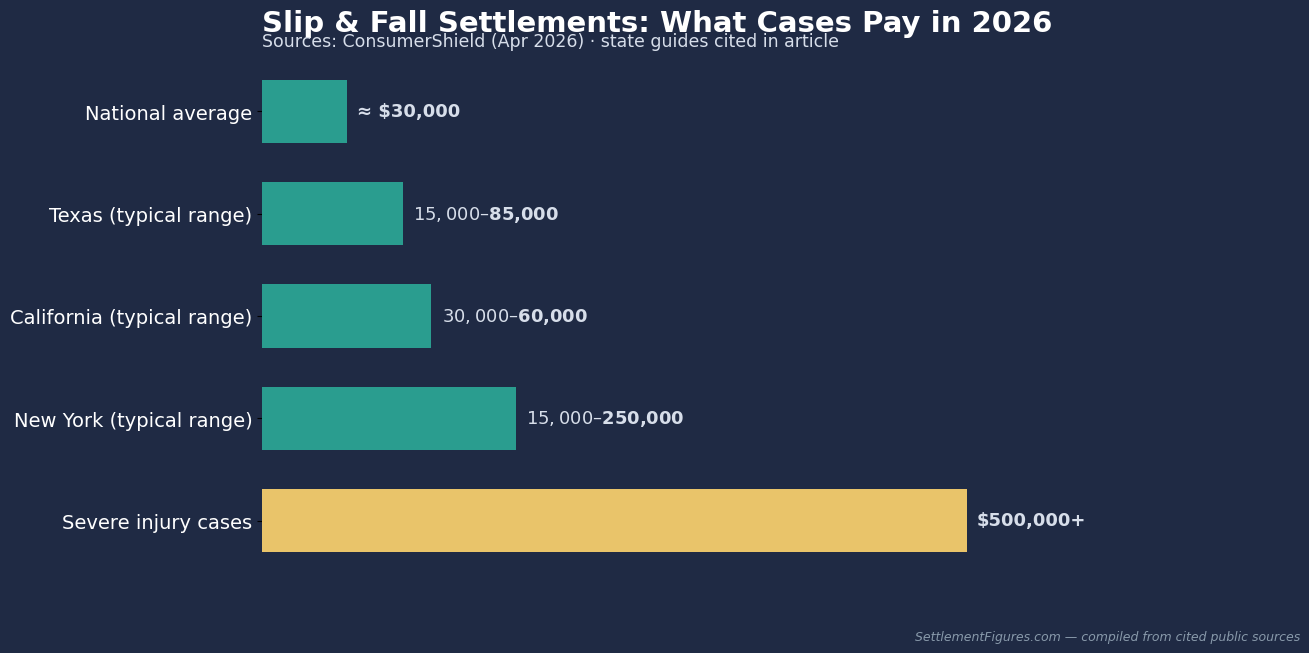
The average slip and fall settlement is about $30,000 (April 2026 data) — but that number hides a brutal spread: bruises settle for four figures while surgical hips and head injuries clear $500,000+. Premises cases pay on two axes: how badly you were hurt, and how provable the property owner’s negligence is.
Ranges by severity
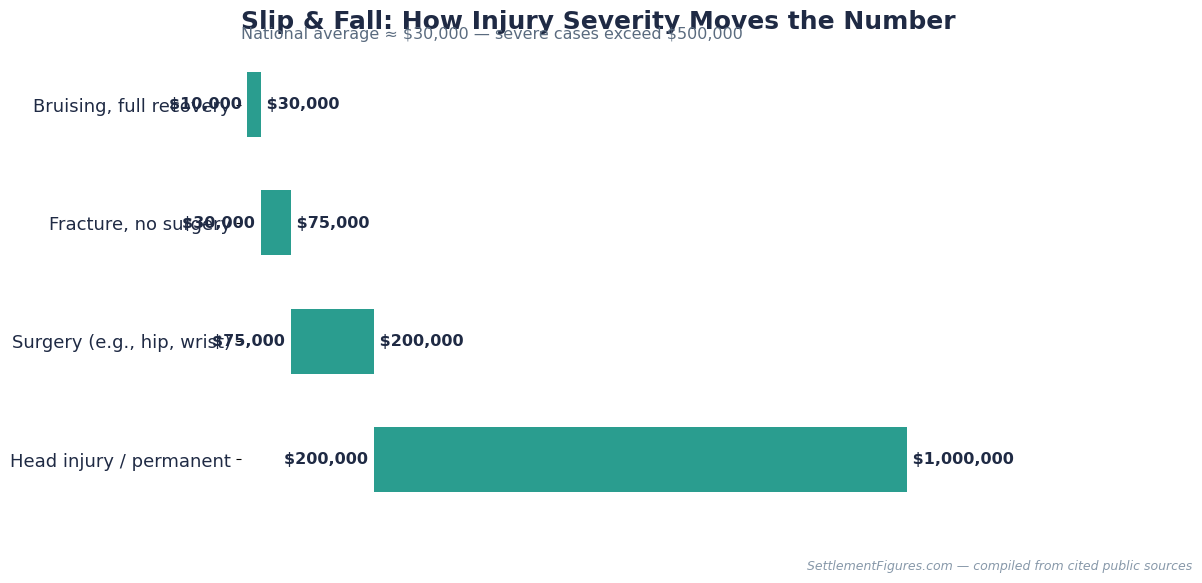
| Injury profile | Typical range |
|---|---|
| Bruising / sprains, full recovery | $10,000 – $30,000 |
| Fracture without surgery | $30,000 – $75,000 |
| Surgery (wrist, hip, shoulder) | $75,000 – $200,000 |
| Head injury / permanent effects | $200,000 – $1,000,000+ |
Regional context: California cases commonly land $30,000-$60,000; Texas $15,000-$85,000; New York $15,000-$250,000 — sources below.
What the national numbers say
Independent trackers cluster tightly on the typical figure. ForThePeople (Morgan & Morgan), DK Law and MyInjuryPros each put the average slip and fall settlement between $10,000 and $50,000, and ConsumerShield’s 2026 midpoint lands near $30,000. Severity is what moves you inside that band: CasePeer and MyInjuryPros place fractures or surgery cases at $25,000 to $100,000, and severe spinal or brain injuries at $100,000 to $500,000 or more.
Falls on stairs behave differently from same-level slips: building code violations — a missing handrail, uneven risers, poor lighting — often make negligence easier to prove and push values up. We cover those cases separately in our guide to stairway fall liability and settlement amounts.
Grocery and big-box store falls
Store cases are their own category because large retailers carry heavy liability policies and keep cameras and sweep logs. MyInjuryPros notes grocery cases settle markedly higher when footage shows a spill sat on the floor for a long stretch. If your fall happened in a shop, our guide on slip and fall claims against stores walks through the invitee standard, actual versus constructive notice, and how retailers’ insurers negotiate.
What drives your number
Three inputs move the figure most: your documented medical bills, the wages you lost, and pain and suffering — the last usually built with a multiplier on your economic losses. Strong proof on the notice question lifts value too, because it pushes the insurer to pay rather than risk trial. Weak evidence, gaps in treatment, or a large share of comparative fault pull it down.
Evidence that moves you up the range
The same injury can settle for very different amounts depending on proof. Photos taken before cleanup, an incident report filed the same day, and witness names lock the basic facts. The strongest single item is usually surveillance footage, because it can show how long the danger sat — the heart of the notice question. Footage overwrites in days, so a written preservation request sent right away can be decisive.
Medical documentation carries equal weight on the damages side. Consistent treatment records, imaging that objectively shows the injury, and a doctor’s opinion on lasting effects turn a disputed claim into a concrete number. Gaps in care give the insurer room to argue you healed or were never badly hurt. Filing deadlines also shape outcomes: they run as short as a few months for falls on government property and commonly two to three years elsewhere, so checking your state’s statute of limitations early keeps a strong case from dying on a technicality.
How comparative negligence changes the total
Owners rarely deny the fall; they argue you share the blame. Under pure comparative negligence your award drops by your fault share, so 30% fault turns a $100,000 case into $70,000. Under modified comparative negligence — the rule in most states — you recover only below the 50% or 51% bar; cross it and you collect nothing. A handful of states apply strict contributory negligence, where any fault at all can end the claim. Because your percentage can swing the total by tens of thousands, it is usually the most contested number in the file.
How long a payout takes
Most premises claims resolve in about 6 to 18 months, and the large majority settle without a trial, according to timelines from 855mikewins and Tenina Law. Cases with disputed fault or serious injuries can run toward two years, because settling before your prognosis is clear can leave future costs uncovered.
The negligence axis (where cases die)
Falling is not enough — you must show the owner knew or should have known about the hazard and failed to fix or warn. Winning evidence: incident reports made THAT DAY, photos of the hazard before cleanup, camera footage (send a preservation letter fast — many systems overwrite in 7-30 days), witness contacts, and prior complaints about the same spot. Comparative negligence cuts both ways: “you should have seen it” arguments reduce recoveries by your fault percentage in most states.
Where the money comes from
Commercial general liability policies (stores, restaurants) or homeowners insurance. Businesses typically carry $1M+ per occurrence, which is why supermarket cases settle higher than identical falls at a private home. The claim math afterward follows the same logic as any injury claim: specials × multiplier — see how pain and suffering is calculated and how settlement timelines run.
If it happened at work
A fall on the job usually routes through workers’ comp instead — different rules, no pain and suffering, but no fault fight either: workers’ comp settlement data. A fall at a third party’s premises while working can open both lanes.
Free official help & resources
- Fall injury statistics & prevention: CDC.gov/falls — falls cause 1M+ ER visits yearly
- Preserve evidence: send the property owner a written “preservation of evidence” letter immediately (templates via legal aid below)
- Insurer misconduct: your state insurance department via NAIC consumer resources
- Free legal help: LSC.gov · ABA Free Legal Answers
Should you accept the first offer?
Rarely, if the injury is more than trivial. Early offers tend to arrive before the full medical picture is clear, and once you sign a release the claim is closed for good, even for symptoms that appear later. Getting your treatment documented and your prognosis confirmed first is what separates a fair number from a lowball. When an offer looks low, a written counter backed by records and the notice evidence usually moves it.
FAQ
I did not report the fall that day. Is my case dead?
Harder, not dead. Medical records from soon after, witnesses, and photos can rebuild the timeline — but report in writing to the property owner as soon as possible, and mind your state’s filing deadline (often 2-3 years, sometimes just 6 months for government property).
The store offered to “cover medical bills” if I sign.
That release likely ends ALL claims, including injuries that surface later. Understand your damages before signing anything.
What is my case worth with a broken wrist and surgery?
With clear liability, surgical wrist cases commonly land in the $75,000-$200,000 band — driven by your specials, permanence, and the venue.
What is the average settlement for a slip and fall in a store?
National figures from ForThePeople, DK Law and MyInjuryPros put the typical store slip and fall between $10,000 and $50,000. Minor injuries settle around $10,000 to $25,000, fractures or surgery commonly reach $25,000 to $100,000, and severe injuries can exceed $500,000.
How long does a slip and fall settlement take?
About 6 to 18 months for most cases, with the majority settling out of court, per 855mikewins and Tenina Law. Disputed liability or severe injuries can push it toward two years.
Do I need a lawyer to settle a slip and fall?
Not for a clearly minor injury with a fair offer. But when injuries are serious, fault is disputed, or a large retailer’s defense team is involved, an attorney paid on contingency usually recovers more. Most offer a free first consultation.
☕ This research is reader-supported. No law firm pays us. If this guide saved you time or money, you can buy the research team a coffee — it keeps the data free and updated.
This article is for informational purposes only and is not legal advice. Settlement values vary significantly by case and by state. Consult a licensed attorney in your state before making decisions about your claim.
