Last updated: July 25, 2026 · Data reviewed quarterly
If you were hurt after slipping in a store, most U.S. slip-and-fall claims against retailers settle for $10,000 to $50,000, with the exact figure driven by how badly you were injured and whether you can prove the store knew about the hazard. That national range is drawn from settlement data compiled by ForThePeople (Morgan & Morgan), DK Law and MyInjuryPros. Minor injuries land at the low end; a broken bone or a fall that needs surgery can push a case to $100,000 or more. This guide covers what the law requires a store to do, what you have to prove, how long it takes, and where to get free help.
| Injury type | Typical settlement range |
|---|---|
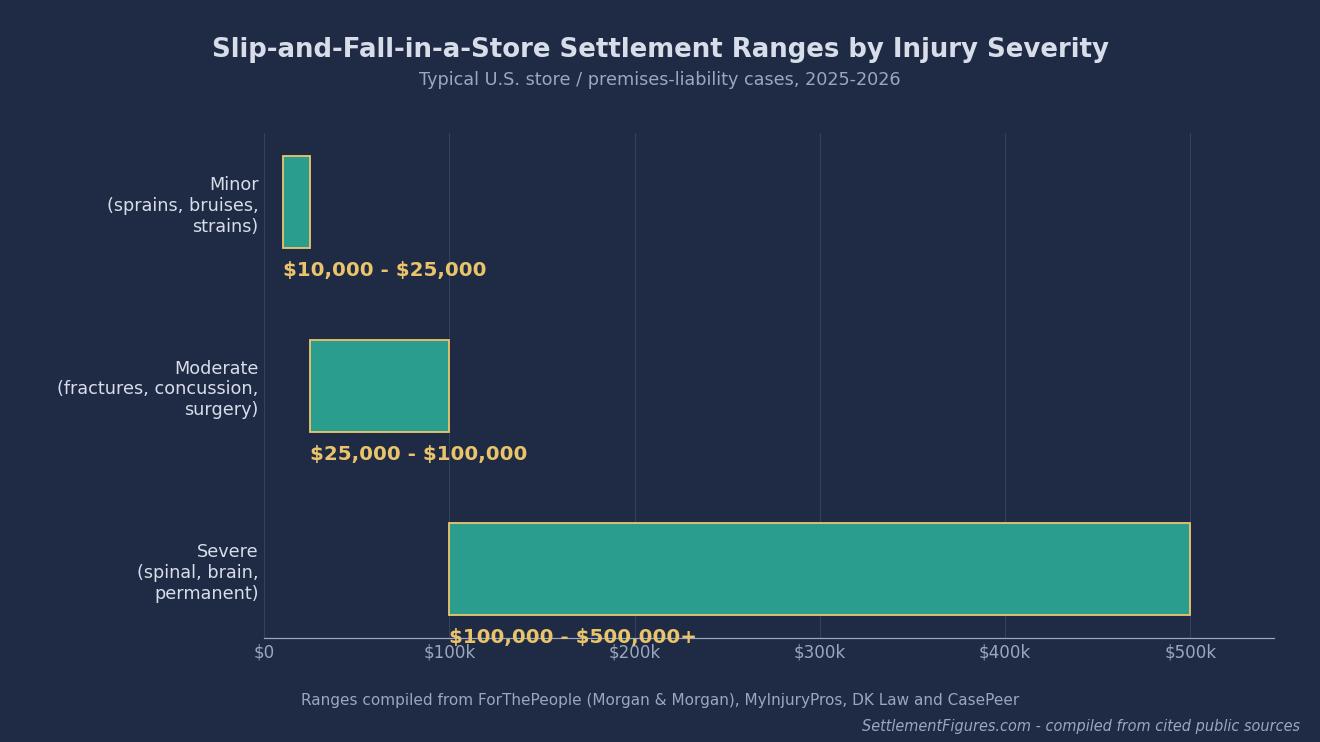
| Minor (sprains, bruises, strains) | $10,000 – $25,000 |
| Moderate (fractures, concussion, surgery) | $25,000 – $100,000 |
| Severe (spinal, brain, permanent injury) | $100,000 – $500,000+ |
| National average, all cases | $10,000 – $50,000 |
What the law actually requires of a store
When you walk into a store to shop, the law treats you as an “invitee” — someone the business invited onto its property for commercial benefit. According to Justia’s personal injury center, invitees are owed the highest duty of care of any visitor. In plain terms, the store has to inspect the property on a reasonable schedule, clean up or block off hazards it finds, and warn you about dangers it cannot fix right away.
That duty does not make the store an automatic insurer of your safety. To win a premises liability claim, you generally have to prove four elements: the store owed you a duty of care, it breached that duty, the breach caused your fall, and you suffered real damages such as medical bills or lost wages. The law firm Kantrowitz, Goldhamer & Graifman describes this as the “invitee standard” — the store is liable when it fails to act as a reasonably careful business would.
The hard part: proving the store knew
Most store cases are won or lost on one question: did the retailer know about the hazard, or should it have known? Lawyers call this “notice,” and it comes in two forms.
Actual notice means an employee knew about the danger — they saw the spill, created it while mopping, or stacked merchandise in a way that made it fall. Constructive notice means the hazard sat there long enough that a reasonable store should have found and fixed it during routine inspections. As the firm Benson & Bingham explains, constructive notice exists when a reasonable jury could decide the store should have known the condition was there.
This is why timing matters so much. A puddle that appeared 30 seconds before you fell is hard to pin on the store; a produce spill that footage shows sat for 45 minutes is a strong case. Surveillance video, employee inspection logs, and witness statements are the evidence that settles the notice question. For a deeper walkthrough of the proof that carries these cases, see our guide on how to prove a slip and fall.
Common store hazards — and who is actually liable
Not every store fall points to the store alone. Identifying the hazard helps you see who may owe you money and what evidence to preserve.
- Wet or freshly mopped floors — the most common claim. If staff created the wet spot or left it unmarked, that is usually direct fault on the store.
- Spills left too long — a leaking freezer or a dropped jar becomes the store’s problem once enough time passes that inspection should have caught it.
- Fallen or badly stacked merchandise — poor stocking that causes items to fall points back to how employees did their job.
- Torn mats, loose tiles, or bad lighting — maintenance defects the store had a duty to find and fix.
- Parking lots and entrances — ice, potholes, or cracked walkways. Here a separate property owner or a snow-removal contractor may share the blame with the store.
The last point matters because more than one party can be responsible. A cleaning company under contract, a landlord who controls the parking lot, or an equipment vendor can all be added to a claim. Naming every liable party early gives you more than one source of recovery and keeps any single insurer from shifting blame elsewhere.
What a store fall is actually worth
Settlement size tracks injury severity more than anything else. The national average payout for a grocery or retail store slip and fall runs from $10,000 to $50,000, according to figures compiled by ForThePeople and DK Law. But the spread inside that average is wide.
MyInjuryPros and CasePeer both place minor injuries — sprains, bruises, a wrenched back that heals — roughly in the $10,000 to $25,000 band. Moderate injuries involving fractures, a concussion, or any surgery generally settle between $25,000 and $100,000. Severe injuries such as spinal damage, a traumatic brain injury, or permanent mobility loss reach $100,000 to $500,000 or more, per the same sources.
Beyond the injury itself, three things move the number: your total medical bills, the wages you lost, and your pain and suffering. That last piece is often calculated with a multiplier applied to your economic losses — we break the math down in our explainer on the pain and suffering multiplier method. Strong evidence on the notice question also lifts value, because it makes the store more likely to pay rather than gamble at trial. For injury-by-injury figures, our page on slip and fall settlement amounts goes further.
How comparative negligence can cut your payout
Stores rarely argue they did nothing wrong. More often they argue you share the blame — you were looking at your phone, wearing the wrong shoes, or stepped past a warning cone. This is comparative negligence, and it directly reduces what you collect.
The rule varies by state. Under pure comparative negligence, your award simply drops by your share of fault: if you were 30% responsible, a $100,000 case becomes $70,000. Under modified comparative negligence — the rule in most states — you recover only if you are below the state’s bar, typically 50% or 51% at fault. Cross that line and you collect nothing. Because your fault percentage can swing the outcome by tens of thousands of dollars, it is usually the most contested number in the file.
Your options after a store fall — and how long they take
You generally have three paths. First, report and document the fall and let the store’s insurer make an offer — the fastest route, and reasonable for a clearly minor injury. Second, negotiate that claim yourself with medical records and a demand letter. Third, hire a contingency-fee attorney, who typically takes a percentage only if you recover. Against a large retailer with an experienced defense team, the third option often makes sense once injuries are serious.
Timing depends on the path and the injury. Straightforward store claims commonly resolve in about 6 to 18 months, and the vast majority settle without a trial, according to timelines published by 855mikewins and Tenina Law. Cases with disputed liability or long-term medical care can stretch toward two years, largely because settling before you know your full prognosis can leave future costs uncovered.
Red flags to watch for
A fast, friendly settlement offer within days of your fall is usually a sign to slow down. Before you sign anything, watch for these moves:
- An offer that arrives before you have finished treatment or know your prognosis.
- A request for a blanket medical authorization letting the insurer dig through your entire history for old injuries to blame.
- Pressure to give a recorded statement before you have written down what happened.
- The store claiming no video exists — ask, in writing, that footage be preserved right away.
- A denial letter with no real explanation.
A denial is not the end of the road. Insurers reverse decisions when you supply the missing proof and follow the appeal process — our guide on appealing a denied insurance claim lays out the steps that actually work.
Free official help & resources
- Dial 211 (United Way) or visit 211.org — free connection to local legal aid, medical-bill assistance, and financial support after an injury.
- American Bar Association Free Legal Answers — freelegalanswers.org — free answers to civil legal questions from volunteer attorneys.
- Legal Services Corporation — lsc.gov — directory of local legal-aid offices for people who cannot afford a lawyer.
- U.S. Consumer Product Safety Commission — report a dangerous store condition at SaferProducts.gov or call the hotline at 1-800-638-2772.
- National Association of Insurance Commissioners — content.naic.org/consumer — file a complaint if the store’s insurer handles your claim unfairly.
Frequently asked questions
Can you sue a store for a slip and fall?
Yes. If a store failed to keep its floors reasonably safe and that failure caused your injury, you can bring a premises liability claim against the retailer, as Cutter Law and others confirm. Most cases settle with the store’s insurer, and a lawsuit is filed only if negotiations stall. You typically need to show the store knew or should have known about the hazard.
What is the average settlement for a slip and fall in a store?
National figures compiled by ForThePeople, DK Law and MyInjuryPros put the typical store slip-and-fall settlement between $10,000 and $50,000. Minor injuries settle around $10,000 to $25,000, while fractures or surgery commonly reach $25,000 to $100,000, and severe injuries can exceed $500,000.
How long does a slip and fall claim against a store take to settle?
Most store claims resolve in about 6 to 18 months, and the large majority settle out of court, according to 855mikewins and Tenina Law. Disputed-liability or serious-injury cases can take up to two years, in part because settling before your treatment is complete can leave future medical costs unpaid.
What do you have to prove to win a slip and fall case against a store?
You generally must prove four things: the store owed you a duty of care as a customer, it breached that duty, the breach caused your fall, and you suffered real damages. The pivotal issue is usually notice — showing the store knew about the hazard (actual notice) or that it existed long enough that the store should have found it (constructive notice).
Do I need a lawyer for a slip and fall in a store?
Not always. For a clearly minor injury with a small, fair offer, you can often handle it yourself. But when injuries are serious, liability is disputed, or you are facing a large retailer’s defense team, an attorney — usually paid only on contingency — tends to recover more. Many offer free consultations, so a first conversation costs nothing.
What should I do right after I fall in a store?
Tell a manager and ask that an incident report be created, then get a copy or the report number. Photograph the hazard, your shoes, the surrounding area, and any injuries. Collect names and numbers of witnesses. Get medical care promptly, and ask — in writing — that the store preserve its security footage before it is overwritten.
This article is for informational purposes only and is not legal advice. Settlement values vary significantly by case and by state. Consult a licensed attorney in your state before making decisions about your claim.
