Last updated: July 24, 2026 · Data reviewed quarterly
Most California car accident settlements fall between $15,000 and $80,000, and injury-firm compilations put the typical payout near $21,000–$23,000 — though the real number depends on your injuries, who was at fault, and the insurance limits available. A minor whiplash claim may close for a few thousand dollars, while a spinal-cord or brain injury can reach seven figures. This guide lays out current California settlement ranges by injury, the state laws that raise or lower your payout, and how long the process actually takes in 2026.
| Injury or claim type | Typical California settlement range |
|---|---|
| Property damage only (no injury) | $3,000 – $15,000 |
| Minor injury (whiplash, soft tissue) | $5,000 – $25,000 |
| Moderate injury (broken bones, concussion) | $30,000 – $85,000 |
| Serious injury (herniated disc, surgery) | $75,000 – $300,000 |
| Catastrophic (spinal cord, TBI, wrongful death) | $500,000 – $1,000,000+ |
California Car Accident Settlement Snapshot
Four state rules shape almost every California car accident settlement. Here is the quick version before we get into amounts.
| California rule | What it means for your claim |
|---|---|
| Statute of limitations | 2 years for injury (Cal. Code Civ. Proc. § 335.1); 3 years for vehicle damage (§ 338(c)) |
| Fault system | At-fault (tort) state using pure comparative negligence — you can recover even if mostly at fault, reduced by your share |
| Minimum liability limits | 30/60/15 since Jan 1, 2025 (SB 1107): $30k per person / $60k per accident / $15k property damage |
| Claims against a government entity | Roughly 6 months to file under the Government Claims Act — far shorter than a standard claim |
Average Settlement Amounts in California (2026)
There is no single “average.” Payouts track the severity of the injury and the strength of the evidence. California injury-firm compilations for 2025–2026 put a typical case near $21,000–$23,000, with most settlements landing between $15,000 and $80,000. Property-damage-only claims settle far lower; catastrophic injuries settle far higher.
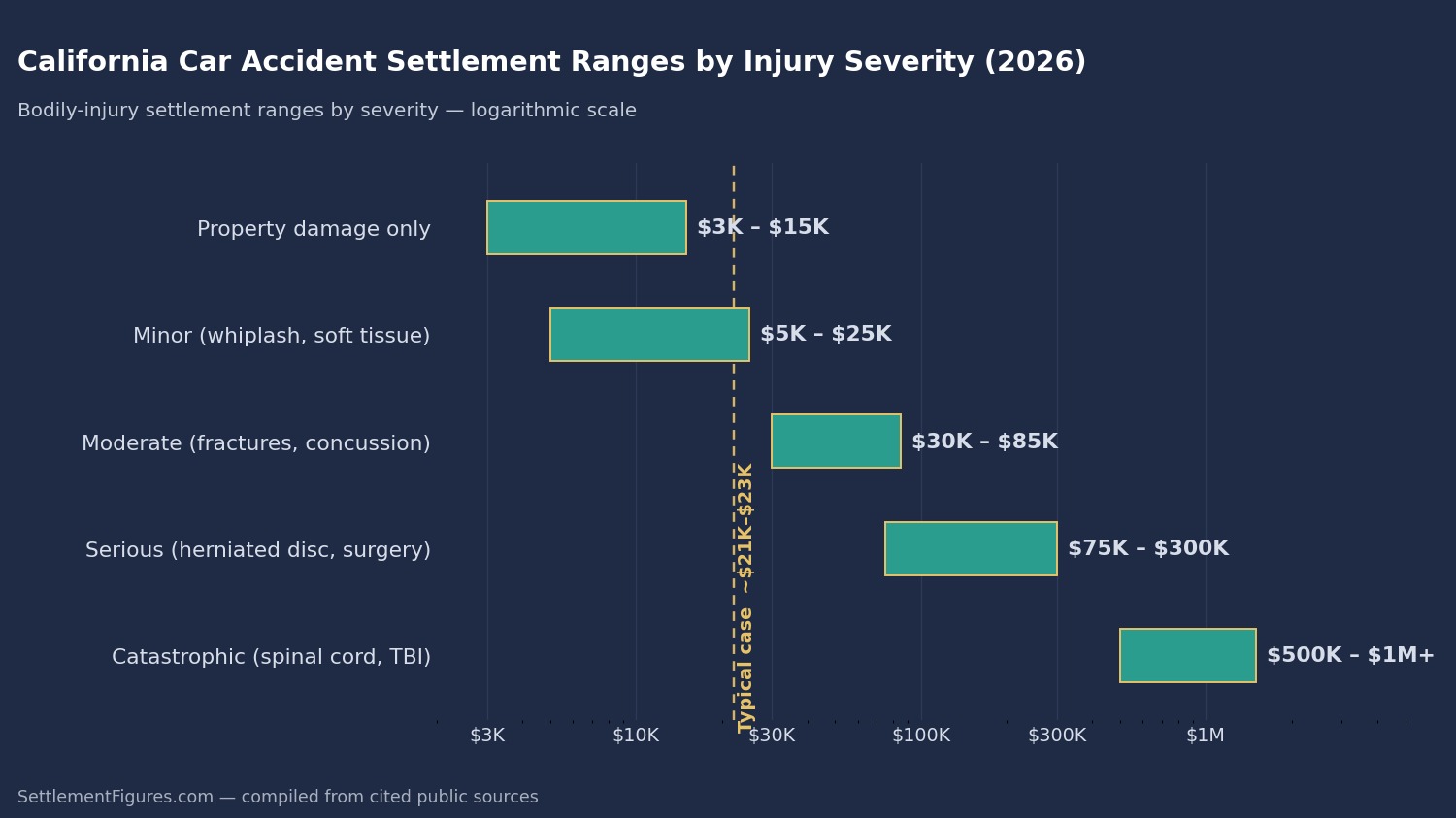
The chart shows why “average” is misleading. A soft-tissue whiplash case and a spinal-cord case are both car accident settlements, yet they sit at opposite ends of the scale. For a national benchmark, see our average car accident settlement amounts breakdown, and for one of the most common injuries, our whiplash settlement amounts guide.
Insurers value most claims as economic damages — medical bills, lost wages, and vehicle repair — plus non-economic damages for pain and suffering. The common shortcut is the multiplier method: total economic damages multiplied by roughly 1.5 to 5, with the higher end reserved for serious or permanent injuries. We break the math down in our pain and suffering multiplier method guide.
California Laws That Change Your Payout
Pure comparative negligence. California lets you recover damages even if you were mostly to blame (a rule set in Li v. Yellow Cab Co., 1975). Your award is reduced by your percentage of fault: a $100,000 case with 30% fault on you pays $70,000. That is more forgiving than the 51% bar used in states like Texas — compare our Texas settlement guide.
Higher insurance minimums (SB 1107). Since January 1, 2025, California’s minimum liability limits rose to 30/60/15 — $30,000 per injured person, $60,000 per accident, and $15,000 for property damage — up from the old 15/30/5 floor. More coverage is now available on many claims, but a serious injury can still exceed the at-fault driver’s policy, which is where your own uninsured/underinsured-motorist coverage matters.
Deadlines. You generally have two years from the crash to settle or file suit for injuries, and three years for vehicle damage. Miss the deadline and the claim is usually gone. Crashes involving a public entity — a city bus or government vehicle — carry a much shorter window of about six months under the Government Claims Act.
Taxes. Money for a physical injury — medical costs, lost wages, and pain and suffering tied to that injury — is generally not taxable under IRS Publication 4345. Punitive damages and any interest are taxable. Confirm your specific split with a tax professional.
Reporting duty. California requires an SR-1 report to the DMV within 10 days of any crash involving injury, death, or more than $1,000 in damage — regardless of fault. Skipping it can suspend your license for up to four years.
How Long a California Settlement Takes
Most straightforward California claims settle in three to nine months. Complexity widens the range: simple cases with clear fault and minor injuries can close in three to six months, moderate cases in six to twelve, and serious or disputed cases in one to two years or more. Auto claims generally move faster than other injury cases. For the general picture, see our how long a car accident settlement takes timeline.
California’s Fair Claims Settlement Practices Regulations set the insurer’s clock. They must acknowledge your claim within 15 days, accept or deny it within 40 days of receiving proof of claim (with one 30-day extension), and pay within about 30 days after you sign a release. Missed deadlines can amount to bad-faith handling.
Two things stretch the timeline most: disputes over who was at fault, and injuries that have not yet stabilized. Settling before you reach maximum medical improvement risks under-valuing future care, so many serious cases wait until the medical picture is clear before the real negotiation starts.
Free official help & resources
- California Department of Insurance — dispute a lowball or delay; file a complaint about an insurer. 1-800-927-4357 (TTY 1-800-482-4833) · insurance.ca.gov
- California DMV — file the required SR-1 accident report. dmv.ca.gov (Accident Reporting)
- California Highway Patrol — report an injury crash within 24 hours. chp.ca.gov
- California Courts Self-Help — deadlines, small claims, and how to file. selfhelp.courts.ca.gov
- IRS Publication 4345 — whether your settlement is taxable. irs.gov
- Free legal aid referrals — LawHelpCA.org, or dial 2-1-1 for local help.
Frequently Asked Questions
Is California a no-fault state for car accidents?
No. California is an at-fault (tort) state. The driver who caused the crash — through their insurer — is responsible for the resulting injuries and damage. You file against the at-fault driver rather than only your own policy.
What is the average car accident settlement in California?
Injury-firm data for 2025–2026 puts a typical case near $21,000–$23,000, with most settlements between $15,000 and $80,000. Minor injuries often settle for $5,000–$25,000, while catastrophic injuries can reach $1 million or more.
How is a car accident settlement calculated in California?
Start with economic damages — medical bills, lost wages, and vehicle repair — then add non-economic damages for pain and suffering. Insurers commonly estimate pain and suffering by multiplying economic damages by about 1.5 to 5, with higher multipliers for severe or permanent injuries.
What is the statute of limitations for a California car accident claim?
Two years from the crash for personal injury (Cal. Code Civ. Proc. § 335.1) and three years for vehicle damage. Claims against a government entity are much shorter — about six months to file under the Government Claims Act.
Do I have to pay taxes on a California car accident settlement?
Compensation for a physical injury — medical costs, lost wages, and related pain and suffering — is generally not taxable under IRS Publication 4345. Punitive damages and interest are taxable. A tax professional can confirm how your specific settlement breaks down.
How long does a California car accident settlement take?
Most settle in three to nine months. Simple cases with clear fault can close in three to six months; serious or disputed cases often run one to two years or more. Under state regulations, insurers must accept or deny a claim within 40 days of proof.
☕ This research is reader-supported. No law firm pays us. If this guide saved you time or money, you can buy the research team a coffee — it keeps the data free and updated.
This article is for informational purposes only and is not legal advice. Settlement values vary significantly by case and by state. Consult a licensed attorney in your state before making decisions about your claim.
