Last updated: August 15, 2026 · Data reviewed quarterly
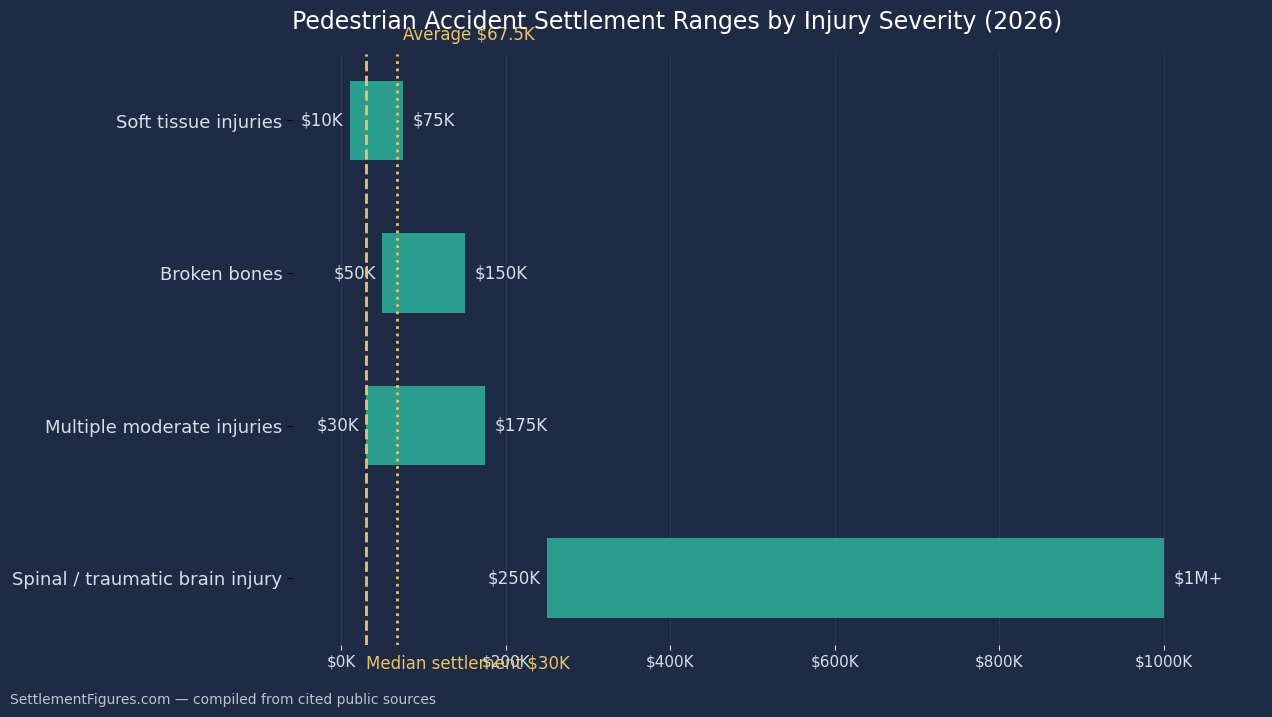
The average settlement for a pedestrian hit by a car in the U.S. is about $67,500, while the median — a better guide to the typical case — sits near $30,000, according to ConsumerShield’s 2026 analysis of pedestrian injury payouts. The gap between those two figures tells the real story: most pedestrian claims resolve in the modest five figures, while a smaller group of severe-injury cases settles for $250,000 to $1 million or more. Here is how the ranges break down by injury severity.
| Injury severity | Typical settlement range | Source |
|---|---|---|
| Soft tissue (sprains, bruising, whiplash) | $10,000 – $75,000 | Real Cost Report |
| Broken bones | $50,000 – $150,000 | Real Cost Report |
| Multiple moderate injuries | $30,000 – $175,000 | Attorney Sam (2026 data) |
| Spinal cord / traumatic brain injury | $250,000 – $1,000,000+ | Real Cost Report; Law Offices of John C. Ye |
| Wrongful death | $500,000 – $5,000,000+ | Real Cost Report |
These are compiled ranges, not promises. What your case actually pays depends on three things above all: how badly you were hurt, how clearly the driver was at fault, and how much insurance coverage exists to collect from. This guide walks through each one — and shows you where the traps are.
What the Law Says About Pedestrians and Fault
Drivers owe every pedestrian a duty of reasonable care, and at marked crosswalks the pedestrian almost always has the right of way. But the law cuts both ways: pedestrians also have duties, such as obeying walk signals and crossing where permitted. Legal publisher Nolo notes that while pedestrians can be found at fault, it is more common that the driver should have yielded.
Most states apply comparative negligence: each party is assigned a percentage of fault, and your compensation drops by your share. If you suffered $100,000 in damages and were found 20% at fault for crossing mid-block, you recover $80,000. In “modified” comparative states, crossing the 50% or 51% fault threshold bars you from recovering anything at all.
A handful of jurisdictions — Alabama, Maryland, North Carolina, Virginia and Washington, D.C. — still follow the older contributory negligence rule, under which even 1% of fault can eliminate your claim entirely, according to Nolo. If you were hit in one of these places, how fault gets argued matters more than anywhere else in the country.
One more clock is running: the statute of limitations. Most states give you two to three years from the accident to file a lawsuit, and a few allow as little as one. Claims against a government vehicle or a city (for a dangerous intersection, for example) often carry notice deadlines measured in months, not years.
What Pedestrian Cases Actually Pay — and Why They Run High
Pedestrian cases sit at the severe end of injury claims for a simple reason: there is no metal shell, no airbag and no seatbelt between you and the vehicle. NHTSA counted 7,080 pedestrian deaths and 71,635 pedestrian injuries in U.S. traffic crashes in 2024 — one injury every 7 minutes. The Maryland firm Miller & Zois reports that pedestrian collisions make up about 9% of its auto tort cases but rank among the most serious it handles.
Severe injuries drive both sides of the settlement equation. Medical bills and lost income (economic damages) climb quickly with surgeries and rehabilitation, and pain-and-suffering compensation is typically calculated as a multiple of those bills. Our guide to how the multiplier method works explains why a case with $40,000 in medical specials can reasonably demand $120,000 or more.
Context also moves numbers. NHTSA’s 2024 data shows 74% of pedestrian deaths happened in dark conditions and only 25% at intersections — facts insurers use to argue visibility and fault. Compare these ranges with average car accident settlements and you will see pedestrian cases skew higher at every severity level, precisely because the injuries are worse.
Your Options for Getting Paid
Many injured pedestrians assume the driver’s insurer is the only door to knock on. In practice there are usually several, and they can stack. Nolo and AllLaw describe the main routes:
| Option | When it applies | What it covers |
|---|---|---|
| Driver’s liability insurance | Driver at fault (fully or partly) | Medical bills, lost wages, pain and suffering — up to policy limits |
| Personal injury protection (PIP) | No-fault states; often covers you as a pedestrian | Medical bills and part of lost wages, regardless of fault |
| MedPay (your own auto policy) | If you carry it — even though you were on foot | Medical bills up to the MedPay limit |
| Uninsured/underinsured motorist (UM/UIM) | Hit-and-run or driver with no/low coverage | Steps into the shoes of the missing liability coverage |
| Health insurance | Always, as a backstop | Treatment now; the insurer may claim reimbursement from your settlement |
| Personal injury lawsuit | When the insurer won’t pay fairly | Full damages, decided by a jury if needed |
Two of these deserve special attention. First, PIP and MedPay pay quickly and regardless of fault — use them to keep treatment going. Second, your own UM/UIM coverage is often the only real source of money in a hit-and-run: NHTSA reports that 1 in 4 pedestrians killed in 2024 was struck by a hit-and-run driver.
On timing: straightforward pedestrian claims tend to resolve within 6 to 12 months after treatment ends, while disputed-fault or severe-injury cases commonly run 12 to 24 months, according to Brown & Crouppen. The rhythm mirrors what we describe in how long car accident settlements take — the clock starts in earnest only once your medical picture is stable.
Red Flags When the Insurer Calls
Insurance adjusters work pedestrian claims hard because the exposure is large. Watch for these patterns:
- An early lowball offer. A check offered before your treatment is finished is priced on incomplete information — and accepting it closes the claim forever.
- The jaywalking narrative. Attorneys report that insurers routinely argue the pedestrian was fully at fault to shrink or deny payouts, even where the driver was speeding or distracted. Partial fault reduces a claim; it rarely eliminates it outside contributory-negligence states.
- Recorded statement requests. You are generally not required to give the other driver’s insurer a recorded statement, and casual phrasing (“I’m fine”, “I didn’t see the car”) gets used against you.
- Blanket medical authorizations. Signing one lets the insurer fish through your entire medical history for pre-existing conditions to blame.
- Unexplained delay. Slow-walking a clear-liability claim can pressure you into accepting less as bills pile up.
The best protection is built in the first days: police report, photos, witness contacts and prompt medical care. The same evidence checklist in our guide on what to do after a car accident applies almost point for point when you are the pedestrian.
What Increases — and What Caps — a Pedestrian Settlement
Within the ranges above, certain facts reliably push a pedestrian case toward the top. A collision inside a marked crosswalk, a driver cited for speeding, impairment or phone use, and camera or witness evidence all strengthen liability. On the damages side, surgery, permanent impairment, visible scarring and documented lost earning capacity raise both the economic total and the multiplier applied to it.
The opposite facts pull cases down: gaps in medical treatment, a pedestrian outside the crosswalk at night in dark clothing, pre-existing conditions in the same body region, and any recorded statement that softens the injury story. None of these usually kills a claim — but each one hands the adjuster a percentage-of-fault argument, and every percentage point comes straight out of the payout.
Then there is the ceiling almost nobody mentions: policy limits. In many states drivers can legally carry as little as $25,000 in bodily-injury liability per person, per the Insurance Information Institute. A catastrophic injury worth $500,000 on paper cannot collect more than the coverage that exists — which is why serious cases hunt for additional defendants (an employer if the driver was working, a commercial fleet, sometimes a municipality for a dangerously designed road) and why your own UM/UIM coverage matters so much.
Commercial-vehicle defendants change the math entirely. When Miller & Zois documented a case in which a company-owned truck struck two pedestrians on a California sidewalk, the claim settled for $1,000,000 — a figure that reflects commercial policy limits far above personal ones. If the vehicle that hit you had a logo on the door, the available coverage is almost certainly larger than a private driver’s.
Where to Get Help
Severe injuries, disputed fault, a hit-and-run driver, or any accident in a contributory-negligence state are strong signals to at least consult a personal injury attorney — most work on contingency and offer free consultations. For smaller, clear-liability claims with full recovery, some people negotiate directly using the documentation habits above. Either way, the free official resources below cost you nothing.
A note on cost, because it stops many people from picking up the phone: personal injury lawyers in pedestrian cases almost universally work on contingency, meaning the fee — typically 33% to 40% of the recovery, per Nolo — is paid only if the case wins. You pay nothing up front, and consultations are free, so getting a case evaluated costs you an hour, not a retainer. Whether the fee is worth it usually comes down to case size: on severe injuries, represented claimants routinely net more even after fees.
Free official help & resources
- NHTSA — Pedestrian Safety · Vehicle Safety Hotline: 1-888-327-4236
- CDC — Transportation Safety · CDC-INFO: 1-800-232-4636
- NAIC Consumer Resources — file a complaint against an insurer through your state insurance department
- Legal Services Corporation — find free legal aid near you if you qualify by income
- ABA Free Legal Answers — ask a volunteer lawyer a question at no cost
- 211 — dial 211 for local help with medical bills, transport and recovery support
Frequently Asked Questions
What is the average payout for a pedestrian hit by a car?
About $67,500 on average, with a median near $30,000, per ConsumerShield’s 2026 data. Soft-tissue cases commonly land between $10,000 and $75,000, while spinal cord and brain injury cases can exceed $1 million.
Who pays your medical bills after a pedestrian accident?
Immediately: your health insurance, PIP (in no-fault states) or MedPay. Ultimately: the at-fault driver’s liability insurer through your settlement, which may also reimburse your health insurer. In a hit-and-run, your own UM coverage takes the driver’s place.
Can a pedestrian be at fault for a car accident?
Yes. Crossing against a signal, stepping out mid-block or walking where prohibited can assign a pedestrian part — occasionally all — of the fault. In most states partial fault only reduces compensation proportionally; it does not eliminate it.
Can a pedestrian still get compensation after being hit while jaywalking?
Usually yes, in comparative-negligence states — the award is cut by your fault percentage, and barred only if you exceed the state’s 50% or 51% threshold. In Alabama, Maryland, North Carolina, Virginia and D.C., any pedestrian fault can block recovery entirely.
How long does a pedestrian accident settlement take?
Commonly 6 to 12 months after treatment is complete for clear-liability cases, and 12 to 24 months when fault is disputed or injuries are complex, per Brown & Crouppen. Litigation can extend that further.
What if the driver who hit you fled the scene?
Report it to police immediately, then look to your own uninsured motorist (UM) coverage or a resident family member’s policy. NHTSA data shows 24% of pedestrian deaths in 2024 involved hit-and-run drivers, so insurers handle these claims constantly — treat yours with the same documentation rigor as any other.
☕ This research is reader-supported. No law firm pays us. If this guide saved you time or money, you can buy the research team a coffee — it keeps the data free and updated.
This article is for informational purposes only and is not legal advice. Settlement values vary significantly by case and by state. Consult a licensed attorney in your state before making decisions about your claim.
