Last updated: August 5, 2026 · Data reviewed quarterly
Most car accident settlements in Georgia fall between $3,000 and $75,000, with minor-injury claims typically resolving for $3,000–$15,000 and moderate injuries for $20,000–$75,000, according to a 2026 analysis by Atlanta’s Weatherby Law Firm. For national context, the Insurance Information Institute (III) reports the average U.S. bodily injury liability claim reached $28,278 in 2024, with property damage claims averaging $6,770. Where your claim lands inside — or well above — these ranges depends on three things: how badly you were hurt, how much insurance exists, and Georgia’s fault rules.
| Injury type | Typical Georgia settlement range |
|---|---|
| Whiplash / minor soft tissue | $3,000 – $15,000 |
| Back & neck injury (non-surgical) | $10,000 – $35,000 |
| Broken bones / fractures | $15,000 – $75,000 |
| Concussion / mild TBI | $20,000 – $80,000 |
| Back & neck injury (surgery required) | $50,000 – $200,000+ |
| Catastrophic injury / wrongful death | $250,000 – $1,000,000+ |
Georgia State Snapshot: Three Rules That Frame Every Claim
Before you talk numbers with an adjuster, three pieces of Georgia law set the boundaries of your claim. They decide how long you have, whether you can recover at all, and how much money is realistically on the table.
| Rule | What Georgia law says |
|---|---|
| Statute of limitations | 2 years from the crash for injury claims; 4 years for vehicle damage (O.C.G.A. § 9-3-33) |
| Fault system | At-fault state with modified comparative negligence — recovery barred at 50% fault (O.C.G.A. § 51-12-33) |
| Minimum liability insurance | $25,000 per person / $50,000 per accident for bodily injury; $25,000 property damage (O.C.G.A. § 33-7-11) |
Georgia is an at-fault state, not a no-fault state. That means you pursue the at-fault driver’s liability insurer directly for medical bills, lost wages, vehicle damage, and pain and suffering — there is no personal injury protection (PIP) layer like Florida’s.
The comparative negligence rule has real teeth. If you were 20% at fault for the crash, your payout drops 20%. Reach 50% fault and you recover nothing at all, per O.C.G.A. § 51-12-33. Adjusters know this, which is why recorded statements so often probe for anything that shifts blame onto you.
The state’s 25/50/25 minimum limits quietly cap many claims. If a minimum-coverage driver causes $60,000 in medical bills, their insurer owes at most $25,000 — the rest comes from your own uninsured/underinsured motorist coverage, if you bought it, or from the driver personally, which rarely pays.
Georgia gives UM coverage unusual weight. Under O.C.G.A. § 33-7-11, insurers must offer it with every policy, and you can only decline it in writing. If you carry “add-on” UM, it stacks on top of the at-fault driver’s limits; “reduced-by” UM only fills the gap up to your own limit. Which type you have can swing a serious claim by tens of thousands of dollars, so pull your declarations page before you negotiate anything.
The First 30 Days: Moves That Protect Your Number
Georgia law requires drivers to report any crash involving injury, death, or property damage of $500 or more to police immediately (O.C.G.A. § 40-6-273). In practice, nearly every real accident clears that bar — so call, and get the responding officer’s report number before leaving the scene.
See a doctor within days, not weeks, even if you feel roughly fine. Whiplash, disc injuries, and concussions routinely surface late, and Georgia adjusters treat every day between crash and first treatment as evidence you weren’t really hurt. Then keep every appointment: treatment gaps are the single most common reason otherwise strong Georgia claims settle low.
Photograph vehicles, the scene, and visible injuries; save witness contacts; and be careful with the other driver’s insurer. You must notify your own insurance company promptly under most policies, but you are not obligated to give the at-fault carrier a recorded statement — and under the comparative fault rule, a stray sentence can cost you a percentage of your payout.
Average Settlement Amounts in Georgia
No government agency publishes official settlement averages, so honest figures come from insurer claim data and law firm case analyses. The III’s 2024 national figures — $28,278 for the average bodily injury claim, $6,770 for property damage — line up closely with independent crash-data firm CCC, which reported an average injury payout of $27,373 in late 2024. Georgia firm data tells the same story with more detail.
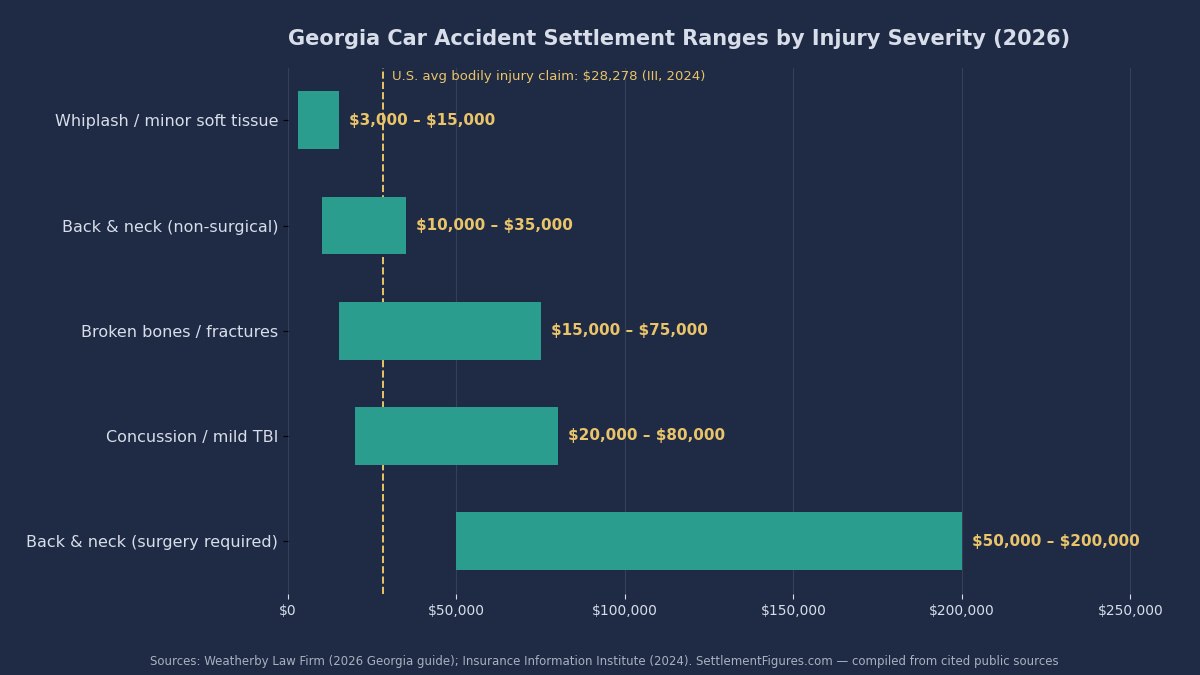
The pattern in the chart matches what we see in national settlement averages: severity drives value more than any other factor. A soft-tissue claim with two months of chiropractic care sits at the bottom of the scale. Add a herniated disc confirmed by MRI and the range triples. Add surgery and it can multiply tenfold.
Beyond severity, Georgia claims rise with clear liability evidence, consistent medical treatment, documented lost income, and permanent impairment ratings. They shrink with treatment gaps, shared fault, pre-existing conditions the insurer can point to, and — most brutally — low policy limits.
For the non-economic side, most Georgia adjusters still start from your economic damages and apply a severity factor. Our guide to how the pain and suffering multiplier works explains the math insurers rarely show you.
A simplified illustration shows how the pieces combine. Say a rear-end crash leaves you with $18,000 in medical bills and $4,000 in lost wages: $22,000 in economic damages. Applying a modest 1.5–2x factor for pain and suffering suggests a claim value around $33,000–$44,000 — before fault adjustments. If the adjuster pins 25% of the blame on you, the realistic range drops to roughly $25,000–$33,000. Real cases are messier, but this is the arithmetic running underneath every offer.
Georgia Laws That Change Your Payout in 2026
Georgia’s settlement landscape shifted more in 2025 than in the previous two decades. Senate Bill 68, the sweeping tort reform package Governor Kemp signed in April 2025, rewrote several rules that directly affect what crash victims recover, according to analyses by international insurance firm Kennedys Law and Georgia trial firms including Jarrett & Price.
First, medical damages are now anchored to amounts actually paid, not amounts billed. Before SB 68, a $40,000 hospital bill could support $40,000 in claimed damages even if insurance settled it for $12,000. Juries now see the paid figure — a change insurers already use to justify lower offers on medical specials.
Second, the long-standing “seat belt gag rule” is gone. Evidence that you weren’t wearing a seat belt is now admissible on fault and causation, which can push your comparative negligence percentage up — dangerous in a state that cuts you off entirely at 50%.
Third, SB 68 restricts “anchoring”: plaintiff attorneys can no longer suggest arbitrary large sums for pain and suffering to juries, and any figure argued must tie to the evidence. Defendants can also split trials into separate fault and damages phases. Kennedys Law notes the provisions apply to pending and future lawsuits alike.
One piece of good news survives all this: money you receive for physical injuries — including the pain and suffering tied to them — is not taxable income under IRS rules explained in Publication 4345. Punitive damages and post-judgment interest are the taxable exceptions, per Nolo’s tax analysis.
A Realistic Settlement Timeline in Georgia
Most Georgia car accident claims settle within 3 to 18 months, according to Atlanta’s Wetherington Law Firm. Simple cases with clear liability and finished treatment tend to close in 3 to 6 months; moderate to serious injury claims usually need 6 to 18 months, per Weatherby Law Firm’s 2026 timeline data.
The clock has fixed early milestones. Georgia insurance regulations require insurers to acknowledge your claim within 15 business days. Once your attorney sends a demand letter, insurers typically take 30 to 60 days to investigate and respond, according to Ross Moore Law’s settlement timeline analysis.
Cases that enter litigation stretch to 1 to 3 years. That is sometimes worth it: filing suit is often what forces a realistic offer, especially in disputed-fault or policy-limits cases. The stage-by-stage mechanics work the same way across states — our breakdown of how long car accident settlements take covers each phase and what speeds it up.
One deadline outranks everything: the 2-year statute of limitations. Settle too early and you may sign away injuries that haven’t fully declared themselves; wait past two years and you lose leverage entirely, because the insurer knows you can no longer sue.
Watch for two warning signs along the way. An unusually fast, unusually friendly offer in the first weeks usually means the adjuster sees exposure and wants your signature before the full injury picture develops. And months of silence, repeated document re-requests, or a new adjuster every call can signal delay tactics — conduct that, in extreme cases, edges toward bad faith.
If your crash happened elsewhere, the rules change meaningfully at state lines — compare Georgia’s system with our guides to car accident settlements in Florida and car accident settlements in Texas.
Free official help & resources
- Georgia Office of Commissioner of Insurance and Safety Fire — file a complaint about an insurer: oci.georgia.gov · 1-800-656-2298
- NAIC consumer insurance help: content.naic.org/consumer
- Georgia Legal Aid — free legal information for Georgians: legalaid-ga.org
- Legal Services Corporation — find free legal aid near you: lsc.gov
- ABA Free Legal Answers — ask a volunteer lawyer online: freelegalanswers.org
- IRS Publication 4345 — how settlements are taxed: irs.gov/pub/irs-pdf/p4345.pdf
- Dial 211 for local help with medical bills, food, and transportation while you recover
Frequently Asked Questions
What is the average car accident settlement in Georgia?
There is no single official average. Most Georgia cases resolve between $3,000 and $75,000 depending on injury severity, per Weatherby Law Firm’s 2026 analysis, while the III reports the average U.S. bodily injury claim at $28,278 (2024). Severe-injury and wrongful death cases regularly exceed $250,000.
Is Georgia a no-fault state for car accidents?
No. Georgia is an at-fault state: the driver who caused the crash — through their liability insurer — pays for the harm. You file against their policy rather than claiming first from your own, and you can pursue pain and suffering without meeting an injury threshold.
How long does a car accident settlement take in Georgia?
Straightforward cases settle in 3 to 6 months; moderate to serious injury claims usually take 6 to 18 months, per Weatherby Law Firm. Litigation extends that to 1–3 years. The biggest driver is medical treatment: sensible claimants wait until doctors can state the full extent of injuries.
What is the statute of limitations for a car accident claim in Georgia?
Two years from the date of the crash for injury claims, and four years for property damage, under O.C.G.A. § 9-3-33. Miss the deadline and courts will almost always dismiss the case, which also destroys your negotiating leverage with the insurer.
How much do car accident lawyers charge in Georgia?
Nearly all work on contingency: no upfront fee, and the lawyer keeps a percentage of the recovery — commonly around 33% if the case settles before suit and up to about 40% if litigation is required, per Nolo. You owe nothing if there is no recovery, though case costs may be deducted separately.
Do I have to pay taxes on a car accident settlement in Georgia?
Generally no. Compensation for physical injuries — medical bills, pain and suffering tied to those injuries, and related lost wages — is excluded from income under the IRS rules in Publication 4345. Punitive damages and interest are taxable, and emotional distress unconnected to physical injury can be too, per Nolo.
☕ This research is reader-supported. No law firm pays us. If this guide saved you time or money, you can buy the research team a coffee — it keeps the data free and updated.
This article is for informational purposes only and is not legal advice. Settlement values vary significantly by case and by state. Consult a licensed attorney in your state before making decisions about your claim.
