Last updated: July 18, 2026 · Data reviewed quarterly
Most Florida car accident settlements fall between $5,000 and $100,000, with minor soft-tissue claims sitting near the bottom and serious-injury cases climbing past $250,000, based on 2026 ranges reported by Florida injury firms and ConsumerShield. Before any of that, Florida’s no-fault system routes your first $10,000 in medical bills through your own Personal Injury Protection (PIP) policy, no matter who caused the crash. What your claim is ultimately worth comes down to four things: how badly you were hurt, what your treatment costs, who was at fault, and how much insurance is available to pay.
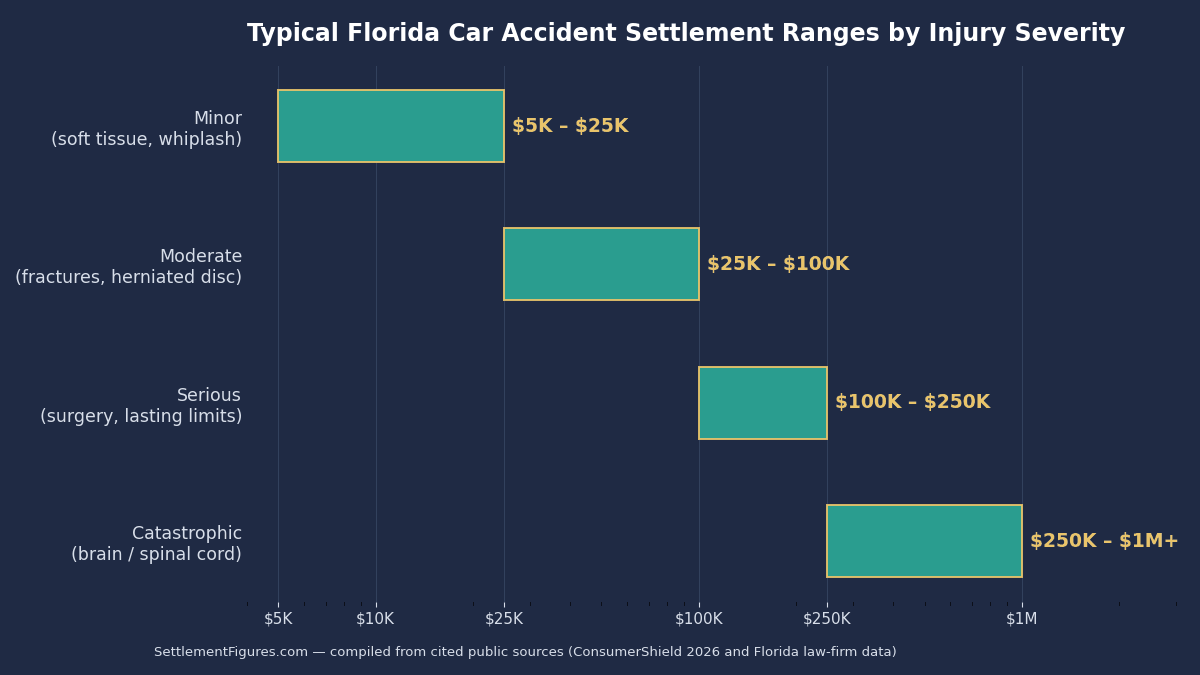
Florida Settlement Ranges by Injury Severity
| Injury severity | Typical Florida settlement range |
|---|---|
| Minor — soft-tissue, whiplash, no surgery | $5,000 – $25,000 |
| Moderate — fractures, herniated disc, concussion | $25,000 – $100,000 |
| Serious — surgery, lasting limitation | $100,000 – $250,000 |
| Severe / catastrophic — traumatic brain injury, spinal cord, paralysis | $250,000 – $1,000,000+ |
The table shows why a single “average” can mislead. Minor claims are the most common, so they pull any headline average down, while a smaller group of catastrophic cases sits far above it. Read the row that matches your situation rather than the overall average, and remember that two people with the same diagnosis can still settle for very different amounts depending on fault and available coverage.
Florida Car Accident Claim Snapshot
Three Florida rules shape almost every claim: how long you have to act, how fault is split, and what insurance the law requires. Here is the short version before the detail.
| Rule | What Florida says |
|---|---|
| Deadline to sue (statute of limitations) | 2 years from the crash date for negligence claims accruing on or after March 24, 2023 — Fla. Stat. § 95.11(5)(a), as amended by HB 837 |
| Fault system | Modified comparative negligence; you recover nothing if you are found more than 50% at fault — Fla. Stat. § 768.81(6) |
| Minimum insurance | $10,000 PIP + $10,000 property damage liability (PDL). Bodily injury liability is not required for most private drivers — Florida Dept. of Highway Safety and Motor Vehicles (FLHSMV) |
Each of these can move your payout up or down before anyone talks numbers. Florida also works differently from a traditional at-fault state; if you want that contrast, our Texas car accident settlement guide walks through a pure fault system side by side.
Is Florida Still a No-Fault State in 2026?
Yes. Despite a wave of headlines and repeal bills, Florida remains a no-fault state in 2026. The Legislature’s 2026 session ended in March without passing a PIP repeal, and Insurance Journal confirmed in May 2026 that lawmakers did not end the no-fault law. So the rules below still apply to your crash today.
No-fault means your own PIP coverage pays first, regardless of who caused the crash. Per FLHSMV and Fla. Stat. § 627.736, PIP covers 80% of reasonable medical bills and 60% of lost wages, up to a $10,000 limit. Two conditions matter most. First, you must get initial medical care within 14 days of the crash, or you forfeit PIP benefits entirely. Second, the full $10,000 is available only if a qualified provider certifies an “emergency medical condition” (EMC); without that finding, your medical benefits cap at just $2,500.
PIP is also where most settlements stop for minor injuries. To step outside no-fault and pursue the at-fault driver for pain and suffering, your injury must cross Florida’s serious-injury threshold in Fla. Stat. § 627.737(2): a permanent injury, significant and permanent scarring or disfigurement, significant loss of an important bodily function, or death. Meet that threshold and your claim opens up to non-economic damages; fall short and you are generally limited to your PIP and property-damage recovery.
What Settlements Actually Pay in Florida
No state agency publishes an official “average Florida settlement,” so every figure you see is compiled from insurer and law-firm reporting rather than a public registry. Some 2026 law-firm analyses put the average Florida car accident settlement near $77,000 — well above the roughly $30,000 national average reported by ConsumerShield — but that number blends a handful of large payouts with many smaller claims, which is exactly why ranges are more honest than a single average.
For the most common crashes, the numbers are more modest. ConsumerShield’s 2026 data puts the average soft-tissue injury settlement at about $17,500, with most landing between $2,500 and $50,000. In Florida specifically, minor soft-tissue and whiplash claims generally run $5,000 to $25,000, according to published Florida firm data.
A settlement is built from two kinds of damages. Economic damages are the receipts: medical bills, future treatment, lost wages, and vehicle repair. Non-economic damages cover pain, physical limitation, and loss of enjoyment, and they are harder to price. Many claims estimate them with a multiplier applied to the medical bills, which we break down in our guide to the pain and suffering multiplier method. Clear liability, consistent medical treatment, and a policy large enough to cover your losses all push a settlement toward the top of its range; gaps in treatment, disputed fault, and a minimum-limits policy pull it toward the bottom.
Florida Laws That Change Your Payout
The two-year deadline. Under Fla. Stat. § 95.11(5)(a), as amended by HB 837, you generally have two years from the crash date to file a lawsuit for negligence — down from the four years that applied before March 24, 2023. Settle or file before that date. Miss it and the insurer has little reason to negotiate, because your right to sue is almost always gone.
The 51% bar. HB 837 moved Florida from pure to modified comparative negligence. Under Fla. Stat. § 768.81(6), your damages are reduced by your share of fault, and if you are found more than 50% at fault, you recover nothing. If your damages are $100,000 and you are 30% responsible, you collect $70,000; if a jury puts you at 51%, you collect nothing. This is why insurers work hard to shift blame onto you, and why documentation of the other driver’s fault matters so much.
Thin coverage and the UM gap. Florida does not require most drivers to carry bodily injury liability at all, and it has one of the nation’s highest uninsured-driver rates. When the at-fault driver has little or no coverage, your own uninsured/underinsured motorist coverage is often what actually pays — and it applies to hit-and-run crashes too. Our guide to how uninsured/underinsured motorist claims work breaks down what those claims pay.
How Long a Florida Settlement Takes
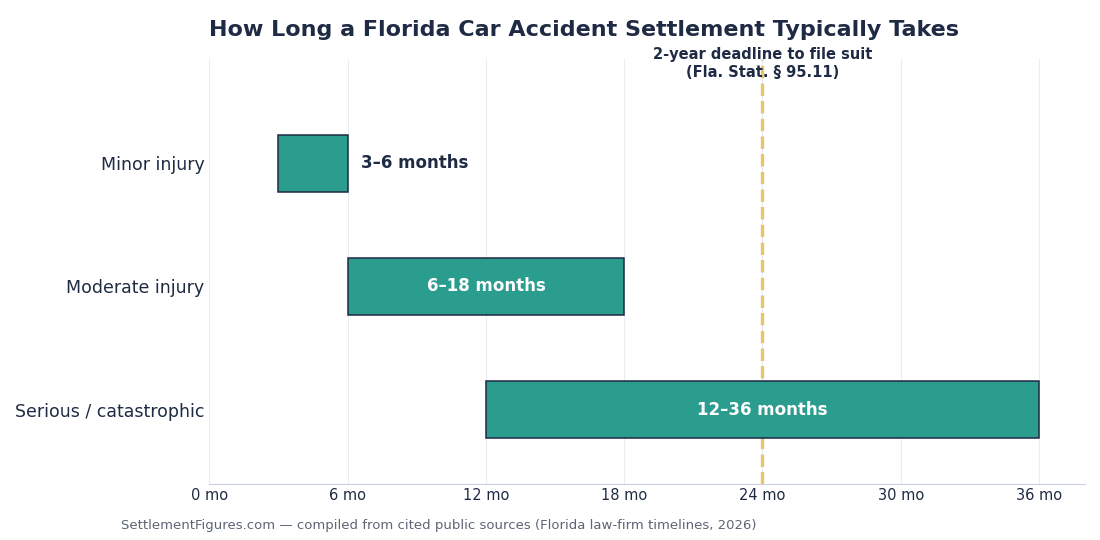
Florida firms that publish case data generally put the timeline at 3 to 18 months. Minor-injury claims often resolve in 3 to 6 months, moderate injuries in 6 to 18 months, and serious or catastrophic cases in 1 to 3 years, especially once a lawsuit is filed. The single biggest factor is your health: most lawyers wait until you reach maximum medical improvement (MMI), the point where your condition has stabilized, before sending a demand. Settling earlier risks leaving future treatment costs uncovered.
Once you agree on a number, expect another 30 to 60 days to actually receive the check while the insurer processes payment and any medical liens are resolved. Cases slow down when liability is disputed, when injuries require surgery, when several drivers or insurers are involved, or when a minimum-limits policy forces a fight over every dollar. For the mechanics of each stage, see our full guide to how long a car accident settlement takes.
Free official help & resources
- Florida Dept. of Financial Services — Insurance Consumer Helpline — questions or complaints about an auto insurer, agent, or adjuster. Call 1-877-693-5236 · myfloridacfo.com/division/consumers
- The Florida Bar Lawyer Referral Service — a matched referral plus a 30-minute consult for no more than $25. Call 800-342-8011 · floridabar.org/public/lrs
- FLHSMV — Florida Insurance Requirements — official explanation of PIP, PDL, and proof of coverage · flhsmv.gov/insurance
- The Florida Bar — Consumer Pamphlet: Automobile Insurance — free, plain-English guide to your coverage and claims · floridabar.org/public/consumer/tip002
- 2-1-1 — free referrals for medical care, transportation, and financial help after an injury. Dial 211 · 211.org
- Insurance Information Institute (III) — neutral consumer guides on filing and settling auto claims · iii.org
If your crash happened out of state, note that the rules shift dramatically: our guide to car accident settlements in New York covers the no-fault system and the 2026 reforms that now decide who can sue for pain and suffering at all.
Frequently Asked Questions
What is the average car accident settlement in Florida?
There is no official state average. Some 2026 law-firm analyses estimate roughly $77,000, but that figure is skewed by a few large payouts. Most claims track the injury: minor soft-tissue cases run $5,000 to $25,000, moderate injuries $25,000 to $100,000, and serious or catastrophic cases $250,000 and up. The range that matches your injury is a better guide than any single average.
Is Florida still a no-fault state in 2026?
Yes. Repeal bills were filed but did not pass, and the 2026 legislative session ended without ending no-fault. Your own PIP coverage still pays the first $10,000 of medical bills and lost wages regardless of fault, and you must seek care within 14 days to keep those benefits.
How long does a car accident settlement take in Florida?
Most claims resolve in 3 to 18 months. Minor injuries can settle in 3 to 6 months, moderate injuries in 6 to 18 months, and serious cases in 1 to 3 years. Reaching maximum medical improvement, disputed fault, surgery, and multiple insurers are the main things that lengthen it, and payment usually arrives 30 to 60 days after you agree on a number.
Can I still recover money if I was partly at fault in Florida?
Yes, as long as you are 50% or less at fault. Under Fla. Stat. § 768.81(6), your damages are reduced by your percentage of fault, but you are barred from recovering anything once your share exceeds 50%. This modified comparative negligence rule took effect with HB 837 in 2023.
How long do I have to file a car accident claim in Florida?
Two years from the date of the crash for negligence claims accruing on or after March 24, 2023, under Fla. Stat. § 95.11(5)(a). Insurance claims can and should start much sooner, but the two-year mark is the hard deadline to file a lawsuit if negotiations stall.
Do I need a lawyer to settle a car accident claim in Florida?
Not always. Minor, clear-fault claims with full recovery are often handled directly with the insurer, and most injury lawyers work on contingency, so there is no upfront cost. Serious injuries, disputed fault, or a low policy limit are the situations where representation tends to matter most. Our guide on settling a car accident claim without a lawyer covers when it makes sense to go it alone.
Crash just across the state line instead? Georgia runs a very different system — pure at-fault with no PIP layer, plus 2025 tort reform that reshaped payouts. See our guide to car accident settlements in Georgia for its ranges, deadlines and fault rules.
☕ This research is reader-supported. No law firm pays us. If this guide saved you time or money, you can buy the research team a coffee — it keeps the data free and updated.
This article is for informational purposes only and is not legal advice. Settlement values vary significantly by case and by state. Consult a licensed attorney in your state before making decisions about your claim.
