Last updated: August 10, 2026 · Data reviewed quarterly
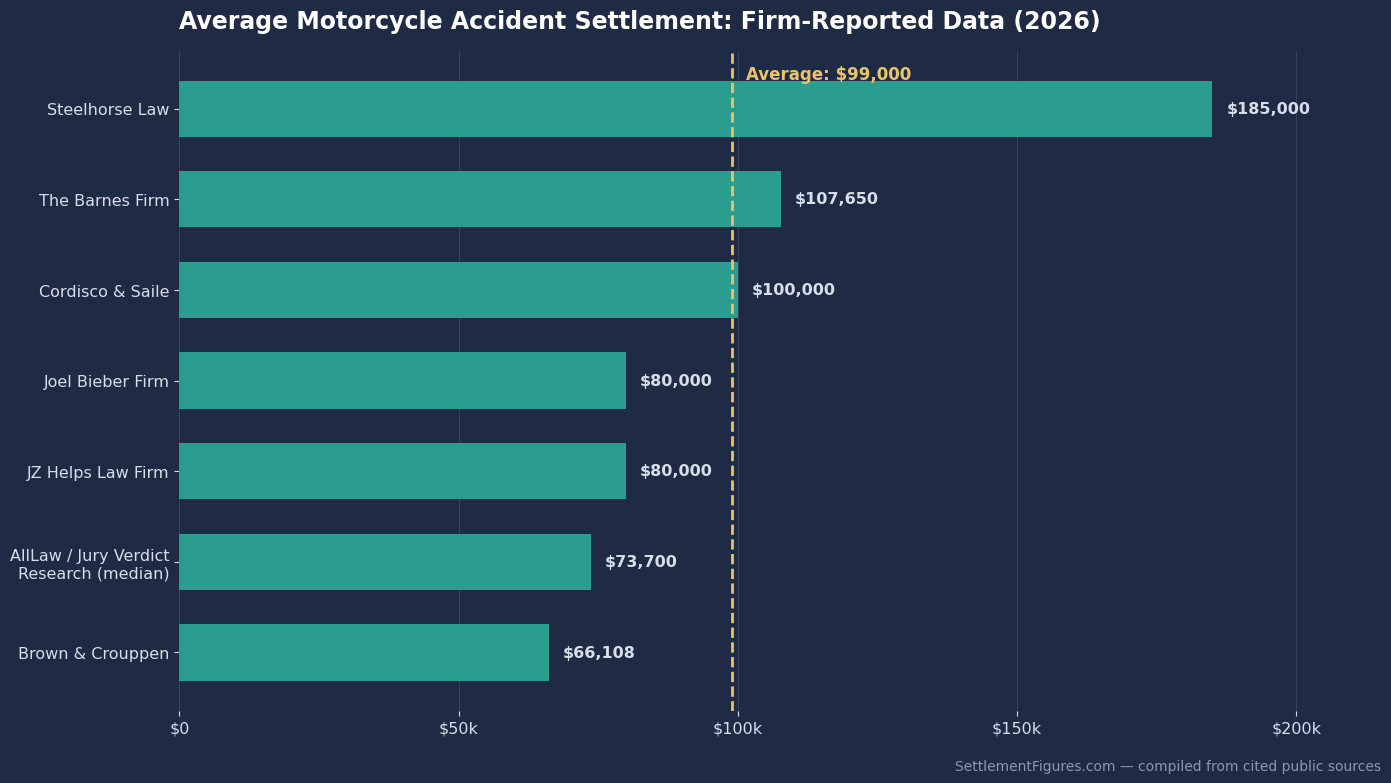
The average motorcycle accident settlement in the United States is $99,000, according to ConsumerShield’s August 2026 analysis of payout data reported by seven law practices. Firm-reported averages run from $66,000 to $185,000, while the median motorcycle injury verdict sits near $73,700, according to Jury Verdict Research figures published by AllLaw. Your claim can land far from any average — injury severity, fault, and the insurance actually available decide the number. The table below shows how wide the honest range really is.
| Injury severity | Typical settlement range | Source |
|---|---|---|
| Road rash / minor soft tissue | $10,000 – $50,000 | SetCalc; Wetherington Law Firm |
| Broken bones without surgery | $30,000 – $100,000 | SetCalc |
| Fractures requiring surgery | $50,000 – $100,000+ | Brown & Crouppen |
| Concussion, herniated disc | $50,000 – $250,000 | Wetherington Law Firm |
| Traumatic brain injury | $100,000 – $1,000,000+ | SetCalc |
| Spinal cord injury / amputation | $500,000 – $5,000,000+ | SetCalc; Wetherington Law Firm |
What Real Settlements Look Like
Averages and medians tell two different stories. A handful of catastrophic cases — brain injuries, amputations, wrongful death — pull the average up toward six figures. The median is the more honest yardstick for a typical rider: half of all motorcycle injury verdicts resolve below roughly $73,700, per Jury Verdict Research.
The firm-level data behind the $99,000 average shows the spread. Brown & Crouppen reports an average of $66,108 across its cases. AllLaw cites $73,700. JZ Helps and the Joel Bieber Firm each report $80,000. Cordisco & Saile reports $100,000, The Barnes Firm $107,650, and Steelhorse Law — a motorcycle-only practice — $185,000 (all compiled by ConsumerShield, August 2026).
For context, motorcycle payouts run roughly three times higher than car accident payouts. The average car accident injury settlement is $28,750 per ConsumerShield’s July 2026 data, and SetCalc places the typical car range at $25,000–$40,000. Severity explains the gap — see how the numbers compare in our guide to average car accident settlement amounts.
The Formula Insurers Use
Adjusters start with your economic damages: medical bills, projected future treatment, lost income, and the bike itself. They then apply a multiplier — typically 1.5 to 5 — to estimate pain and suffering, with permanent or disfiguring injuries earning the high end. We break down how that works in our guide to the multiplier method.
Motorcycle claims start from bigger numbers because the injuries are objectively worse. Per vehicle mile traveled, motorcyclists are almost 27 times more likely to die in a crash and nearly 5 times more likely to be injured than passenger-car occupants, according to NHTSA data. No steel frame, no airbags — the medical bills reflect that.
What Increases a Motorcycle Settlement
Three things reliably push value up. First, documented severity: surgery, hardware, a permanent impairment rating, or a doctor’s written work restrictions. Second, clean liability — a rider rear-ended at a stop has far more leverage than one hit in a disputed lane change. Third, insurance depth: the at-fault driver’s limits plus your own uninsured/underinsured motorist (UM/UIM) coverage set the practical ceiling on any payout.
Paper wins claims. Keep every bill, imaging report, pay stub, and out-of-pocket receipt, and follow your treatment plan without gaps — adjusters read a missed month of physical therapy as proof you healed.
What Decreases It
Comparative negligence is the big one. If the insurer pins 30% of the fault on you, your payout drops 30% — and in states with a modified rule, crossing the 50% or 51% threshold bars recovery entirely. Insurers know jurors sometimes assume riders were speeding or weaving, and they price that bias into offers.
Helmet use matters in a specific way. In states that require helmets, riding without one lets the defense argue your head injuries were partly self-inflicted — but that argument only touches head-injury damages, and the insurer must actually prove a helmet would have helped. Broken bones and internal injuries are unaffected, a point law firms including Steelhorse Law and G. Aldrich Law make consistently. Low policy limits and treatment gaps do the rest of the damage.
Do You Need a Lawyer?
Not always. A rider with road rash, a clearly at-fault driver, and a few thousand dollars in bills can often self-negotiate a fair result — our guide to settling without a lawyer explains when that makes sense.
The calculus flips once surgery, disputed fault, or a serious injury enters the picture. Contingency representation typically costs 33–40% of the recovery, so the question is whether an attorney can move the offer by more than the fee — in catastrophic motorcycle cases, where insurers defend hardest, they usually can. Most offer free consultations, so pricing that decision costs nothing.
State Differences
Where you crashed changes the math three ways. Helmet laws: 18 states and D.C. require helmets for every rider, per the Insurance Institute for Highway Safety, and non-use in those states invites the damage argument above. Fault rules: California and New York apply pure comparative fault, while Florida moved to a modified 51% bar in 2023 and Georgia cuts recovery off at 50%. Deadlines: statutes of limitations run two to four years — our California guide covers the two-year rule that trips up the most riders.
Free official help & resources
- NHTSA — Motorcycle Safety: nhtsa.gov/road-safety/motorcycles · Vehicle Safety Hotline: 1-888-327-4236
- Your state insurance department (complaints about claim handling): content.naic.org/consumer
- Legal Services Corporation — find free legal aid near you: lsc.gov
- ABA Free Legal Answers — ask a volunteer lawyer at no cost: freelegalanswers.org
- IRS Publication 4345 — when settlement money is taxable: irs.gov/pub/irs-pdf/p4345.pdf
- 211 — dial 211 for local help with medical bills and transportation while you recover
Motorcyclists share a hard legal reality with other unprotected road users: with no metal shell, injuries — and therefore claim values — run higher at every crash speed. The same dynamic shapes pedestrian accident settlements, where severity-based ranges look strikingly similar to motorcycle cases.
Frequently Asked Questions
What is the average motorcycle accident settlement?
About $99,000, per ConsumerShield’s August 2026 compilation of seven firms’ reported averages ($66,000–$185,000). SetCalc’s 2026 guide estimates $85,000. Both figures sit far above typical car accident payouts.
How much are most motorcycle accident settlements?
Most cases resolve between $10,000 and $100,000, according to Brown & Crouppen’s case data. The median verdict of roughly $73,700 (Jury Verdict Research) confirms that half of riders recover less than that — the multimillion-dollar results you see advertised are outliers.
How long does a motorcycle accident settlement take?
Straightforward claims with completed treatment often settle in a few weeks to a few months, per ConsumerShield. Disputed fault or catastrophic injuries push cases into litigation, where resolution can take a year or more.
Why are motorcycle settlements higher than car accident settlements?
Injury severity. NHTSA data shows motorcyclists are almost 27 times more likely to die per mile traveled and about 5 times more likely to be injured, so medical costs — the base of every settlement formula — start much higher.
Does not wearing a helmet reduce my settlement?
It can, but only for head injuries, and only where the defense proves a helmet would have made a difference. In states without a universal helmet law, the argument is weaker still. Injuries to your spine, limbs, or organs are valued the same either way.
Should I accept the insurance company’s first offer?
Treat the first number as an opening position, not a verdict. Initial offers routinely arrive before your treatment costs are final, and accepting one waives every future claim tied to the crash. Compare the offer against your documented economic damages and the ranges above, get any long-term prognosis in writing first, and remember that a signed release is permanent — you cannot reopen the claim if your injury turns out worse than expected.
☕ This research is reader-supported. No law firm pays us. If this guide saved you time or money, you can buy the research team a coffee — it keeps the data free and updated.
This article is for informational purposes only and is not legal advice. Settlement values vary significantly by case and by state. Consult a licensed attorney in your state before making decisions about your claim.
