Last updated: August 12, 2026 · Data reviewed quarterly
Work-related hearing loss is one of the most common — and least claimed — permanent injuries in American workplaces. Most workers’ comp hearing loss claims involving measurable, permanent loss pay $10,000 to $30,000, according to Workers Compensation Experts, while serious both-ear cases average $30,000 to $120,000 per Matt Fendon Law Group. Federal NIOSH researchers put the average insurer cost per compensated claim near $12,000. Three inputs decide your number: your measured impairment percentage, your state’s scheduled-award chart, and your average weekly wage.
| Severity of hearing loss | Typical payout | Source |
|---|---|---|
| Mild partial loss (low impairment rating) | $3,000 – $10,000 | Workers Compensation Experts |
| Moderate loss, one or both ears | $10,000 – $30,000 | Workers Compensation Experts |
| Significant loss in both ears | $30,000 – $120,000 | Matt Fendon Law Group |
| Total loss of hearing, both ears (high-benefit states) | $75,600 (NJ) – $123,351 (WA) | NJ fee schedule; WorkersCompData (WA) |
| Average insurer cost per claim, all severities | ≈ $12,000 | NIOSH, Seminars in Hearing (2023) |
Those bands are wide because hearing loss is priced by formula, and the formula changes at every state line. This guide walks through what the law requires, the options you can act on, the red flags that sink claims, and where to get free help.
What the Law Says
Every state workers’ compensation system treats occupational hearing loss as a compensable injury. Claims arrive by two routes: gradual noise-induced loss built up over years of exposure (treated as an occupational disease), and acoustic trauma from a single event such as an explosion or equipment failure (treated as a standard injury).
Federal rules shape the evidence long before any claim exists. OSHA requires employers to run a hearing conservation program whenever workers average 85 decibels of exposure over an 8-hour shift — including baseline and annual hearing tests, free hearing protection, and long-term record keeping, per OSHA’s occupational noise standard (29 CFR 1910.95). Those yearly audiograms often become the backbone of a later claim.
The scale of the problem is documented. CDC’s NIOSH estimates that 22 million U.S. workers are exposed to hazardous noise each year, yet a NIOSH study published in Seminars in Hearing (2023) counted only about 4,965 compensated hearing loss claims per year nationwide, worth roughly $60 million annually. The same researchers concluded that most occupational hearing loss is never compensated — often because workers assume nothing can be done, or never connect the loss to the job.
The claims that do get filed cluster in predictable industries. In the NIOSH claim-cost study, 18 of the 40 industry classifications with 50 or more hearing loss claims were in manufacturing — machine shops, metal fabrication, and similar floors. A practical rule of thumb: if your job is loud enough to require annual hearing tests, it is loud enough to produce a claim.
The audiogram: the test that sets your percentage
Every dollar figure in a hearing claim traces back to one document: the audiogram. The test charts the quietest sound you can hear at each frequency, and examiners compare it against your baseline — the test your employer recorded when you first started working in noise under OSHA’s program.
Two numbers matter most. A “standard threshold shift” — an average drop of 10 decibels or more at speech frequencies on an annual test — is what forces employers to notify you in writing under OSHA rules. Your impairment percentage, calculated from your measured thresholds, is what the state schedule converts into weeks of pay.
Independent testing exists outside your employer’s program, and an audiologist you choose gives you a result nobody at the plant selected. Bring your old workplace audiograms if you can get them — the trend line across years is often the strongest evidence in the file.
How states turn hearing loss into dollars
Hearing is a “scheduled” body part in most states. An audiologist measures your impairment percentage with an audiogram; the state assigns a fixed number of weeks of benefits for total loss; and your award is your impairment percentage multiplied by those weeks, paid at roughly two-thirds of your average weekly wage. The mechanics mirror the permanent partial disability rating system used for other body parts.
The week counts vary sharply. Pennsylvania law assigns 60 weeks for total loss in one ear and 260 weeks for both ears (77 P.S. § 513, via FindLaw). New Jersey’s schedule pays up to 200 weeks — about $75,600 — for total binaural loss, per the state fee schedule published by Davis & Mendelson. Georgia sets 75 and 150 weeks, North Carolina 70 and 150, and Ohio 25 and 125, according to the statutes and firms practicing in each state.
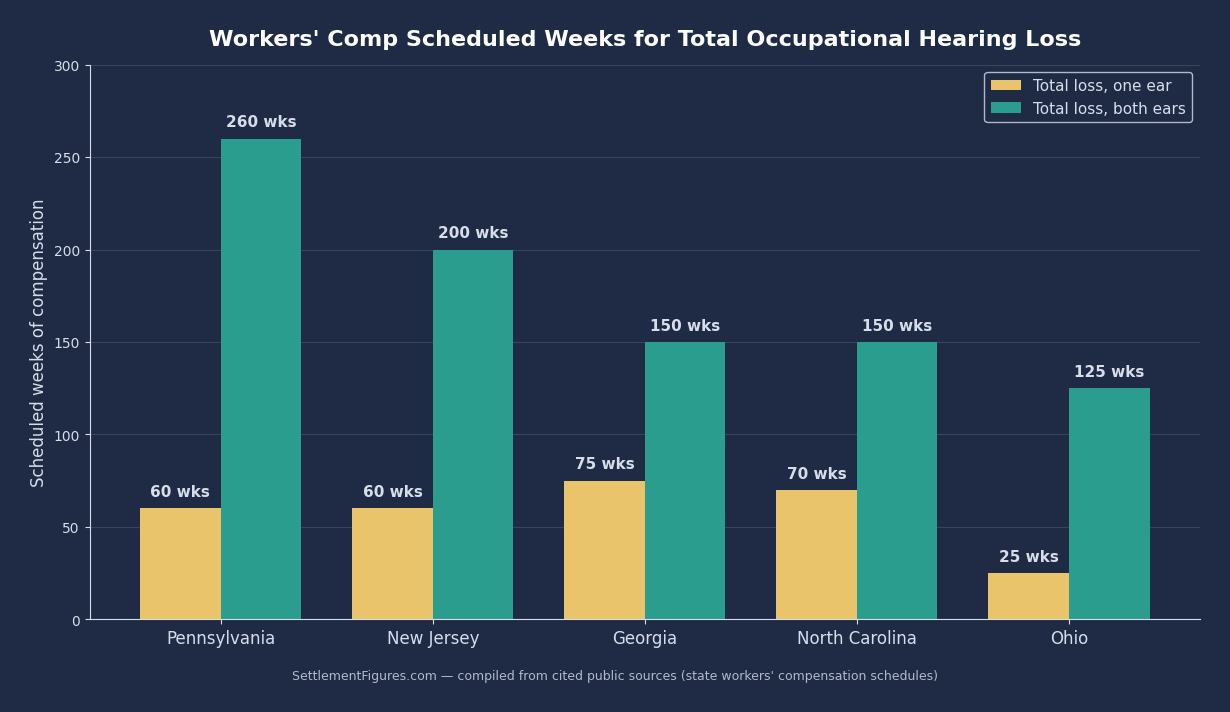
A few states use different math entirely. Washington’s L&I system values complete loss of hearing in both ears at $123,351, per WorkersCompData’s 2026 chart. Arizona pays 55% of the average monthly wage for up to 20 months for one ear and up to 60 months for both, according to Matt Fendon Law Group. Identical ears, very different checks — the state you file in matters as much as the audiogram.
Your Options
Hearing claims reward workers who act in the right order. These are the levers actually available, from simplest to most involved.
| Option | What it gets you | Deadline pressure |
|---|---|---|
| Report the loss and file a state claim | Opens the door to all benefits below | Highest — notice clocks run from when you knew the loss was work-related |
| Claim medical benefits | Hearing exams, hearing aids, batteries and replacements, typically at no cost to you | Low once the claim is accepted |
| Scheduled permanent partial award | The lump-sum or weekly money in the table above | Requires a valid audiogram, often after time away from noise |
| Third-party lawsuit | Extra recovery from equipment makers or chemical suppliers (ototoxic exposure) — pain and suffering included | Separate, shorter personal-injury deadlines |
| Federal-employee route (OWCP/FECA) | Scheduled award under federal rules if you work for the U.S. government | Own filing system via DOL |
Filing starts with written notice to your employer and a claim form to your state board — the same sequence covered in our guide to filing a workers’ comp claim. For hearing loss specifically, timing has two quirks worth knowing.
First, the clock usually starts when you knew or should have known the loss was work-related — not when the exposure happened. California applies a one-year limit from that discovery point, per Soundtrace’s state guide. New York generally requires workers to be out of the noisy environment for 90 days before hearing loss is measured for a claim, per MCV Law. Second, because valid audiograms may require time away from noise, retirees can and do file — claims commonly surface years after the last shift.
A hearing claim standing alone usually resolves faster than a lost-time injury because there is no wage-replacement dispute. The stages still follow the standard sequence — filing, medical evaluation, offer, negotiation — described in our breakdown of how long workers’ comp settlements take.
One more option deserves a hard look: if defective machinery, missing guards, or ototoxic chemicals contributed to your loss, a separate lawsuit against that third party can recover damages workers’ comp never pays — including pain and suffering and full lost wages.
Red Flags
Hearing claims fail in predictable ways. Watch for these patterns.
- “That’s just aging.” Insurers routinely attribute loss to presbycusis — age-related decline. Your counterweight is the audiogram trail: a noise-notch pattern on the test and years of documented workplace exposure point to the job.
- Missing hearing test records. OSHA requires employers to retain audiometric records long-term. If your annual tests have vanished, request them in writing — the absence itself says something about the program.
- Pressure not to file after an STS letter. If a workplace test showed a “standard threshold shift” and the follow-up was a shrug instead of better protection, that letter is evidence. Keep it.
- Quick, small offers before a valid audiogram. An offer made before your hearing is properly measured — sometimes months away from noise are required first — prices the claim before anyone knows what it is worth.
- Retaliation. Discipline, sudden schedule cuts, or termination after you report hearing loss follows the same illegal playbook as any comp claim — our guide to being fired while on workers’ comp covers how to document it.
For a sense of where hearing loss sits against other injuries, our table of average workers’ comp settlement amounts by body part shows why hearing claims run smaller than back or shoulder cases — and why they are still worth filing: the medical benefit alone can cover hearing aids for life.
Where to Get Help
Free, official help exists at every stage — from measuring your hearing to reporting the noise that caused the damage.
Free official help & resources
- OSHA — report hazardous noise or ask about exposure records: osha.gov/noise · 1-800-321-6742
- NIOSH (CDC) — occupational hearing loss science and prevention: cdc.gov/niosh · CDC-INFO 1-800-232-4636
- U.S. Department of Labor, OWCP — hearing loss claims for federal employees: dol.gov/agencies/owcp
- ABA Free Legal Answers — ask a volunteer attorney about your claim at no cost: freelegalanswers.org
- 211 — local referrals for benefits, health care and legal aid: 211.org · dial 211
Frequently Asked Questions
Can you get workers’ comp for hearing loss?
Yes. Every state compensates work-related hearing loss, whether it built up over years of noise exposure or came from one loud event. You will need an audiogram showing measurable loss and evidence connecting it to workplace noise or ototoxic chemicals — employment history in a loud trade usually carries that weight.
How much is a hearing loss workers’ comp claim worth?
Typical permanent-loss claims pay $10,000 to $30,000, per Workers Compensation Experts, and serious both-ear cases average $30,000 to $120,000, per Matt Fendon Law Group. The exact figure is your impairment percentage applied to your state’s scheduled weeks, paid at about two-thirds of your average weekly wage.
Does workers’ comp cover hearing aids?
In an accepted claim, medical benefits generally cover hearing exams, hearing aids, batteries, and replacements. For many workers with moderate loss, lifetime hearing aid coverage ends up worth more than the lump-sum award itself — hearing aids commonly run $2,000 to $7,000 per pair out of pocket.
How long do I have to file a hearing loss claim?
Deadlines typically run from the date you knew or should have known the loss was work-related, not the date of exposure — California allows one year from that point, per Soundtrace. Some states also require a waiting period out of the noise before your hearing is measured. Check your state board before assuming you are too late; retirees file successfully every year.
Can I file if I still work at the same job?
Yes. Filing while employed is legal, and retaliation for it is illegal in every state. The practical wrinkle: some states measure your hearing only after a stretch away from injurious noise, so your award may be calculated later even though your claim is on file now.
What if I wore hearing protection?
You can still qualify. Hearing protection reduces — but does not always eliminate — hazardous exposure, and OSHA’s own program assumes damage can occur despite it, which is why annual audiograms are required. Using protection does not bar a claim; documented loss on the audiogram is what counts.
Is hearing loss a permanent disability?
Noise-induced hearing loss does not heal, so workers’ comp systems treat established loss as a permanent partial disability rather than a temporary injury. That is why it pays through the scheduled-award system — a fixed number of weeks — instead of open-ended wage replacement, and why the medical benefit for hearing aids continues after the award is paid.
☕ This research is reader-supported. No law firm pays us. If this guide saved you time or money, you can buy the research team a coffee — it keeps the data free and updated.
This article is for informational purposes only and is not legal advice. Settlement values vary significantly by case and by state. Consult a licensed attorney in your state before making decisions about your claim.
