Last updated: July 13, 2026 · Data reviewed quarterly
If you were hurt at work, the clock starts the moment the injury happens. In most states you have 30 days to report a work injury to your employer, and then roughly one to three years to file the formal workers’ compensation claim with your state. Miss the first deadline and your benefits can be delayed; miss the second and the claim can be barred for good. This guide walks the process one stage at a time — what to do, when to do it, and where to get free help.
One nuance before the stages: conditions that build gradually instead of happening in one moment — work-related hearing loss is the classic example — usually start the clock when you knew or should have known the condition came from the job.
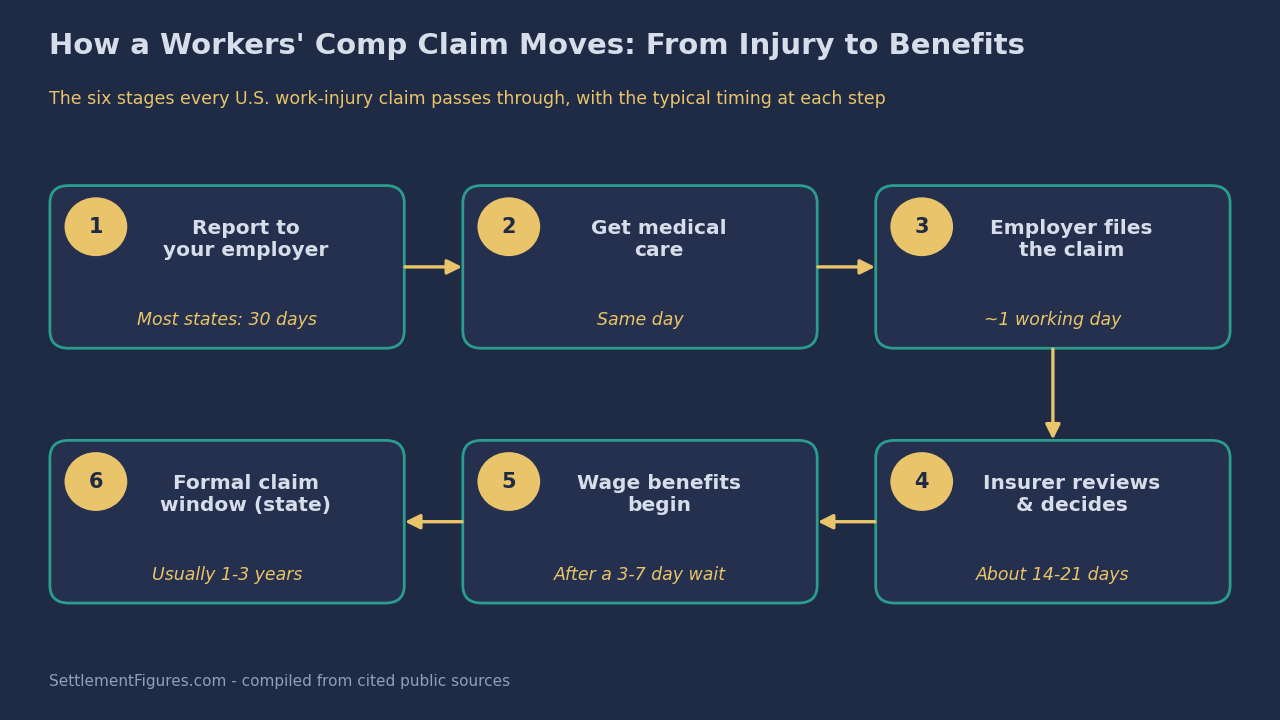
The Filing Timeline at a Glance
The stages below are compiled from U.S. Department of Labor guidance, state workers’ compensation agencies, and Nolo. Exact windows vary by state, so treat these as the typical shape of a claim rather than a rule for your specific case.
| Stage | What happens | Typical timing |
|---|---|---|
| 1. Report the injury | You tell your employer, ideally in writing | Most states: 30 days (range 3–180) |
| 2. Get medical care | A provider treats and documents the work injury | Same day / as soon as possible |
| 3. Claim form filed | Employer gives you the claim form and reports it to its insurer | About 1 working day after notice |
| 4. Insurer decision | The carrier investigates and accepts or denies | Roughly 14–21 days in many states |
| 5. Wage benefits begin | Lost-wage checks start after the waiting period | After a 3–7 day wait; first check near day 14 |
| 6. Formal claim deadline | You file with the state board if the claim is disputed | Usually 1–3 years (statute of limitations) |
The Process, Stage by Stage
Report first. Tell a supervisor or HR right away, then put it in writing — an email or a signed note — so there is a dated record. Roughly half of states set the reporting deadline at 30 days, according to Work Injury Source and Pie Insurance, but a written report on day one removes the insurer’s favorite argument: that the injury did not really happen at work.
Get treated, and say it happened at work. Tell the provider the injury is job-related so it lands in the medical record that way. Keep every appointment; gaps in treatment are read by adjusters as a sign the injury was minor.
Complete your part of the claim form. Once you report, your employer must give or mail you a claim form — within one working day in California, per its Division of Workers’ Compensation. Fill in only the employee section, sign and date it, keep a copy, and return it by certified mail so you can prove the date. The employer forwards it to its insurer, which starts the formal claim. From there, if you are off work beyond the waiting period, wage benefits typically run at two-thirds of your average weekly wage up to a state cap — the standard formula described by Nolo and the Social Security Administration.
What Speeds Your Claim Up
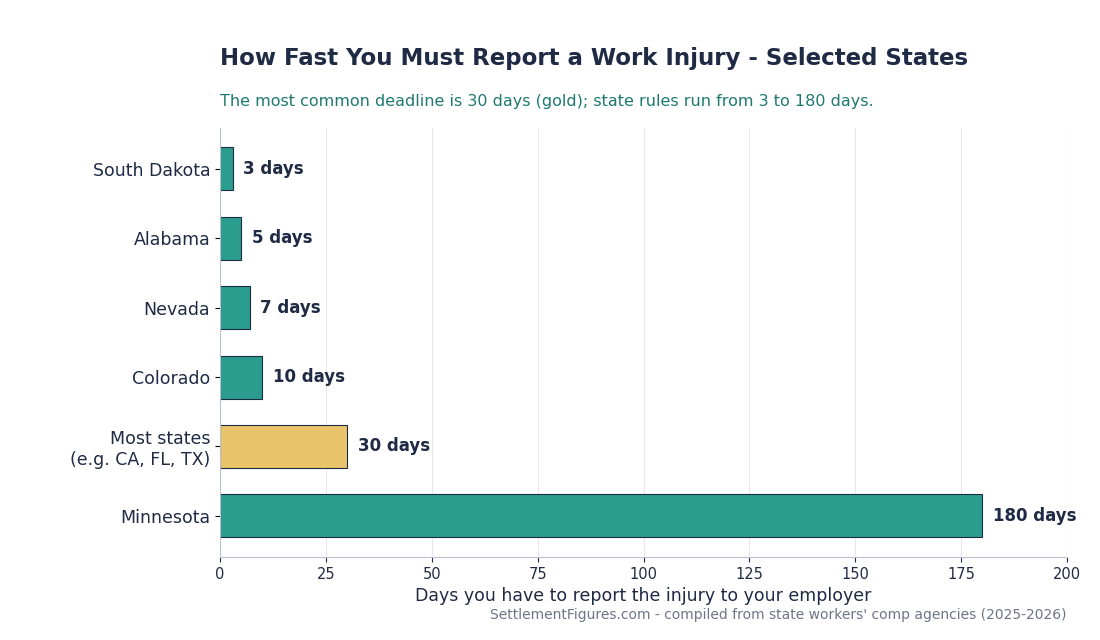
Speed comes from removing doubt. Report in writing the same day, get prompt medical care, and hand over a complete, signed claim form. The reporting window is the deadline people miss most, and it varies more than any other — from three days in South Dakota to 180 days in Minnesota, with 30 days the most common cutoff.
Consistent medical records help too. Attend follow-ups, follow the treatment plan, and keep copies of bills and mileage. Claims that show steady, documented care move faster than ones with missing weeks. If you want a sense of the road ahead, see our guide on how long a workers’ comp settlement takes.
What Delays or Denies a Claim
Late reporting is the top reason claims stall. After that come gaps in treatment, incomplete forms, and disputes over whether the injury is work-related. If the insurer denies the claim, you are not stuck — you can file a formal claim or appeal with your state board, but only within the statute of limitations. That formal deadline is usually one to three years, though FindLaw and Atticus note it runs as short as 90 days in Nevada and as long as four years in Massachusetts.
Two more traps: assuming you cannot be fired, and assuming you do not need a paper trail. State law bars retaliation for filing, but it does not freeze every job — read being fired while on workers’ comp for the line between the two. And if a serious injury may become permanent, the numbers change; our pages on permanent partial disability ratings and average workers’ comp settlement amounts explain how payouts are built.
When to Worry — and Who to Call
Get help fast if your employer refuses to give you a claim form, the insurer denies the claim or stops payments, or a permanent limitation is on the table. You are not required to hire a lawyer, but you can talk to one at any point — and the free resources below can answer most first questions at no cost. If you are weighing whether comp is even the right path, compare workers’ comp versus a personal injury lawsuit.
Free official help & resources
- Your state workers’ comp board — private, state, and local employees file through their state office. The U.S. Department of Labor lists every state office at dol.gov/agencies/owcp/wc.
- OSHA (unsafe workplace or retaliation complaints): 1-800-321-6742 · osha.gov/workers
- Federal employees (U.S. DOL OWCP / FECA): dol.gov/agencies/owcp · (202) 513-6860
- Free legal answers: the ABA’s freelegalanswers.org and Legal Services Corporation’s directory at lsc.gov.
- Example state hotlines: Florida Division of Workers’ Compensation 1-800-342-1741; Alabama Workers’ Compensation Division 1-800-528-5166.
Frequently Asked Questions
How long do I have to file a workers’ comp claim?
Two clocks run at once. You usually have 30 days to report the injury to your employer, then one to three years to file the formal claim with your state, per FindLaw and Atticus. Nevada is as short as 90 days and Massachusetts as long as four years, so check your own state’s rule early.
What happens after you file a workers’ comp claim?
Your employer reports the claim to its insurer, which investigates and then accepts or denies it — often within about 14 to 21 days. If accepted, medical bills are covered and wage benefits begin after the waiting period. If denied, you can appeal through your state board.
How long does it take to get paid on workers’ comp?
Wage benefits usually start after a 3-to-7-day waiting period, with the first check landing near day 14 once your employer knows about the lost time, according to Nolo and state labor departments. If you stay out past a longer threshold (often 14 or 21 days), many states pay the waiting period back.
Do I need a lawyer to file a workers’ comp claim?
No. You can file on your own, and many straightforward claims are handled without one. A lawyer becomes worth considering when a claim is denied, benefits stop, or a permanent injury is involved. You can also start with the free resources above before deciding.
Can I be fired for filing a workers’ comp claim?
Not for the claim itself — every state prohibits firing or punishing a worker in retaliation for filing. An employer can still act for unrelated, legitimate reasons, so document your work history if you sense trouble. Our guide on being fired while on workers’ comp covers the details.
How much does workers’ comp pay?
Wage-replacement benefits are typically two-thirds of your average weekly wage, up to a state maximum — the standard formula noted by Nolo and the Social Security Administration. Medical care for the injury is covered separately. Permanent injuries can add a disability award on top.
☕ This research is reader-supported. No law firm pays us. If this guide saved you time or money, you can buy the research team a coffee — it keeps the data free and updated.
This article is for informational purposes only and is not legal advice. Settlement values vary significantly by case and by state. Consult a licensed attorney in your state before making decisions about your claim.
