Last updated: July 15, 2026 · Data reviewed quarterly
If you hurt your knee on the job, start with this: the average workers’ compensation knee claim runs about $35,332, according to 2023 National Safety Council Injury Facts data — roughly $18,009 in medical care and $17,323 in lost wages.
That average sits well below the $70,575 the same source reports for neck claims, but it hides a wide spread. A knee you sprain and rehab in a few weeks is a different case than a torn ACL or a total knee replacement, and the settlements are not close. Knowing where your own injury falls on that range is the first step to judging any offer.
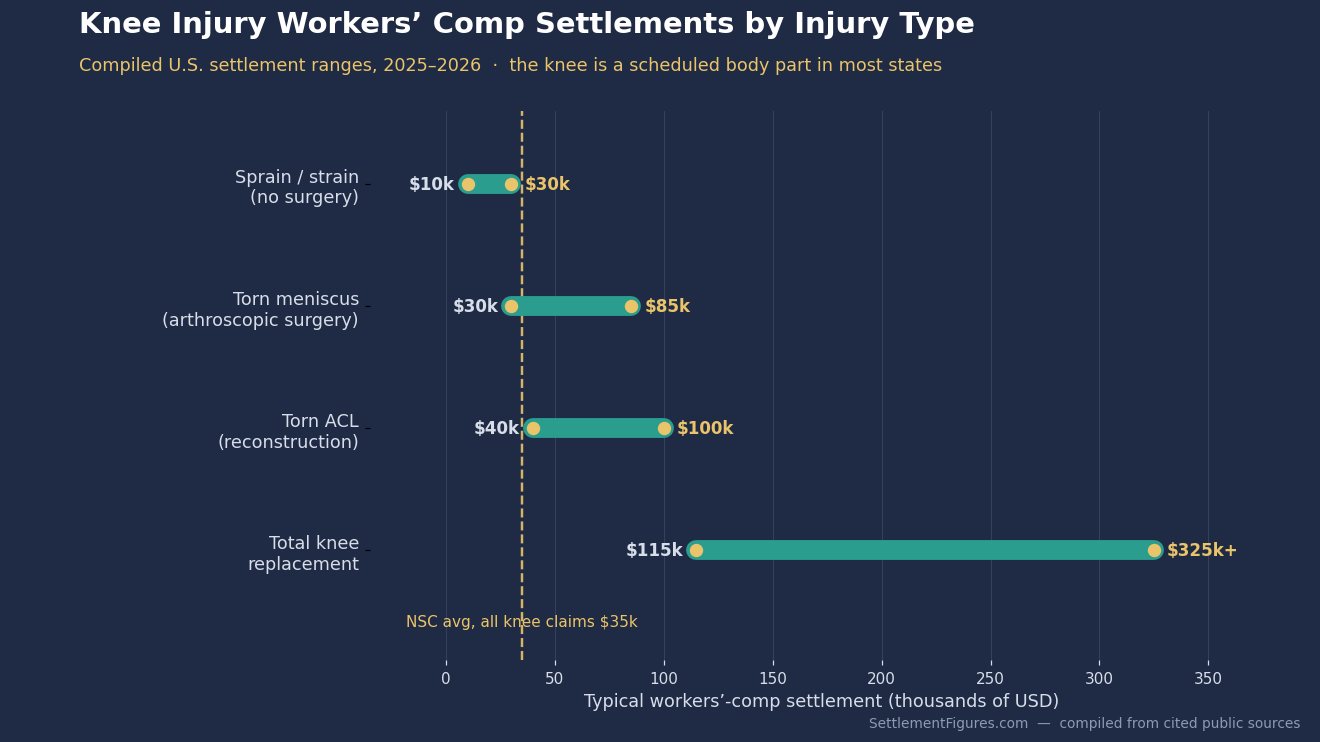
| Knee injury type | Typical workers’-comp settlement | What drives it |
|---|---|---|
| Sprain / strain (no surgery) | $10,000 – $30,000 | Soft tissue, physical therapy, recovery expected |
| Torn meniscus (arthroscopic surgery) | $30,000 – $85,000 | Repair vs. partial removal; some permanent loss |
| Torn ACL (reconstruction) | $40,000 – $100,000+ | Surgery plus permanent restrictions |
| Knee fracture | ~$62,000 average | Hardware, longer recovery |
| Total knee replacement | $115,000 – $325,000+ | High impairment rating, permanent limits |
| National average, all knee claims | ~$35,332 per claim | NSC Injury Facts (2023) |
What real knee settlements look like
The single biggest factor is whether you need surgery, and what kind. A sprain or strain treated with physical therapy and time off usually settles between $10,000 and $30,000, according to Morgan & Morgan and Atticus. Nothing here is a reward — it reflects short treatment and an expected recovery.
Surgery moves the number up quickly. A torn meniscus fixed with arthroscopic surgery commonly lands between $30,000 and $85,000, and a torn ACL that needs reconstruction runs from about $40,000 to $100,000 or more, per Sharpe Law and Miller & Zois. Knee fractures average around $62,240 on their own.
The top of the range belongs to total knee replacement. Those cases commonly settle between $115,000 and $325,000, and severe ones climb higher, because a replaced joint means a permanent impairment and lasting work limits. For a sense of how any of these compare to the wider system, see our data on average workers’ comp settlement amounts.
Combined injuries change the picture again. A torn ACL alongside a meniscus tear is more complex than either alone, so it tends to settle higher — and to take longer, often 18 to 24 months, because doctors wait to see how the repaired joint holds up before anyone fixes a final value.
Repair, removal, or replacement
The exact surgery matters to the value. A meniscus repair stitches the cartilage back together and preserves the joint, with a longer recovery; a meniscectomy simply trims the torn piece and heals faster, but it can raise the risk of arthritis later — a future cost that belongs in the settlement.
An ACL reconstruction rebuilds the ligament and usually leaves lasting limits on pivoting and heavy labor. A total knee replacement is the most serious of the common procedures: it carries the highest impairment ratings, and because a modern joint lasts roughly 15 to 20 years, a future revision surgery is often built into the number. That combination is why replacements sit at the top of the range.
The scheduled-member formula
Here is where a knee differs from a neck. Most states treat the knee, as part of the leg, as a “scheduled” body part — the law assigns the leg a set number of weeks of benefits. Your neck, by contrast, is usually a whole-body injury valued a different way.
The math waits for one milestone: Maximum Medical Improvement, or MMI. That is the point where your doctor decides your knee has recovered as much as it reasonably will. At MMI, the doctor assigns a permanent impairment rating — a percentage, usually from the AMA Guides. Lower-extremity ratings of 40 to 70% are common after a total knee replacement.
The scheduled payout is then roughly your impairment rating, multiplied by the leg’s scheduled weeks, multiplied by your weekly comp rate — about two-thirds of your average weekly wage.
As an illustration, a 20% leg impairment in a state that schedules the leg at 215 weeks, at a $500 weekly rate, works out near $21,500 — but the weeks and rates vary sharply by state, so treat that only as a shape. Our guide to how impairment ratings convert to a payout walks through it in detail.
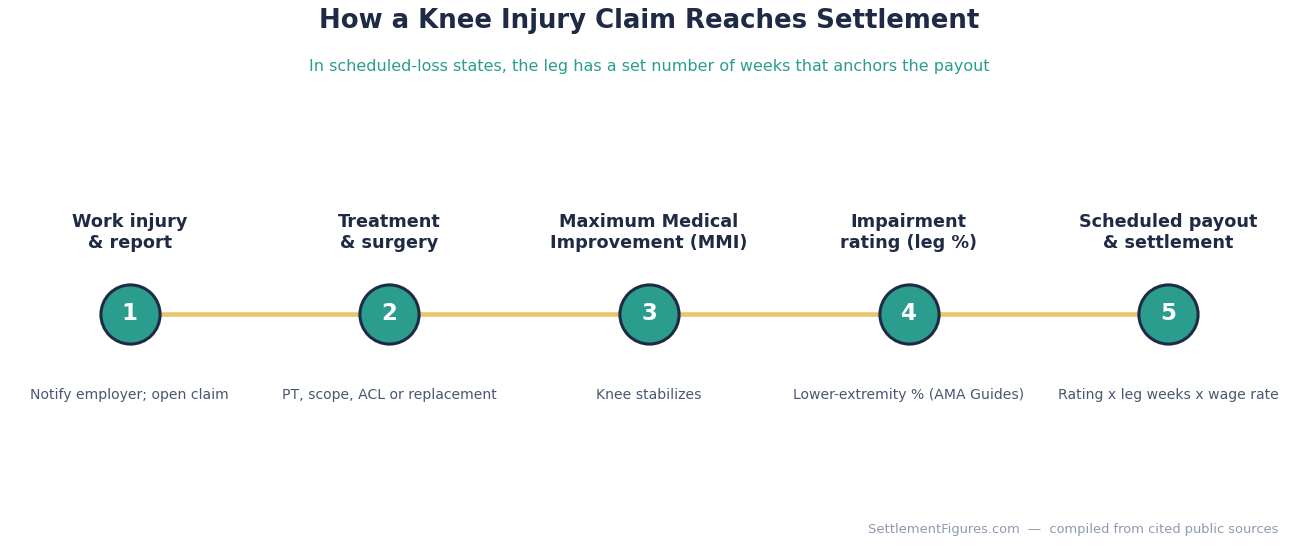
Not every state uses a schedule. In “wage-loss” states, the payout tracks the earnings you actually lose because of the injury rather than a fixed number of weeks. That system can help a worker who cannot return to a physical job, and pay less to one who goes back at full wages — so knowing which model your state follows tells you which numbers matter.
Two extra pieces often stack on top: temporary total disability while you are off work, again about two-thirds of your wage, and the cost of future care. Because a replacement joint eventually wears out, a future revision can be part of the deal. For a sense of timing, see how long a workers’ comp settlement takes.
One choice quietly moves the total: whether you settle medical care open or closed. Closing out future medical for a knee that may need injections or a revision later should carry a higher number, because you are giving up the insurer’s duty to pay for that care down the line.
What pushes a knee settlement up
Surgery is the biggest multiplier, and the more the joint is rebuilt, the higher the value: a replacement outweighs a reconstruction, which outweighs a scope. A high average weekly wage raises every wage-based part of the claim, and a documented need for future care forces the insurer to fund it.
Permanent restrictions carry real weight for a knee. Limits on kneeling, squatting, climbing, or prolonged standing can keep you out of your old job, and that pushes the number higher. Whether you can return to work matters as much as the medical facts — a worker back at full duty and full pay generally settles for less than one forced into a lower-paying role with the same rating.
What pulls a knee settlement down
Pre-existing arthritis is the most common drag. Knees wear with age, and insurers argue that your imaging shows ordinary osteoarthritis rather than a work injury. Records showing you worked without symptoms before the incident help counter that.
Gaps in treatment hurt, too — long stretches between visits read as recovery. A low average weekly wage caps the wage portion of any settlement. And if an independent medical examiner assigns a low impairment rating, or clears you for full duty, the offer usually follows.
How the injury happened shapes the fight as well. A single fall gives a clear date and cause; a knee worn down by years of kneeling or climbing — a cumulative-trauma claim — is harder to prove, and easier for an insurer to blame on aging, even when the job is the real reason.
Do you need a lawyer?
Not every knee claim needs one. A minor sprain that the insurer accepts without a fight can resolve on its own. The picture changes with surgery, a disputed cause, a low impairment rating, or permanent restrictions that threaten your job.
A common flashpoint is the rating itself. If the insurer’s independent medical examiner assigns a lower percentage than your treating doctor, that gap can be worth tens of thousands of dollars on a scheduled leg — exactly the kind of dispute where representation tends to pay for itself.
Watch the timing of light-duty offers, too. Going back to a modified job can help your recovery, but an early offer can also be a way to cut off wage benefits before your knee reaches MMI, when its true impairment finally becomes clear.
If someone other than your employer helped cause the injury — a defective machine, or a driver who hit you during a work errand — you may have a claim beyond workers’ comp. Our comparison of workers’ comp versus a lawsuit covers when both apply.
Attorney fees in comp cases are set by each state and usually come out of the settlement as a capped percentage, so representation rarely costs anything up front.
Why your state changes the answer
Because the knee is scheduled, the number of weeks your state assigns the leg drives the outcome as much as your injury does. Two workers with the same 25% leg rating can settle for very different amounts simply because their states schedule the leg differently and set different weekly caps.
Some states also adjust their weekly maximums every year against a statewide wage average, and some fund future medical care separately from the impairment payout. Before you accept or reject an offer, confirm your state’s leg schedule, its weekly cap, and how it handles future treatment. Your state workers’ compensation board can point you to the current numbers.
Free official help & resources
- U.S. DOL — Office of Workers’ Compensation Programs (OWCP): for federal and specific-industry workers. dol.gov/agencies/owcp · 1-844-493-1966
- OSHA (workplace safety & worker rights): report hazards or retaliation. osha.gov/workers · 1-800-321-6742
- Your state workers’ compensation board: the right office for most private and state employees. Find yours through dol.gov/general/topic/workcomp
- Social Security Administration (SSDI, if you cannot return to work): ssa.gov · 1-800-772-1213
- IRS — tax treatment of workers’ comp (Publication 525): irs.gov
- Free local referrals: dial 211 or visit 211.org
Frequently asked questions
What is the average workers’ comp settlement for a knee injury?
About $35,332 per claim, according to 2023 NSC Injury Facts data ($18,009 medical and $17,323 in wages). Your figure depends on severity — a sprain settles far lower than a replacement.
How much is a torn meniscus worth in workers’ comp?
Meniscus tears that need arthroscopic surgery commonly settle between $30,000 and $85,000, depending on whether the tear is repaired or partly removed and how much permanent loss remains. Non-surgical cases settle lower.
How much is a total knee replacement settlement?
Total knee replacements commonly settle between $115,000 and $325,000, per sources including cpollardlaw and Shultz Legal, and severe cases go higher. Replacements often carry lower-extremity impairment ratings of 40 to 70%.
How is a knee injury workers’ comp settlement calculated?
In most states the knee is scheduled: your impairment rating is multiplied by the leg’s set number of weeks and your weekly comp rate (about two-thirds of your average weekly wage), with medical and future care added on top.
Does knee surgery increase my workers’ comp settlement?
Usually, yes. Surgery signals lasting impairment, and the more the joint is rebuilt, the higher the value — a replacement outweighs an ACL reconstruction, which outweighs an arthroscopic scope.
Is a workers’ comp knee injury settlement taxable?
Workers’ compensation benefits for a job injury are generally not taxable at the federal level, per IRS rules (Publication 525). Amounts can interact with Social Security disability benefits, so confirm your own situation.
☕ This research is reader-supported. No law firm pays us. If this guide saved you time or money, you can buy the research team a coffee — it keeps the data free and updated.
This article is for informational purposes only and is not legal advice. Settlement values vary significantly by case and by state. Consult a licensed attorney in your state before making decisions about your claim.
