Last updated: July 30, 2026 · Data reviewed quarterly
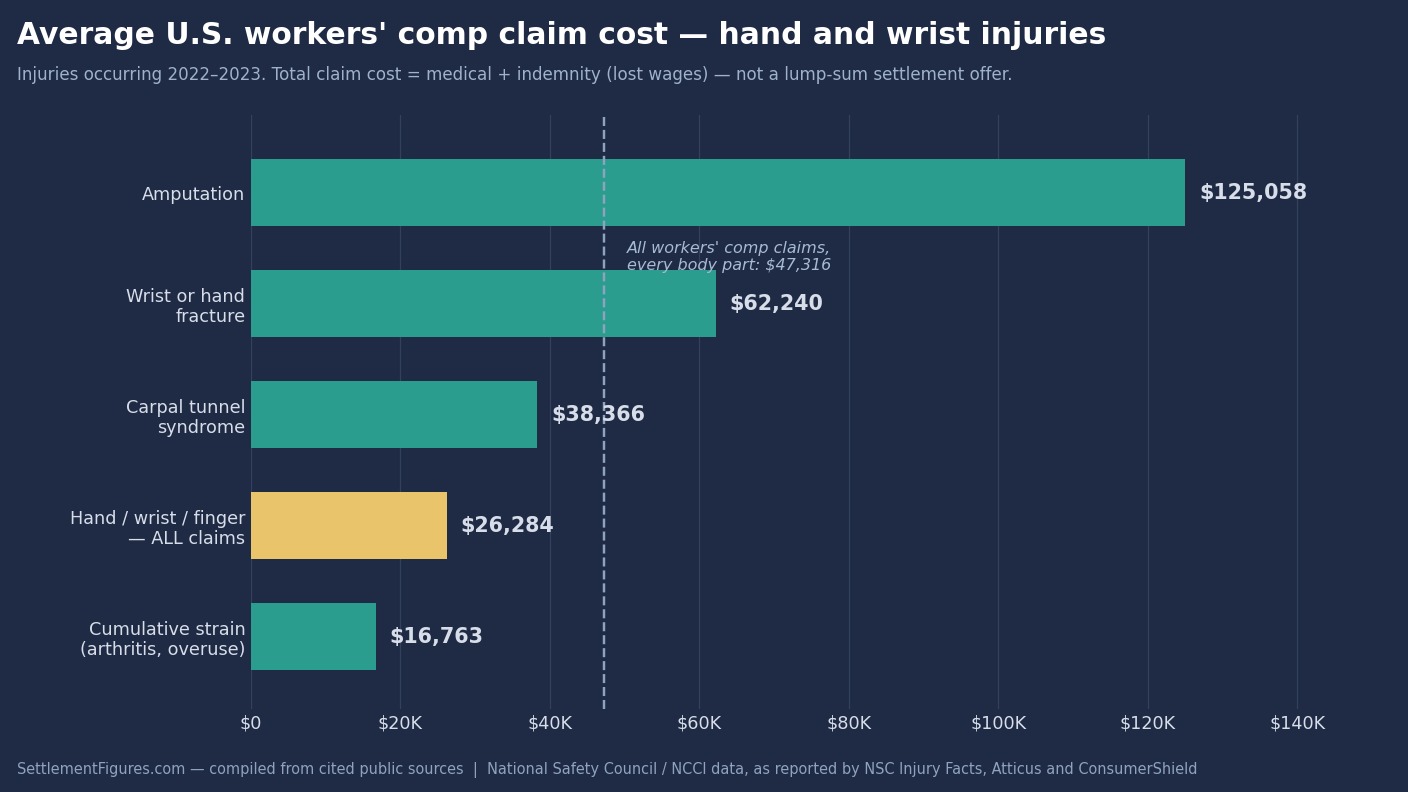
The average U.S. workers’ compensation claim for a hand, wrist or finger injury costs $26,284 — roughly $14,576 in medical care and $11,708 in indemnity (lost-wage) payments, based on National Safety Council data reported by both Atticus and Miller & Zois. That is about 56% of the $47,316 average across all workers’ comp claims. From there the number moves hard in both directions: cumulative strain averages $16,763, carpal tunnel $38,366, a fracture $62,240.
| Hand or wrist injury | Average total claim | Source |
|---|---|---|
| Cumulative strain (arthritis, overuse) | $16,763 | NSC data, reported by Atticus |
| Hand / wrist / finger — all claims | $26,284 | NSC data, reported by Atticus and Miller & Zois |
| Carpal tunnel syndrome | $38,366 | NSC data, reported by ConsumerShield |
| Wrist or hand fracture | $62,240 | NSC data, reported by Atticus |
| Amputation (any body part) | $125,058 | NSC Injury Facts / NCCI |
| All claims, every body part | $47,316 | NSC Injury Facts / NCCI |
What Real Hand and Wrist Settlements Look Like
Read those figures carefully: they are total claim costs, not lump-sum checks. They combine what the insurer paid your doctors with what it paid you in wage replacement. A claim that “cost $26,284” may have put $11,708 in the worker’s pocket, spread over months. A settlement is separate money, paid to close the file.
The second pattern: hand and wrist claims sit below the all-claims average. NSC’s list of above-average body parts includes the head, neck, hip, leg and shoulder — the hand and wrist are absent. In the same dataset, the arm-and-shoulder category averages $55,115.
Miller & Zois explain why that undersells the injury. Hand surgery is quick and cheap next to a spinal fusion, so the bills stay low — but a hand that can no longer grip is permanent. Adjusters anchor on the bills. Juries do not: the average finger-and-hand verdict runs near $630,000 against a median of about $70,000.
The Formula Insurers Use
In most states the hand and wrist are “scheduled” body parts, so your permanent award is arithmetic rather than negotiation. Three inputs decide it:
- The statutory weeks your state assigns to that body part.
- Your impairment percentage, assigned by a doctor once you reach maximum medical improvement (MMI).
- Your compensation rate — in most states two-thirds of your average weekly wage, capped at a state maximum.
New York’s schedule, set in Workers’ Compensation Law §15(3), values a hand at 244 weeks, an arm at 312 and a thumb at 75. Nolo notes the same mechanism runs in most states, with the week counts changing at every border.
Run it with real numbers. A New York worker earning $1,200 a week has a compensation rate of $800. A doctor assigns a 30% schedule loss of use of the hand. That is 244 × 0.30 = 73.2 weeks × $800 = $58,560, minus any temporary benefits already paid on the claim.
Notice what actually moved that number: the impairment percentage, not how sympathetic your story is. Each point of loss-of-use is worth 2.44 weeks of pay in New York, so a 30% versus 40% rating is a $19,520 disagreement. Our guide to how permanent partial disability ratings are calculated covers how doctors reach that figure.
Four large states — California, Florida, Nevada and Texas — have no schedule at all, per Nolo. They pay permanent disability through impairment ratings or wage-loss formulas instead, so the week counts above simply do not apply to you there.
What Increases a Hand or Wrist Settlement
- The dominant hand. Same injury, higher impairment rating and higher wage impact.
- Thumb and index involvement. A 2020 Injury Prevention analysis of Global Burden of Disease data found thumb loss is the largest single cause of hand-related permanent disability worldwide.
- Surgery with an imperfect outcome. Hardware, nonunion, a bone graft or a second procedure all signal permanence.
- Nerve or crush injury. Miller & Zois rank these highest-value, because grip and sensation rarely come all the way back.
- A job that requires the hand. Atticus notes workers who depend on grip miss more time and settle higher.
- Age. Older workers recover more slowly, lengthening the indemnity side.
What Decreases It
- A surgery that works. This one surprises people. ConsumerShield is direct about it: a carpal tunnel release that restores full function and leaves no restrictions can lower the settlement, because there is less permanent impairment to pay for.
- Causation disputes. Cumulative-trauma claims average $16,763 — the lowest tier — because insurers argue the condition came from age, diabetes or hobbies, not the job.
- Late reporting. Most states allow three to seven days to report a work injury, per Atticus. Miss it and approval gets very hard.
- Pre-existing arthritis in the same joint, which hands the insurer an apportionment argument.
- A low average weekly wage, which caps the formula no matter how bad the injury is.
Do You Need a Lawyer?
Not always. If you are in a scheduled-loss state, the injury is accepted, and the treating doctor’s rating looks reasonable, the award is largely arithmetic — and paying a third of it away buys you little. Four situations flip that:
- The insurer’s doctor rates your impairment far below your own doctor’s number.
- Carpal tunnel or another repetitive-strain claim is denied on causation.
- You are in California, Florida, Nevada or Texas, where there is no schedule to fall back on.
- The settlement would close future medical care — a permanent decision on a joint that may need more surgery.
Fees are contingency-based, capped by state law, and consultations are free. Treat the claim that lawyers double settlements with caution — it comes from firms marketing legal services. The useful point is narrower: rating disputes are won with medical evidence. Either way, know how long these cases take, because no settlement talk starts until MMI.
State Differences That Change Your Payout
Two workers with identical injuries and identical wages can be tens of thousands apart across a state line. What moves the most money:
- Schedule or no schedule. New York pays 244 weeks for a hand. California, Florida, Nevada and Texas use a different system entirely.
- Whether returning to work matters. New York pays a schedule loss of use award even if you go back to your old job at full pay. In wage-loss states, returning can reduce or end benefits.
- The weekly maximum. Your two-thirds rate is capped, so high earners in low-cap states lose the most.
- Disfigurement. New York pays up to $20,000 separately for permanent disfigurement to the face, head or neck.
Your state board publishes its own schedule and benefit caps, and the call is free. If you have not opened a claim yet, start with the filing steps and deadlines, then compare your figure against average settlements across all injury types.
Free official help & resources
- Your state workers’ comp board — publishes the schedule of weeks and benefit caps that decide your award. New York’s answers at (877) 632-4996, free language assistance included (wcb.ny.gov).
- OSHA — 1-800-321-6742. Report unguarded machinery, or retaliation for filing a claim (osha.gov).
- U.S. DOL, OWCP — federal employees file here, not with a state board (dol.gov/agencies/owcp).
- Social Security Administration — 1-800-772-1213. If the injury ends your ability to work, SSDI may apply alongside comp (ssa.gov).
- IRS Publication 525 — the official rule on why comp benefits are generally untaxed (irs.gov/publications/p525).
- Free legal help — volunteer attorneys answer civil questions at no cost (freelegalanswers.org); LSC.gov finds local legal aid.
- EEOC — 1-800-669-4000, if you were fired or demoted after reporting the injury (eeoc.gov).
Frequently Asked Questions
How much is the average workers’ comp settlement for a hand injury?
National Safety Council data puts the average hand, wrist and finger claim at $26,284 — about $14,576 medical and $11,708 indemnity. Atticus and Miller & Zois both report the same figure. Treat it as a midpoint, not a target.
Will wrist surgery increase my workers’ comp settlement?
It depends on the outcome, not the operation. Surgery raises medical costs and recovery time, which lifts claim value. But if it restores full function and leaves no restrictions, your impairment rating drops and so does the award. A surgery that fails, or leaves hardware behind, is worth more than one that works.
How much is a finger worth in a workers’ comp claim?
In scheduled states, statute sets it — New York values a thumb at 75 weeks against 244 weeks for a whole hand. Which digit matters: thumb and index settle highest, ring and little lowest. Amputation claims across all body parts average $125,058 in the NCCI data.
Is carpal tunnel covered by workers’ compensation?
Usually yes, if you can tie it to your job. Most states require three things: a medical diagnosis, evidence that job duties caused or contributed to the condition, and timely reporting. You never have to prove your employer did anything wrong. Causation is the fight — not fault.
Will I pay tax on my workers’ comp settlement?
Benefits paid under a state or federal comp act are generally excluded from taxable income. The exceptions are narrow and mostly involve offsets against Social Security disability payments. IRS Publication 525 states the rule; a tax preparer can confirm how it applies to your settlement.
Should I accept the first workers’ comp settlement offer?
Check three things first. Does the amount match your state’s schedule times your impairment rating? Does it close future medical care, and could your hand need more treatment? And have you reached MMI — an offer before that is a guess about an injury still healing.
☕ This research is reader-supported. No law firm pays us. If this guide saved you time or money, you can buy the research team a coffee — it keeps the data free and updated.
This article is for informational purposes only and is not legal advice. Settlement values vary significantly by case and by state. Consult a licensed attorney in your state before making decisions about your claim.
