Last updated: July 30, 2026 · Data reviewed quarterly
If the other driver caused your crash, their insurance company owes you a replacement ride while your car sits in the shop — the industry calls it “loss of use.” If you carry rental reimbursement on your own policy, it typically pays $30 to $50 per day, with per-claim caps of $900 to $1,500, according to MoneyGeek and ValuePenguin. The catch: nobody hands you keys automatically. Who actually pays, and for how long, depends on fault, your coverage, and how quickly an adjuster accepts liability.
Here is how payment responsibility breaks down in the situations drivers actually face.
| Scenario | Who pays for the rental | Source |
|---|---|---|
| Other driver at fault, liability accepted | Their liability insurer, as part of loss of use | FindLaw; WalletHub |
| Fault still being investigated | You pay upfront, then seek reimbursement | WalletHub |
| You were at fault, with rental reimbursement | Your own add-on, typically $30–$50/day | MoneyGeek; ValuePenguin |
| You were at fault, no add-on | You, out of pocket | MoneyGeek |
| Hit by an uninsured driver | UMPD in some states, or your own add-on | Todd Miner Law; state insurance departments |
| Car declared a total loss | Coverage ends days after the settlement offer | Insure.com; WalletHub |
What the Law Says
In at-fault states, the driver who caused the collision is responsible for all reasonable damages — and courts treat the temporary loss of your vehicle as real damage. FindLaw notes that rental fees fall within the at-fault driver’s liability coverage, alongside repair costs. That is why an adjuster who accepts liability will usually set up a rental billed directly to their company.
Two legal wrinkles trip people up. First, the at-fault insurer owes nothing until it actually accepts liability, and WalletHub cautions that fault determinations can take days or weeks — during which you either drive a rental on your own dime or wait. Second, even after accepting fault, the insurer only owes a “reasonable” rental, not a luxury upgrade of whatever you drove before.
In no-fault states, personal injury protection handles medical bills regardless of blame, but vehicle damage and rental costs still generally follow fault rules. Your own collision coverage — plus a rental reimbursement add-on if you bought one — fills the gap while fault gets sorted out.
One more duty cuts against you: mitigation. You are expected to keep rental costs reasonable, so a 6-week premium SUV rental for a 10-day repair invites a fight over the bill.
Your Options While Your Car Is in the Shop
Most drivers have more than one route to a paid rental. Each has different limits and different traps.
| Option | What it typically pays | Watch out for |
|---|---|---|
| Claim against the at-fault insurer | Reasonable rental for the repair period | No payment until liability is accepted; save every receipt |
| Your rental reimbursement add-on | $30–$50/day typical; $900–$1,500 per claim (MoneyGeek, ValuePenguin) | Daily cap may not cover an SUV or minivan at today’s rates |
| Uninsured motorist property damage (UMPD) | Rental costs after an uninsured driver hits you, in some states | Not sold in every state; limits vary |
| Pay out of pocket, claim later | What you actually spent, if reasonable | Insurer may benchmark against economy rates |
Carrier menus differ more than most people expect. Progressive’s rental reimbursement options typically run $40 to $70 per day for up to 30 or 45 days depending on the state, while GEICO sells limits up to $75 per day and $2,250 per claim. The add-on itself is cheap — roughly $2 to $15 per month, according to WalletHub and MoneyGeek.
Is it worth it? Allstate estimates its average customer files a rental reimbursement claim about once every 10 years, per WalletHub. If your area’s repair shops are backed up and you have no second car, the math favors carrying it; if you could borrow a vehicle for two weeks, it favors skipping it.
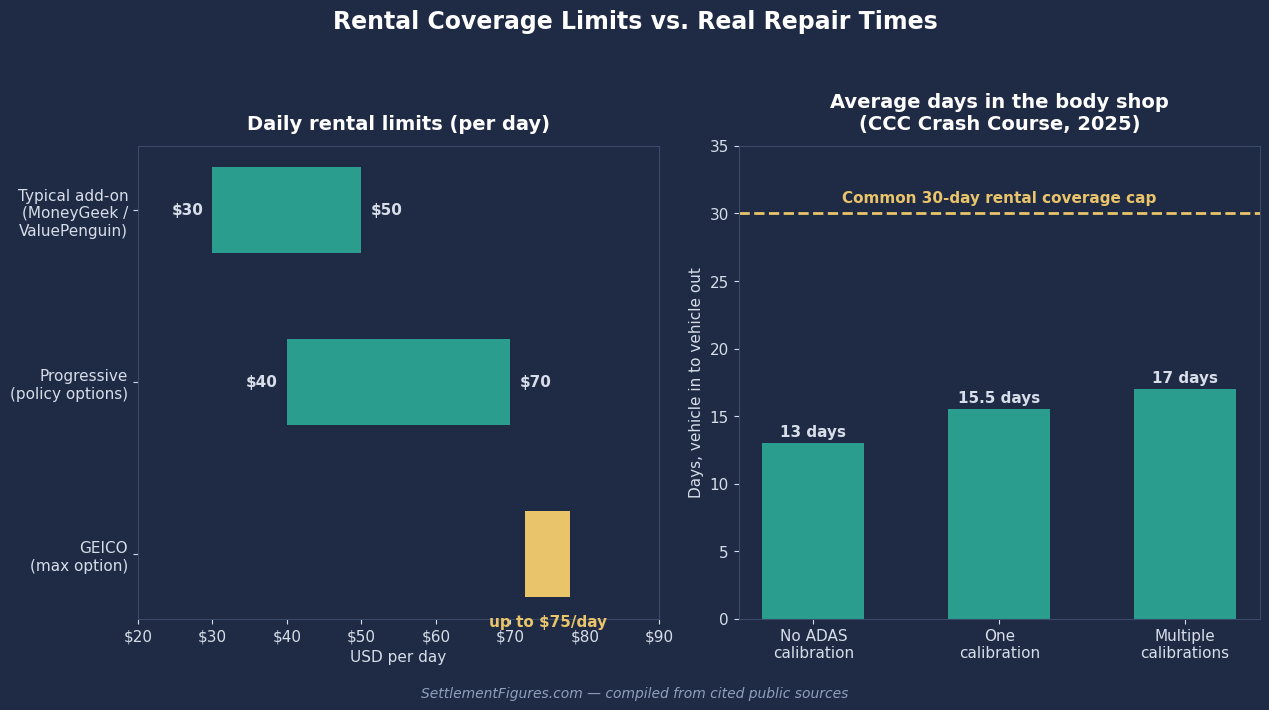
How long will you actually need the car? CCC Intelligent Solutions’ 2025 Crash Course data puts the average repair at about 13 days from vehicle-in to vehicle-out with no ADAS calibrations, 15.5 days with one calibration, and over 17 days with multiple — and calibrations now appear in more than a third of repair estimates, per Autobody News. A common 30-day coverage cap clears most repairs, but parts delays or a shop backlog can burn through it.
Red Flags
The liability investigation that never ends. Some adjusters slow-walk fault decisions while your out-of-pocket rental bill grows, betting you will give up and file on your own policy. Weeks of unreturned calls and shifting document requests are the classic pattern of bad faith claim handling, and state regulators treat unreasonable delay as a sanctionable practice.
The total-loss cutoff. When your car is declared totaled, rental coverage does not run until you buy a replacement. Insure.com reports insurers typically end the rental within days of making a settlement offer — commonly around 3 to 5 days after the offer or payment. If the offer looks low, keep negotiating, but know the rental clock is separate; here is how a total loss payout negotiation actually works.
“We only cover economy.” Insurers can steer you toward reasonable rates, but reasonable depends on your situation — a contractor who needs a pickup for work has a case for a comparable vehicle, not a compact.
A flat denial without explanation. If the insurer refuses rental coverage you believe you are owed, demand the denial in writing and the specific policy language behind it. A written denial is also the first document you need for an insurance claim appeal.
The repair is done, but your car is worth less. Rental coverage ends when repairs do — yet a repaired accident history still cuts resale value. That loss is a separate, recoverable claim in many states, known as a diminished value claim.
Where to Get Help
If an insurer is stalling on a rental it owes you, a complaint to your state insurance department is free, fast to file, and gets assigned to a regulator the company must answer. For larger disputes — a totaled car, an injury, a denied claim — a consultation with a local attorney costs nothing at most personal injury firms.
Free official help & resources
- Your state insurance department — file a complaint about rental delays or cutoffs via the NAIC directory: content.naic.org/consumer
- Legal Services Corporation — find free legal aid near you: LSC.gov
- ABA Free Legal Answers — ask a volunteer lawyer online at no cost: freelegalanswers.org
- 211 (United Way) — dial 2-1-1 for local emergency transportation help while you are without a car: 211.org
- USAGov — help navigating consumer complaint channels: 1-844-872-4681 · usa.gov
Frequently Asked Questions
Does the at-fault driver’s insurance have to pay for my rental car?
Yes, once it accepts liability. FindLaw and WalletHub both note the at-fault driver’s liability coverage extends to your loss of use, usually as a rental. Until liability is accepted, though, that insurer owes nothing — which is why many drivers start on their own coverage and let the companies settle up through subrogation.
How long will insurance pay for a rental car after an accident?
Typically until repairs are reasonably complete, subject to policy caps — commonly 30 days, with some carriers such as Progressive offering up to 45 days depending on the state. With CCC’s 2025 data showing average repairs of 13 to 17 days, most claims fit inside the cap.
How long will insurance pay for a rental car after a total loss?
Far shorter than people expect: roughly 7 to 30 days in total, and Insure.com reports the rental usually ends about 3 to 5 days after the insurer makes its settlement offer — not when you find a replacement car. Disputing the valuation does not automatically extend the rental.
What happens if I don’t have rental reimbursement coverage?
You can still bill the at-fault insurer once it accepts fault, pay out of pocket and claim reimbursement, or rely on UMPD if an uninsured driver hit you and your state sells it. Keep every receipt and keep the class of car reasonable — reimbursement fights are almost always about “excessive” rentals.
Do I have to use the rental company my insurer recommends?
No. Insurers partner with specific agencies for direct billing, which is convenient, but you can usually rent anywhere and submit the bill, per WalletHub. Your reimbursement is still capped at your policy’s daily limit, so a pricier agency comes out of your pocket.
What if the driver who hit me is uninsured?
There is no liability insurer to bill, so you fall back on your own policy: rental reimbursement if you carry it, or uninsured motorist property damage where available. Roughly one in seven U.S. drivers is uninsured, so this scenario is common — here is the full playbook for an uninsured motorist claim. And if the driver fled the scene entirely, see your insurance options after a hit and run.
☕ This research is reader-supported. No law firm pays us. If this guide saved you time or money, you can buy the research team a coffee — it keeps the data free and updated.
This article is for informational purposes only and is not legal advice. Settlement values vary significantly by case and by state. Consult a licensed attorney in your state before making decisions about your claim.
