Last updated: August 17, 2026 · Data reviewed quarterly
Your repaired car is worth less than an identical never-crashed one — and in most states, the at-fault driver’s insurer owes you that difference. It is called a diminished value claim, insurers calculate it with a formula designed to lowball (17c), and knowing how it works routinely turns a $900 offer into a $3,000+ recovery.
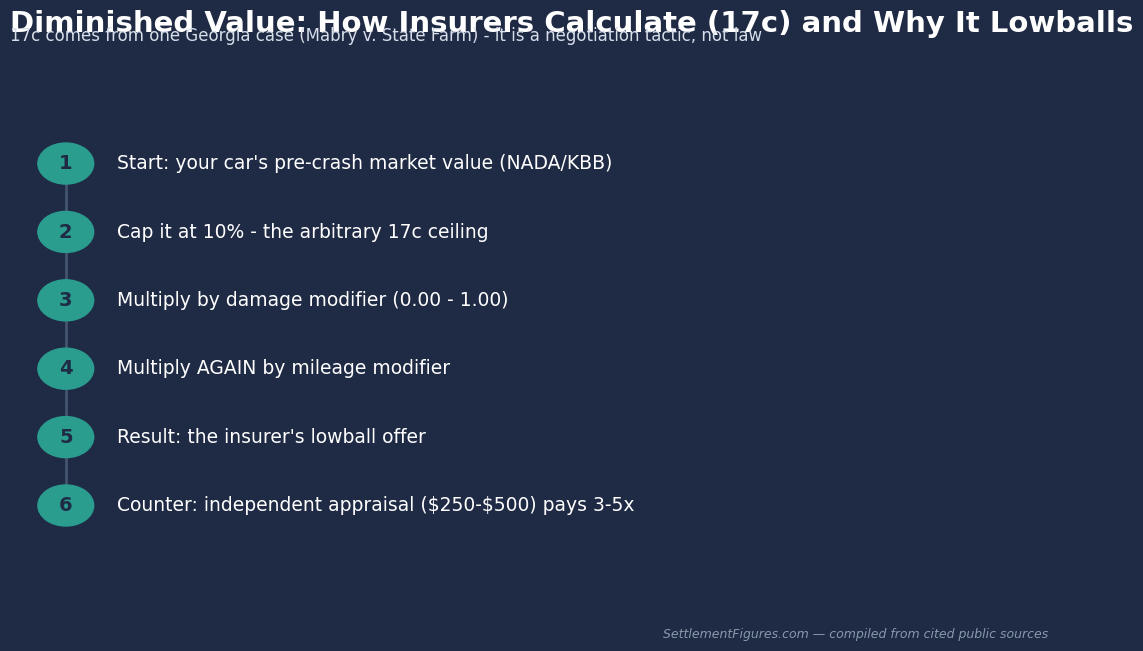
The 17c formula, exposed
Born from a single Georgia case (Mabry v. State Farm, 2001), the 17c method starts with your car’s pre-crash market value, caps the possible loss at an arbitrary 10%, then multiplies by a damage modifier (0.00-1.00) and AGAIN by a mileage modifier. Example: $25,000 car → $2,500 cap → ×0.75 moderate damage → ×0.60 mileage → $1,125 offer — for a car that lost $4,000-$6,000 of real resale value. Every multiplication is a discount stacked on a cap with no market basis.
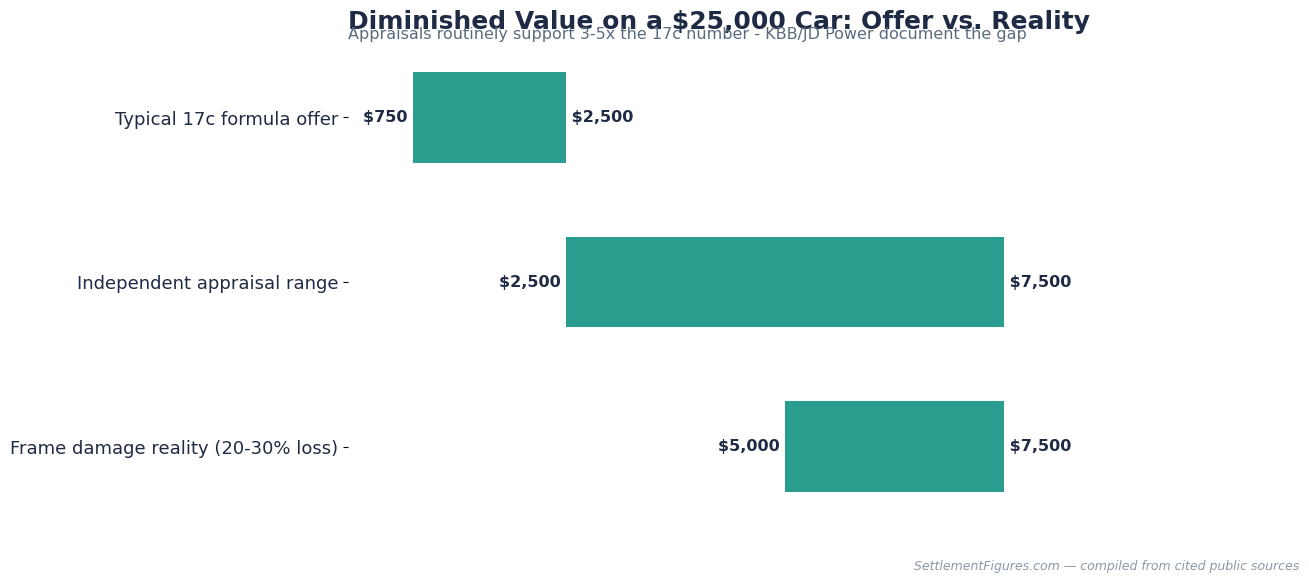
Three kinds of diminished value
Appraisers recognize three distinct losses, per InsureMojo’s 2026 guide. Inherent diminished value is the stigma loss: even after flawless repairs, a vehicle with an accident on its history report sells for less than an identical clean one. It is the most widely recognized type and the basis of nearly every successful claim. Repair-related diminished value adds the loss from imperfect work — mismatched paint, aftermarket parts, uneven panel gaps.
The third, immediate diminished value, is the drop between the crash and the repair; it matters mainly in litigation. When you write a demand letter, name the type you are claiming. Insurers sometimes “grant” a token repair-related amount while ignoring the far larger inherent loss, and separating the two on paper blocks that move.
What your claim is actually worth
| Damage level | 17c-style offer | Market reality |
|---|---|---|
| Minor (panels, no structure) | $500 – $1,200 | $1,500 – $3,000 |
| Moderate (airbags, quarter panel) | $900 – $2,500 | $2,500 – $7,500 |
| Frame / structural damage | $1,500 – $2,500 (capped!) | 20-30% of value — $5,000+ on a $25k car |
The gap in the table is not theoretical. Diminished Value of Georgia, an appraisal firm that handles these claims daily, reports a typical diminished value near $2,000, while first offers built on 17c often land around $300. In a 2025 example the same firm documented, an insurer facing an $8,000 repair bill offered $2,400 — the formula’s 10% cap doing exactly what it was designed to do. The Georgia Insurance Commissioner has instructed insurers that 17c is not legally determinative, and a USPAP-compliant independent appraisal overrides it in negotiation, per Expert Asset Protection.
How to actually collect
1) Claim against the AT-FAULT driver’s insurer (third-party) — first-party DV is excluded in most policies, Georgia being the famous exception. 2) Get an independent appraisal ($250-$500): appraisers document 3-5x the 17c figures using real dealer and auction data, per KBB and J.D. Power analyses. 3) Send a written demand attaching the appraisal, the CARFAX showing the reported accident, and comparable listings. 4) Refused? Same escalation as any dispute: appeal and state complaint path. Mind the deadline — DV follows property-damage statutes of limitation (2-6 years by state).
State rules shape both the deadline and the defendant. Georgia — the state that created the modern DV claim — allows first-party claims against your own insurer and gives you four years from the accident under its property-damage statute (O.C.G.A. § 9-3-31, per M. Austin Jackson Injury Lawyers). Most other states limit you to a third-party claim against the at-fault driver’s carrier, with property-damage windows running two to six years.
That third-party structure is why a fleeing driver usually ends a DV claim: with nobody identified, there is no liability carrier to demand from, and uninsured motorist property damage coverage rarely includes diminished value. If that is your situation, put your energy into the recoveries that do work — see your insurance options after a hit and run.
When DV is not worth chasing
Older cars (8+ years), high mileage, prior accidents on the history report, or damage under ~$2,000 usually produce DV too small to fight for. The sweet spot: vehicles under 5 years old, clean history, repair bills over $5,000 — there the diminished value often rivals the repair cost. Totaled instead of repaired? Different fight: total loss negotiation.
Free official help & resources
- Market value baselines: KBB.com · JDPower.com (both publish DV guidance)
- Vehicle history that proves the hit: your CARFAX/AutoCheck report
- Insurer refuses to engage: state insurance department via NAIC
- Small claims court: DV amounts often fit the limits — self-help via USA.gov
FAQ
The insurer says my state does not allow DV claims.
Third-party DV is recognized in the vast majority of states. Ask them to cite the statute — that sentence usually ends the bluff.
Can I claim DV if I never plan to sell?
Yes — the loss exists at the moment of the accident, not at resale. Courts value it at repair completion.
Leased car — who gets the money?
Usually the leasing company holds the right; check your lease. Some negotiate splits, since you eat the loss at turn-in inspection.
How is diminished value calculated?
Two competing ways. Insurers run 17c: pre-accident value, capped at 10%, multiplied by damage and mileage modifiers. Independent appraisers instead compare actual sale prices of clean-history vehicles against accident-history ones, which is why their figures routinely come out 3-5x higher, per KBB and J.D. Power analyses cited above.
How long do I have to file a diminished value claim?
It follows your state’s property-damage statute of limitations: four years in Georgia, and generally two to six years elsewhere. The practical deadline is earlier — appraisals and comparable listings are easiest to assemble in the first months after repair.
Can I claim diminished value if the at-fault driver was uninsured or fled?
Usually not — the claim targets the at-fault driver’s liability policy, and UM property damage coverage rarely extends to lost market value. Your recovery then runs through your own collision or UM coverage for the repair itself.
☕ This research is reader-supported. No law firm pays us. If this guide saved you time or money, you can buy the research team a coffee — it keeps the data free and updated.
This article is for informational purposes only and is not legal advice. Settlement values vary significantly by case and by state. Consult a licensed attorney in your state before making decisions about your claim.
