Last updated: August 17, 2026 · Data reviewed quarterly
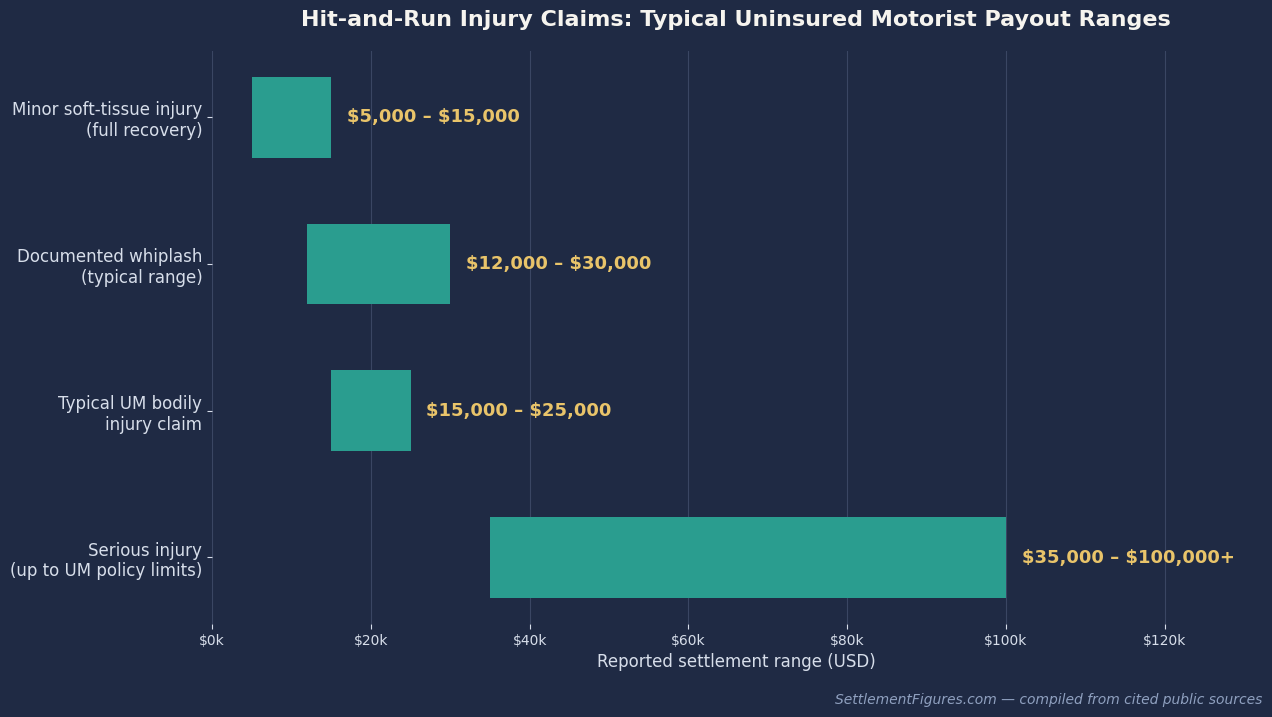
Hit by a driver who fled the scene? In most states, your own policy — not the missing driver’s — pays the claim. Uninsured motorist (UM) coverage treats an unidentified hit-and-run driver as uninsured, and typical UM bodily injury claims settle for $15,000 to $25,000, according to settlement data published by Florida injury attorney Justin Ziegler. Documented whiplash cases commonly resolve between $12,000 and $30,000, per Miller & Zois. Below: which coverage pays, the deadlines that can void your claim, and where to get free help.
| Claim scenario | Reported range | Source |
|---|---|---|
| Minor soft-tissue injury, full recovery | $5,000 – $15,000 | Scher & Bassett |
| Documented whiplash | $12,000 – $30,000 | Miller & Zois |
| Typical UM bodily injury claim | $15,000 – $25,000 | Justin Ziegler settlement data |
| Serious injury | $35,000 up to UM policy limits ($100,000+) | Compiled from Ziegler and Miller & Zois case reports |
What the Law Says After a Hit and Run
Leaving the scene of an injury crash is a crime in every state, and the problem is growing. The AAA Foundation for Traffic Safety counts an average of 682,000 hit-and-run crashes per year in the U.S., and in 2023 a fleeing driver was involved in 15% of all police-reported crashes — the highest share recorded. NHTSA data shows 2,872 people died in hit-and-run crashes in 2023, close to the record 2,972 deaths of 2022.
For victims, three legal clocks start immediately. First, the police report: some states require reporting within 24 hours, while Florida allows up to 10 days, according to LegalClarity. A prompt report also preserves surveillance footage before it is overwritten. Second, insurer notice: most policies require notice within 24 to 72 hours, and LegalClarity notes some UM provisions set windows as short as 30 days.
Third, coverage itself. Per the Insurance Information Institute (III), 22 jurisdictions require uninsured motorist coverage; elsewhere it is optional and you may have declined it in writing. Check your declarations page today — and note that Progressive and LegalClarity both flag that some states require evidence the phantom vehicle made physical contact with yours before UM applies.
Before any claim, lock down evidence at the scene: photos of the damage and debris, paint transfer on your car, the direction the other vehicle fled, and names of witnesses. Nearby doorbell or business cameras often capture plates — but many systems overwrite footage within days, so ask the same week.
Your Options: Which Coverage Pays
When the driver is never identified, there is no liability policy to claim against. Your recovery comes from coverage you already bought. Each option below has its own rules and ceilings.
| Coverage | What it pays after a hit and run | Watch for |
|---|---|---|
| UM bodily injury (UMBI) | Medical bills, lost wages, pain and suffering | Your UM limit is the ceiling on recovery |
| UM property damage (UMPD) | Vehicle repair or replacement | Deductibles of $100–$1,000; some states exclude unidentified drivers |
| Collision | Vehicle repairs regardless of fault | Your collision deductible applies |
| MedPay / PIP | Immediate medical bills, any fault | Lower limits, but pays fast |
| Health insurance | Ongoing treatment | May claim reimbursement from your settlement |
| State crime victim compensation | Out-of-pocket medical costs and lost wages | Requires a police report; apply through your state program |
The UM bodily injury claim is usually where the real money is, and it works much like a normal uninsured motorist claim: you document injuries, treatment and lost income, then negotiate with your own carrier up to your policy limit. If your damages are $200,000 and your UM limit is $30,000, you recover $30,000 — which is why coverage limits matter more here than in any other claim type.
For the car itself, UMPD or collision pays for repairs, and if the vehicle is beyond repair you can push back on the insurer’s valuation the same way as in any total loss payout negotiation. While the car is in the shop, rental reimbursement coverage — explained in our guide to who pays for your rental car after an accident — keeps you moving.
Red Flags When Your Own Insurer Handles the Claim
A UM claim quietly changes the relationship: your insurer now sits on the other side of the negotiation. Watch for a fast, low offer before treatment ends — once you sign a release, later medical bills are yours. Watch for repeated document requests that reset the clock, and for pressure to give a recorded statement in the first days after the crash.
Another red flag is the suggestion that pressing the claim will raise your rates. A not-at-fault UM claim generally should not increase your premium; The Zebra reports the average effect at roughly $98 per year, and states such as Colorado and Tennessee prohibit rate increases based solely on UM claims. If delay or lowballing crosses into stonewalling, that conduct can amount to a bad faith insurance claim, and a written denial can be challenged through a formal insurance claim appeal.
Where to Get Help
You do not need to pay anyone to get oriented. Your state insurance department reviews complaints about claim handling for free, legal aid programs handle injury questions for people who qualify, and every state runs a crime victim compensation fund that can cover out-of-pocket costs when the driver is never found.
Free official help & resources
- Your state insurance department — file a complaint about claim handling: content.naic.org/consumer (NAIC directory of every state regulator)
- State crime victim compensation — reimbursement for medical costs and lost wages: ovc.ojp.gov
- NHTSA — crash safety questions and complaints: nhtsa.gov · 1-888-327-4236
- Legal Services Corporation — find free legal aid near you: lsc.gov
- ABA Free Legal Answers — ask a volunteer lawyer online: freelegalanswers.org
- 211 — local help with medical bills and transportation: dial 2-1-1 or visit 211.org
Frequently Asked Questions
Does insurance cover a hit-and-run accident?
Usually, yes — through your own policy. Uninsured motorist coverage pays injury claims, while UMPD or collision coverage pays for vehicle damage. Liability-only policies generally leave you uncovered for your own losses.
Does uninsured motorist coverage pay for hit-and-run accidents?
In most states, an unidentified fleeing driver is treated as uninsured, which activates UM coverage. A minority of states require proof of physical contact with the phantom vehicle, per Progressive and LegalClarity.
How long do you have to report a hit and run?
Police deadlines run from 24 hours in some states to 10 days in Florida. Insurers commonly expect notice within 24–72 hours, and some UM provisions allow as little as 30 days. Report the same day if you can.
Will a hit-and-run claim raise my insurance rates?
It generally should not, because you were not at fault. The Zebra puts the average effect of a UM property claim near $98 per year, and some states — including Colorado and Tennessee — bar increases based solely on UM claims.
What happens if the hit-and-run driver is never found?
Your claim proceeds against your own coverage: UM for injuries, UMPD or collision for the car, MedPay or PIP for early bills. State crime victim compensation funds can also reimburse out-of-pocket losses.
Can I file a hit-and-run claim without a police report?
Some insurers will open a claim without one, but a police report is the strongest evidence that the crash happened as described, and crime victim compensation programs require it. File one even if the damage seems minor.
☕ This research is reader-supported. No law firm pays us. If this guide saved you time or money, you can buy the research team a coffee — it keeps the data free and updated.
This article is for informational purposes only and is not legal advice. Settlement values vary significantly by case and by state. Consult a licensed attorney in your state before making decisions about your claim.
