Last updated: August 19, 2026 · Data reviewed quarterly
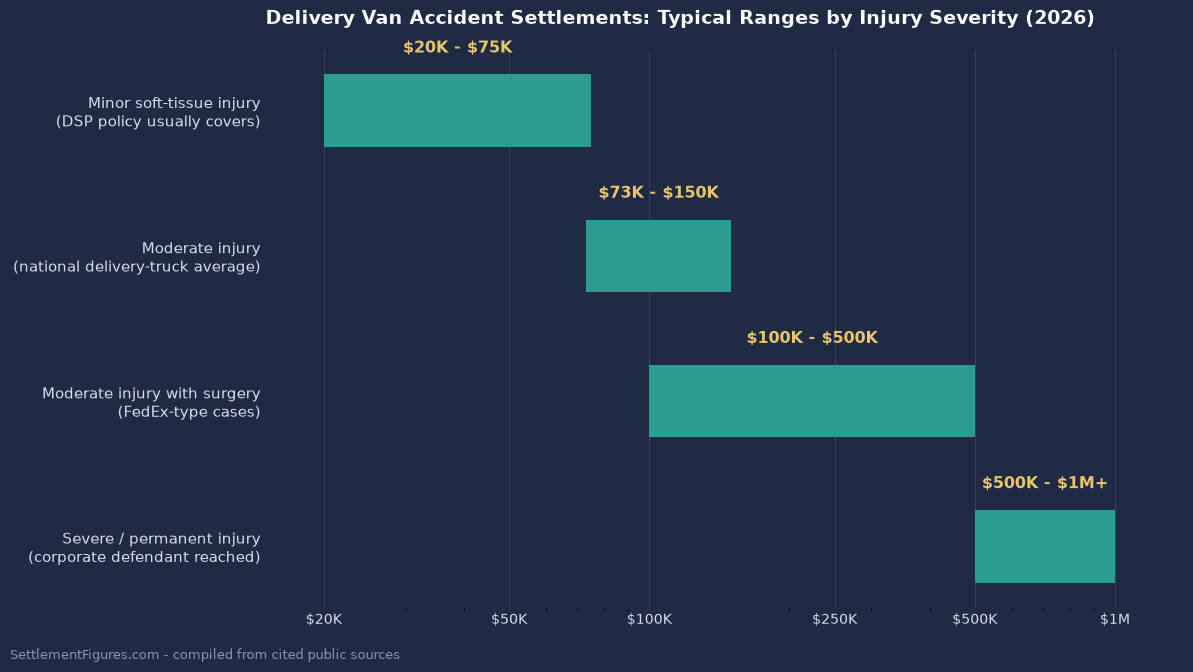
If a delivery van hit you, the money question has an unusually wide answer: most delivery van accident settlements fall between $20,000 and more than $1 million, according to 2026 case guides from Lawfold and Todd Miner Law. The spread is wide because the logo on the van — Amazon, FedEx, or UPS — changes which insurance policy pays, how large that policy is, and how hard the claim gets fought. The table below shows the ranges reported across cited sources; the rest of this guide explains where your case is likely to land and why.
| Scenario | Typical settlement range | Source |
|---|---|---|
| Minor soft-tissue injury | $20,000 – $75,000 | Lawfold; Todd Miner Law |
| Moderate injury (national delivery-truck average ≈ $103,654) | $73,000 – $150,000 | Kash Legal |
| Moderate injury requiring surgery | $100,000 – $500,000 | Uptown Injury; Lawsuit Information Center |
| Severe or permanent injury, corporate defendant reached | $500,000 – $1,000,000+ | Fuicelli & Lee; Trantolo & Trantolo |
What Real Delivery Van Settlements Look Like
Published results give the clearest picture of how these claims resolve. In 2025, Colorado firm Fuicelli & Lee reported a $500,000 settlement for a client rear-ended by an Amazon delivery driver who suffered a head injury, herniated discs, and a shoulder separation. Connecticut firm Trantolo & Trantolo reported a $1 million settlement for a motorcyclist struck by an Amazon delivery van. At the other end, Bottaro Law reported a $100,000 settlement for a mother and her children hurt in an Amazon truck crash.
Delivery vehicle cases tend to pay more than ordinary car crashes. The average jury award against large commercial carriers such as UPS runs about $510,000, versus roughly $34,000 for a standard car accident, according to an analysis by PI Law News. Oberg Law Office notes that in several 2024 and 2025 trials, juries awarded two to five times the insurer’s last settlement offer — pressure that pushes companies to settle credible claims.
Company patterns differ as well. FedEx claims most often resolve between $75,000 and $110,000 for typical injury cases, per Uptown Injury, while UPS settlements average above $90,000 with far larger results at trial, according to SetCalc’s 2026 settlement guides. Amazon results scatter more widely because the DSP structure caps many claims at the partner’s policy unless Amazon itself can be reached.
Who Is Actually Behind the Van — and Why It Decides Who Pays
Before anything else, photograph the van and its door decals: with Amazon vans, the DSP company name — not Amazon — is what appears on the police report and the insurance certificate, and claimants regularly lose weeks chasing the wrong company. The three big delivery networks use three different employment models, and each one changes your claim. UPS drivers are W-2 employees, so UPS itself is directly responsible for crashes its drivers cause under the doctrine of respondeat superior. UPS is also largely self-insured, meaning the company — not a third-party insurer — pays claims up to a set retention, as PI Law News explains.
FedEx Ground runs an Independent Service Provider (ISP) model: the driver usually works for a small contractor company, not FedEx. That adds a layer between you and FedEx, though FedEx maintains liability coverage with a combined single limit of about $5 million, according to PI Law News. FedEx Express drivers, by contrast, are direct employees.
Amazon is the most complicated. Most branded Amazon vans are operated by Delivery Service Partners (DSPs) — separate small businesses Amazon requires to carry at least $1 million in liability coverage, a figure confirmed by Block O’Toole & Murphy, Sam Aguiar Injury Lawyers, and Justice Counts. Amazon Flex drivers deliver in their own cars, where personal auto policies often exclude commercial driving. Sorting out which entity controlled the driver is the core of how liability is assigned in commercial vehicle cases.
Reaching the parent company matters because a DSP’s $1 million policy can be exhausted by one serious injury. Courts have allowed it: in a 2021 South Carolina case cited by Justice Counts, Amazon was found vicariously liable for a DSP driver’s conduct because of the control Amazon exercised over routes, schedules, and performance metrics.
The Formula Insurers Use
Adjusters in delivery van cases start the same way they do in any injury claim: they total your economic losses — medical bills, projected future treatment, lost wages — and apply a multiplier for pain and suffering that grows with injury severity. Two things distinguish delivery claims from ordinary crashes.
First, the policy ceiling is higher. Federal Motor Carrier Safety Administration rules require carriers operating vehicles over 10,001 pounds — which includes most step vans — to carry at least $750,000 in liability coverage, and the corporate policies stacked above that reach into the millions. Second, the defendant is a company with lawyers on retainer, so weak claims get fought harder and strong claims settle for more than the averages seen in commercial truck settlements would suggest for the same injury against an individual driver.
A realistic example: a claimant with $40,000 in medical specials, $8,000 in lost wages, and a full recovery might see offers between $90,000 and $140,000 — roughly a doubling of specials plus wages. The same bills with a permanent impairment support multipliers of three to five, which is how surgical cases reach the $100,000–$500,000 tier reported by Uptown Injury.
What Increases a Delivery Van Settlement
Injury severity drives value most: surgery, permanent impairment, or a brain injury moves a claim from the $20,000–$75,000 tier into six or seven figures. Beyond that, the strongest lever is evidence of company-level negligence. FMCSA violations — hours-of-service breaches, skipped brake inspections, poor maintenance records — become powerful proof of negligence, as both FindTheLawyers and SetCalc document.
Delivery fleets also generate their own evidence. Many vans carry onboard cameras and telematics that record speed, braking, and phone use; preserved early, that data can settle a fault dispute in your favor. Evidence that Amazon controlled a DSP driver’s routes and quotas can open the door to Amazon itself — and to policy limits far above the DSP’s $1 million.
Act quickly on evidence. Camera footage and telematics are routinely overwritten within weeks, so attorneys send preservation letters immediately after a crash to force the company to retain video, GPS logs, and the driver’s delivery-app records. A documented pattern of missed rest breaks or impossible quota schedules on the day of the crash supports a negligence case against the company, not just the driver.
What Decreases It
Shared fault cuts recoveries directly: in most states your settlement drops by your percentage of blame, and a handful of contributory negligence states bar recovery entirely if you share any fault. Gaps in medical treatment give adjusters an argument that you were not seriously hurt.
Early moves matter too. Todd Miner Law and other firms warn against accepting a quick offer or giving a recorded statement before the full extent of your injuries is known — early offers tend to reflect the insurer’s target, not your losses. Flex-driver crashes carry a special trap: the driver’s personal insurer may deny the claim as excluded commercial activity, leaving you to chase Amazon’s contingent coverage instead.
Pre-existing conditions are the other workhorse argument. Adjusters comb prior medical records for old back or neck complaints and attribute your symptoms to them; consistent treatment records and a physician who documents the difference between old and new injury blunt the tactic.
Do You Need a Lawyer?
For a property-damage-only claim, or a minor injury that healed fully with a clear at-fault driver, you can often negotiate directly with the DSP’s or carrier’s insurer. Keep records, get the police report, and compare any offer against your total bills before signing anything.
For anything involving surgery, lasting symptoms, disputed fault, or an Amazon-branded van, the calculus changes. These cases involve layered corporate defendants, contract structures built to limit exposure, and evidence — telematics, driver logs, DSP contracts — you cannot subpoena on your own. Injury attorneys handle these claims on contingency, typically 33–40% of the recovery, so the practical question is whether representation is likely to add more than it costs in your specific case.
If you handle a claim yourself, put every communication in writing, ask for the DSP’s or carrier’s certificate of insurance, and never sign a release until treatment is finished — a signed release ends the claim even if new symptoms appear later.
State Differences That Change Your Payout
Where the crash happened matters as much as who hit you. Statutes of limitations for injury claims run from one year to six, most commonly two or three — miss the deadline and the claim is gone. Fault rules vary too: pure comparative negligence states pay you even if you were mostly at fault, modified comparative states cut you off at 50% or 51%, and contributory negligence jurisdictions (Alabama, Maryland, North Carolina, Virginia, D.C.) can bar recovery over 1% of fault.
State minimum auto policies (often $25,000–$50,000 per person) are also why being hit by a delivery van is a financially different event from an ordinary crash: the commercial policies behind delivery fleets start at ten to forty times the personal minimums, which changes what a serious injury can actually recover.
Timing follows a fairly consistent pattern regardless of state. Straightforward claims with clear fault settle in about 4–6 months, while contested delivery cases typically run 12–18 months, according to Lawfold and the Law Offices of Norman Gershon — a rhythm that mirrors the stages of a commercial truck settlement.
Free official help & resources
- FMCSA — report an unsafe commercial carrier or file a complaint: fmcsa.dot.gov · 1-888-368-7238
- NHTSA Vehicle Safety Hotline — report vehicle safety defects: nhtsa.gov · 1-888-327-4236
- NAIC — file a complaint against an insurer with your state regulator: content.naic.org/consumer
- Legal Services Corporation — find free legal aid near you: lsc.gov
- ABA Free Legal Answers — ask a volunteer attorney online: freelegalanswers.org
- IRS Publication 4345 — how settlement money is taxed: irs.gov · or dial 211 for local help
Frequently Asked Questions
Can I sue Amazon directly if their delivery driver hit me?
Sometimes. Most Amazon vans are run by separate DSP companies, so the claim usually starts with the DSP’s $1 million policy. Courts have held Amazon itself liable where it exercised significant control over the driver’s routes, schedule, and performance — as in the 2021 South Carolina case cited by Justice Counts — or was negligent in selecting and monitoring its partners.
Who is liable when an Amazon delivery driver causes an accident?
Usually the DSP that employs the driver, through its required $1 million liability policy. The driver personally, Amazon, and — for Flex drivers — Amazon’s contingent commercial coverage can also be in play depending on who controlled the work and whether the driver was actively delivering.
What is the average delivery truck accident settlement?
Kash Legal puts the national average at about $103,654, with typical results between $73,000 and $150,000. Minor-injury claims settle well below that, while surgical and permanent-injury cases against corporate defendants regularly exceed $500,000.
How long does a delivery van accident settlement take?
About 4–6 months for simple claims with clear fault, and 12–18 months for typical contested cases, per Lawfold. Disputed liability, multiple policies, or severe injuries push timelines past two years, especially if a lawsuit is filed.
Are FedEx and UPS drivers employees of the company?
UPS drivers and FedEx Express drivers are direct employees, which makes the parent company answerable for their driving. FedEx Ground drivers typically work for independent contractor businesses under the ISP model, so claims there run through the contractor first.
What should I do right after being hit by a delivery van?
Call 911 and get a police report, photograph the van (including any company or DSP name on the door and the license plate), collect the driver’s name and insurance details, and get medical care the same day. Decline recorded statements and early offers until you know the full extent of your injuries.
☕ This research is reader-supported. No law firm pays us. If this guide saved you time or money, you can buy the research team a coffee — it keeps the data free and updated.
This article is for informational purposes only and is not legal advice. Settlement values vary significantly by case and by state. Consult a licensed attorney in your state before making decisions about your claim.
