Last updated: August 19, 2026 · Data reviewed quarterly
In a car crash you sue a driver. In a truck crash you may have claims against six different parties — driver, carrier, broker, maintenance shop, cargo loader and manufacturer — each with its own policy. Finding every liable party is the single biggest value lever in truck settlements.
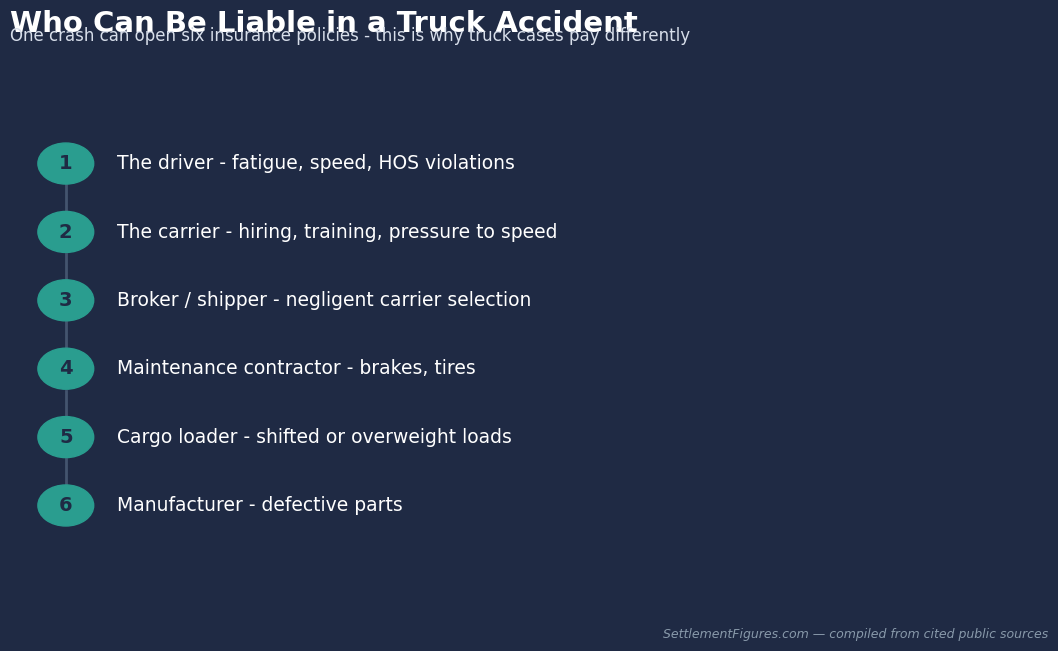
The six potential defendants
| Party | Liable when | Why it matters |
|---|---|---|
| Driver | Fatigue, speeding, impairment, HOS violations | Baseline claim; logs prove it |
| Motor carrier | Negligent hiring/training, pushing schedules, vehicle condition | Vicarious liability + the big policy |
| Broker / shipper | Hired a carrier with a bad safety record | A growing theory with real verdicts |
| Maintenance contractor | Brake, tire, light failures | Third-party policy stacks on top |
| Cargo loader | Shifted or overweight loads | Load-securement rules are strict |
| Manufacturer | Defective brakes, tires, underride guards | Product liability — different clock |
When the company answers for the driver
Employee drivers put their employer on the hook automatically: under respondeat superior, a carrier is liable for crashes its drivers cause within the scope of work. That is why claims against UPS — whose drivers are W-2 employees — run straight at the company, while FedEx Ground and Amazon route deliveries through contractor firms that carry their own policies. The contractor structure is not a dead end: in a 2021 South Carolina case cited by Justice Counts, Amazon was found vicariously liable for a Delivery Service Partner driver because Amazon controlled routes, schedules and performance metrics. How those delivery van claims against Amazon, FedEx and UPS actually work is covered in our dedicated guide.
Negligent hiring and supervision is the second path. A carrier that put a driver with a suspended CDL, prior DUIs or a failed drug test behind the wheel is directly negligent — separate from the driver’s own fault. Driver qualification files, which federal rules require carriers to keep, are where those cases are made. Requesting them early — before retention windows lapse — is standard discovery practice, and a carrier that cannot produce them faces spoliation sanctions.
The broker theory, in practice
Freight brokers pick which carrier hauls a load. When a broker hires a carrier with a poor safety record — visible for free in FMCSA’s public SMS database — plaintiffs argue negligent selection. It matters because broker liability adds a policy that is not capped by the carrier’s coverage. Brokers respond that federal law preempts these claims, and courts remain split, so outcomes vary by circuit.
Why finding every defendant changes the number
Federal rules set the floor: carriers hauling general freight in vehicles over 10,001 pounds must carry at least $750,000 in liability coverage, and most carry $1 million. One policy is often enough for a moderate case — truck settlements average about $103,654 per Brown & Crouppen — but a catastrophic injury exhausts it quickly.
Each added defendant stacks another policy: the maintenance contractor’s commercial coverage, the broker’s errors-and-omissions policy, the manufacturer’s product-liability coverage. In severe-injury cases the difference between suing the driver alone and pursuing all six parties is routinely the difference between a policy-limits settlement and full compensation.
The evidence that decides it — and its expiration dates
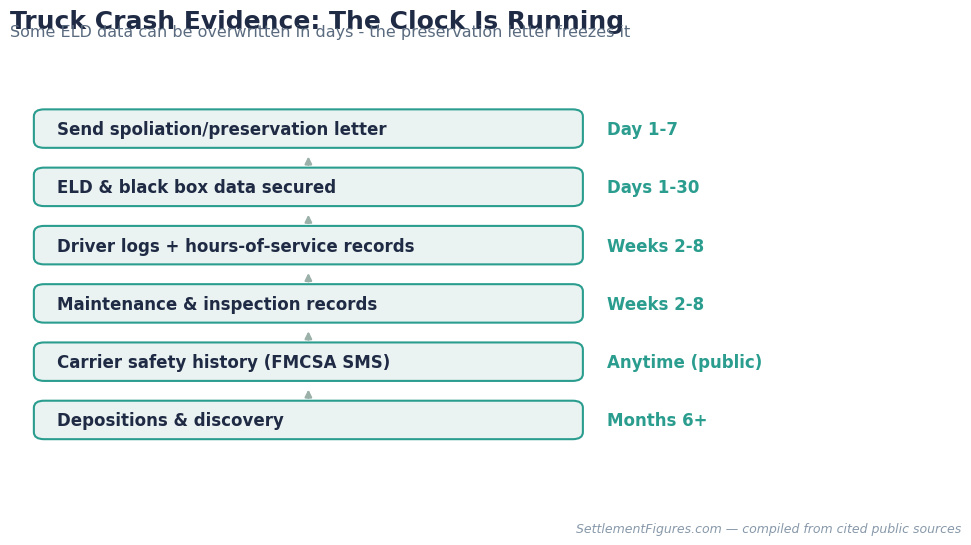
Modern trucks are rolling data centers: engine control modules, ELDs, dashcams, GPS pings, dispatch messages. But some of that data can be overwritten within days and trucks get repaired or salvaged fast. The single most important early move is a spoliation (preservation) letter to the carrier and its insurer — it legally freezes the black box, camera footage, logs, inspection records and the truck itself. Sent in week one, it preserves the case; skipped, the best evidence often “no longer exists.” Federal rules give carriers only six months to retain driver duty records (49 CFR 395.8), which is why the first 60 days set the pace of the entire truck accident settlement timeline.
HOS: the violation hiding in plain sight
Federal hours-of-service rules cap driving at 11 hours within a 14-hour window with mandated breaks. ELD data comparing driving time against pickup/delivery stamps regularly exposes violations — and a carrier whose dispatch schedule REQUIRED breaking HOS turns an accident case into a negligence-per-se case with punitive exposure. This is why carriers settle documented-fatigue cases before trial.
One crash, many policies — how they stack
The carrier’s $1M policy pays first; maintenance contractors, brokers and manufacturers add theirs above it. In catastrophic cases, layered “excess” policies (carriers often hold $5M+ in umbrella coverage) come into play. Your own underinsured-motorist coverage can top up the stack too. The practical takeaway: never assume the first disclosed policy is the whole pie — demand disclosure of ALL coverage in discovery.
Fault allocation works the same math in reverse: every percentage point assigned to you comes off the total, and in contributory negligence states (Alabama, Maryland, North Carolina, Virginia, D.C.) any share of fault can bar recovery. Carriers argue comparative fault aggressively — another reason documented evidence beats recollection.
Remember the imbalance you are up against: carriers dispatch investigators to serious crash scenes within hours, photographing skid marks, downloading the engine module and interviewing witnesses while the claimant is still in the emergency room. The defense starts building its file on day one — nothing equivalent happens on your side unless you make it happen.
Free official help & resources
- Carrier safety history & crash records (free, public): FMCSA SMS · company snapshot at SAFER.fmcsa.dot.gov
- Hours-of-service rules (what counts as a violation): fmcsa.dot.gov/regulations/hours-of-service
- Report a dangerous carrier: 1-888-368-7238
- Free legal aid: LSC.gov
FAQ
The police report only names the driver. Is that final?
No — police assign traffic fault, not civil liability. Carrier, broker and maintenance liability emerge from records, not the roadside.
What does a preservation letter cost?
An attorney sends it as routine intake — effectively free with representation. Template letters exist for the determined self-represented, but serious truck cases justify counsel: when self-representation works (and when it does not).
The trucking company already called me offering help. Normal?
That is the rapid-response team working. Be polite, give no statement, sign nothing — their job is locking your story before you know your injuries.
Can more than one party be liable at the same time?
Yes — that is the norm, not the exception. A fatigued driver, a carrier that pushed the schedule and a broker that hired that carrier can all share liability for one crash, each through its own insurer. Settlements then apportion payment among the policies.
Who is liable if the driver was an independent contractor?
The contractor’s own commercial policy pays first — Amazon, for example, requires its Delivery Service Partners to carry $1 million in coverage, per Block O’Toole and Sam Aguiar Injury Lawyers. The hiring company can still be reached where it controlled the work or selected the contractor negligently.
Does the trucking company’s insurer pay my medical bills as they come in?
No. The liability insurer pays once, at the end, against a signed release. Your own health insurance, med-pay coverage or letters of protection fund treatment in the meantime — a gap adjusters use as leverage for early lowball offers.
☕ This research is reader-supported. No law firm pays us. If this guide saved you time or money, you can buy the research team a coffee — it keeps the data free and updated.
This article is for informational purposes only and is not legal advice. Settlement values vary significantly by case and by state. Consult a licensed attorney in your state before making decisions about your claim.
