Last updated: August 14, 2026 · Data reviewed quarterly
Shoulder claims sit near the top of workers’ comp payouts for a reason: rotator cuff tears rarely heal on their own, surgery is common, and many workers never regain full overhead strength. NCCI puts the average arm/shoulder claim at $55,115 — and surgical cases typically run 2-4× their non-surgical equivalents.
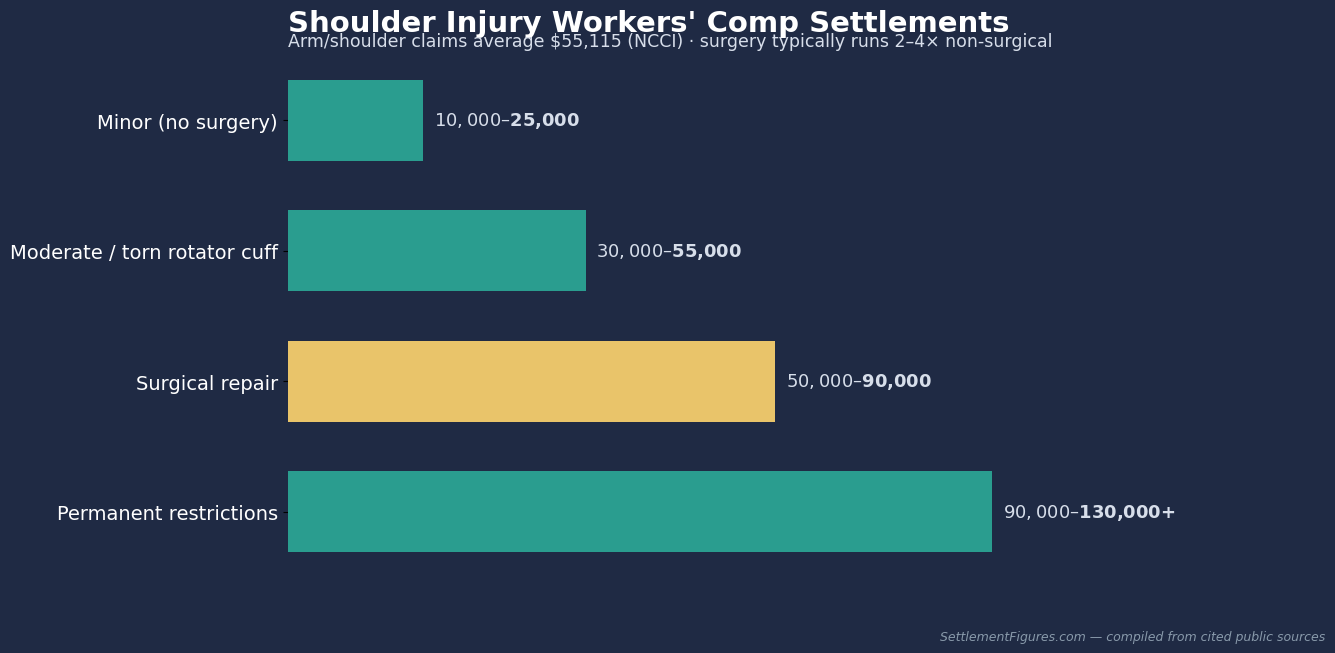
Ranges you can benchmark against
| Shoulder injury profile | Typical settlement |
|---|---|
| Strain/tendinitis, full recovery, no surgery | $10,000 – $25,000 |
| Partial rotator cuff tear, conservative care | $30,000 – $55,000 |
| Surgical repair (cuff, labrum), good outcome | $50,000 – $90,000 |
| Surgery + permanent restrictions | $90,000 – $130,000+ |
The single biggest driver is the impairment rating your doctor assigns at MMI — understand it before you talk numbers: how PPD ratings turn into money.
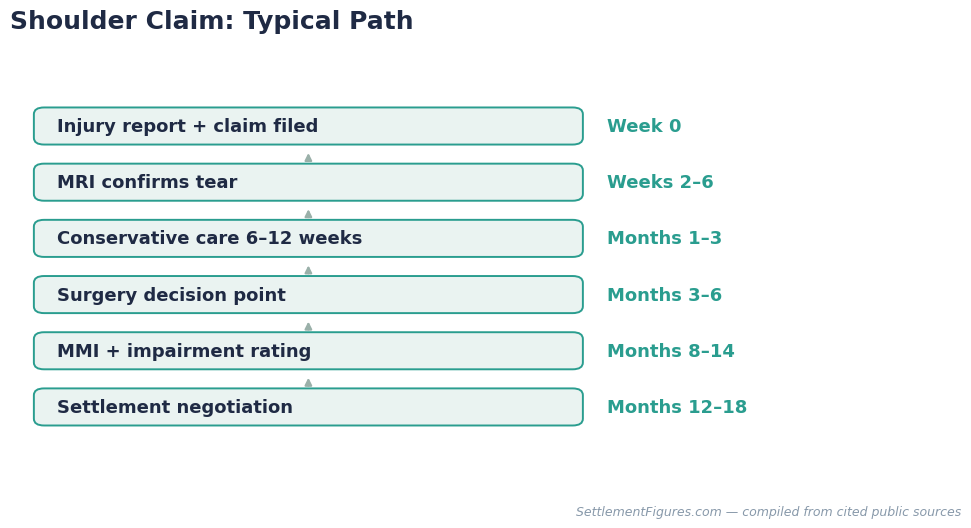
The typical shoulder claim path
Report and claim (week 0) → MRI confirms the tear (weeks 2-6) → conservative care trial (months 1-3) → surgery decision (months 3-6) → MMI and rating (months 8-14) → negotiation (months 12-18). Settling before the surgery decision means pricing the unknown — insurers love that; you should not.
What raises a shoulder settlement
MRI-documented tears (not just reported pain), a job requiring overhead work (higher wage-loss exposure), permanent lifting restrictions, dominant-arm involvement, and consistent treatment. What lowers it: degenerative findings the insurer blames on age, treatment gaps, and returning to full duty before your rating.
How shoulder settlements are calculated
In most states the shoulder is valued as a scheduled member or as loss of use of the arm. The formula has three inputs: your average weekly wage, the number of weeks your state assigns to the arm, and the impairment percentage your doctor certifies at maximum medical improvement. Multiply them and you have the indemnity core of the settlement.
Example: a state assigning 250 weeks to the arm, a 15% impairment rating, and a $700 comp rate (two-thirds of a $1,050 wage) yields 37.5 weeks × $700 = $26,250 in PPD money — before adding future medical or wage-loss components. That is why two workers with identical MRIs settle for very different amounts. The claim itself has to be filed correctly first; see how to file a workers’ comp claim step by step.
Surgery vs. no surgery: what the data shows
The 2026 numbers split cleanly. WorkCompCalc puts the average shoulder settlement at $47,350, with rotator cuff tears averaging about $28,500 without surgery and $82,400 with surgical repair. Attorney-published guides report typical rotator cuff settlements of $25,000–$75,000, with full-thickness tears requiring reconstruction reaching $120,000–$200,000.
State data runs lower than national averages: 2024 Florida settlement data put the average upper-extremity claim at $25,000–$30,000, according to attorney analyses of state filings. The gap between averages and surgical cases is the whole negotiation: insurers anchor to the state average, while your demand should price the actual surgical outcome and restrictions.
When you can claim beyond workers’ comp
Workers’ comp is exclusive against your employer, but not against everyone. If a defective ladder, a negligent subcontractor, or a third-party driver caused the shoulder injury, a separate liability claim can add pain-and-suffering damages comp never pays. The two systems value the same injury very differently — the comparison is here: workers’ comp vs. personal injury lawsuit.
Reading your impairment rating
Most states rate shoulders under the AMA Guides, and the difference between a 5% and a 15% upper-extremity rating can move a settlement by tens of thousands of dollars. Ratings reflect measured range of motion, residual weakness, and whether hardware or an arthroplasty was involved — not how much the shoulder hurts. If the insurer’s doctor rates you low, nearly every state gives you a path to a second rating: an independent medical examination, your treating surgeon’s rating, or a state-appointed examiner.
Before agreeing to close the claim, price the future medical component honestly. Rotator cuff repairs re-tear in a meaningful share of cases, and a full-and-final settlement usually ends the insurer’s obligation to pay for revision surgery. If you are on or near Medicare, a Medicare set-aside may be required, and that money is restricted to injury-related care.
Should you accept the first offer?
First offers on shoulder claims tend to arrive before maximum medical improvement, precisely when the value is least knowable. An offer made before your rating exists is an offer priced on the insurer’s optimism, not your outcome. Waiting for MMI, the final rating, and a written set of work restrictions converts guesswork into arithmetic — and arithmetic is much harder for an adjuster to argue down.
The counterweight is time: contested shoulder claims with surgery routinely take 12 to 18 months to resolve. If you need money sooner, some states allow partial advances or stipulated agreements that keep medical open while paying indemnity now. Ask your board — the option exists more often than adjusters volunteer it.
Free official help & resources
- State board directory: dol.gov/agencies/owcp
- Second medical opinion: most states allow an independent medical exam — ask your board how to request one
- Free legal aid: LSC.gov · ABA Find Legal Help
- Unsafe conditions caused it? OSHA 1-800-321-6742
FAQ
My MRI shows a tear but the insurer blames arthritis.
Common tactic. An aggravation of a pre-existing condition is still compensable in most states — your treating doctor’s causation opinion is the battleground, and a second opinion helps.
Do I settle before or after surgery?
After, in most cases: the outcome swings value by tens of thousands. Context: average settlements by injury.
Light duty pays less. Does comp cover the gap?
Usually yes — temporary partial disability typically pays about two-thirds of the wage difference.
What is the average workers’ comp settlement for a shoulder injury?
About $47,350 in 2026 according to WorkCompCalc, consistent with NCCI’s $55,115 average cost for arm and shoulder claims. Non-surgical strains settle well below that; surgical rotator cuff repairs average roughly $82,400 and severe reconstructions exceed $150,000.
Can I be fired while on workers’ comp for a shoulder injury?
Retaliation for filing is illegal in every state, but most employment remains at-will and layoffs for unrelated reasons stay legal. Timing and documentation decide these disputes — know your rights if you’re fired while on comp.
☕ This research is reader-supported. No law firm pays us. If this guide saved you time or money, you can buy the research team a coffee — it keeps the data free and updated.
This article is for informational purposes only and is not legal advice. Settlement values vary significantly by case and by state. Consult a licensed attorney in your state before making decisions about your claim.
