Last updated: August 14, 2026 · Data reviewed quarterly
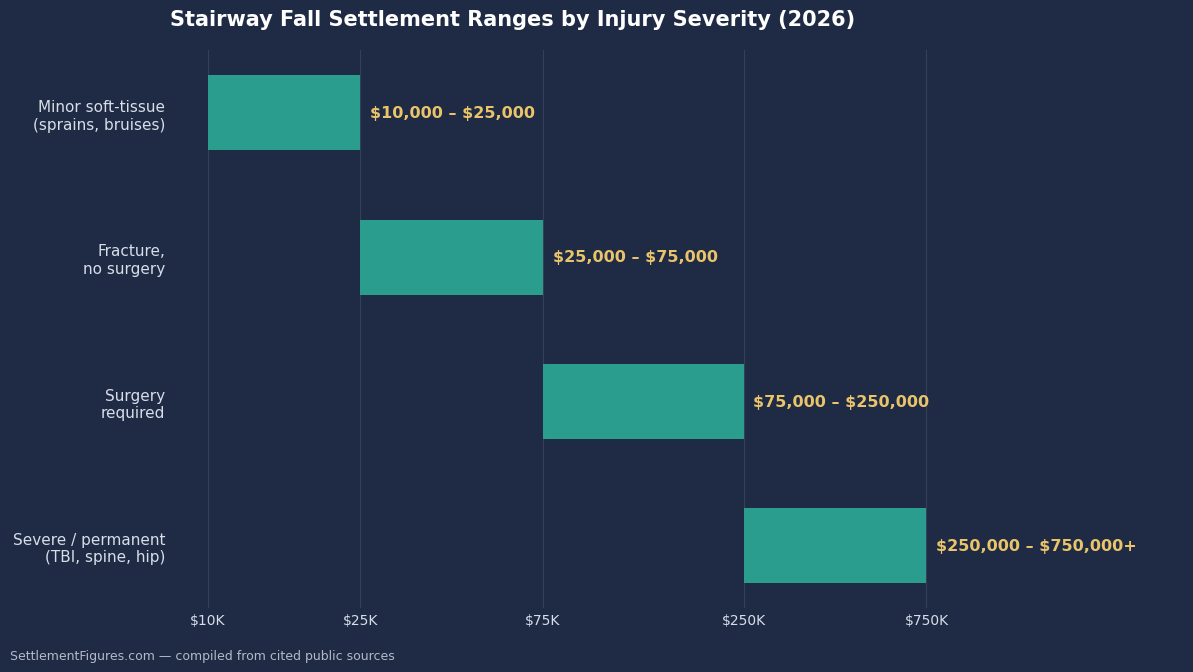
Most stairway fall settlements in the U.S. resolve for between $10,000 and $75,000, and the typical slip-and-fall claim settles in the $20,000–$50,000 range, according to the law firm Miller & Zois. Cases that require surgery commonly reach $75,000–$250,000, and permanent injuries — hip fractures, spinal damage, traumatic brain injury — regularly exceed $250,000 in published 2025–2026 results. Stairs earn their reputation: falls on stairs send roughly 1 million Americans to emergency rooms every year, based on a national study published in the American Journal of Emergency Medicine, and the CDC recorded 2,521 deaths from falls on stairs and steps in a single year.
| Injury severity | Typical settlement range | Source |
|---|---|---|
| Minor soft-tissue (sprains, bruising) | $10,000 – $25,000 | ConsumerShield (2026); attorney-published guides |
| Fracture, no surgery | $25,000 – $75,000 | Miller & Zois; 2026 settlement guides |
| Surgery required | $75,000 – $250,000 | 2026 attorney settlement reports (multiple) |
| Severe / permanent (TBI, spine, hip) | $250,000 – $750,000+ | Published 2025–2026 verdicts and settlements |
What Real Stairway Settlements Look Like
Published results show how widely stairway cases spread. A tenant who fell through rotted wooden stairs at an apartment complex recovered $890,000. A 78-year-old who suffered a fractured hip and spinal cord damage in a poorly maintained stairwell recovered $1,500,000. At the other end, Miller & Zois reports a $9,200 Maryland verdict for minor injuries in a dimly lit stairway.
The injury mix explains the spread. In the national emergency-department study, sprains and strains made up 32.3% of stair-fall injuries, soft-tissue injuries 23.8%, and fractures 19.3% — and it is the fracture-and-surgery minority that generates most of the settlement dollars. Legs, ankles and feet were hurt most often, followed by head and neck injuries.
The middle matters more than the extremes. Miller & Zois puts the median premises liability jury verdict at $100,000 nationally — but most claims settle before trial for considerably less. One jury awarded $1.17 million for a stairway fall, then reduced it to $740,184 because the injured person was found partly at fault.
The Formula Insurers Use
Adjusters start with your economic losses — medical bills, projected future treatment, and lost wages — then apply a multiplier, usually between 1.5 and 5, to value pain and suffering. A claim with $20,000 in bills and a multiplier of 2 lands near $60,000 before any fault reduction. We break down how adjusters pick that number in our guide to the multiplier method.
Stairway claims have a second layer: liability strength. The same broken hip is worth far more when a building code violation makes negligence easy to prove than when the insurer can argue you simply missed a step.
What Increases a Stairway Settlement
Building code violations lead the list. Missing or loose handrails, uneven riser heights, worn tread edges, and inadequate lighting all violate model codes adopted across the U.S., and Nolo notes that a code violation can create a presumption of negligence against the owner. Photographs of the defect taken the day of the fall are often the single most valuable piece of evidence — our guide on proving a slip and fall case covers what to capture.
Prior complaints help too. Maintenance requests, earlier incident reports, or inspection citations show the owner knew about the hazard. Documented wage loss and a clear surgical record push values toward the upper end of each range.
What Decreases It
Comparative fault is the biggest deduction. Insurers argue you were on your phone, skipped the handrail, or wore unsuitable footwear — and every percentage point of fault assigned to you comes off the payout, as the $1.17 million verdict cut to $740,184 shows.
Gaps in medical treatment, no incident report, and vague fall descriptions also depress offers. If the fall happened on stairs inside a business, the retailer’s incident procedures shape the record from day one — our guide to claims against retailers explains how those claims work.
Do You Need a Lawyer?
For minor soft-tissue claims under roughly $10,000, some people negotiate directly. For anything involving a fracture, surgery, or a disputed code violation, premises cases reward representation: they turn on expert testimony about code compliance and on evidence the owner controls, such as maintenance logs and camera footage. Most premises liability attorneys work on contingency, typically 33–40% of the recovery.
State Differences That Change Your Payout
Two rules vary sharply by state. First, the deadline: statutes of limitations for premises claims run two years in California, Texas, Georgia, and Florida, and three years in New York. Miss it and the claim is gone regardless of merit.
Second, the fault rule. Pure comparative states like California and New York pay even a 60%-at-fault claimant their remaining share. Modified comparative states, including Texas and Georgia, cut off recovery at 50–51% fault. A handful — Maryland, Virginia, North Carolina, Alabama, and D.C. — still apply contributory negligence, where even 1% of fault can bar recovery entirely, per Nolo. Where your stairs are located can matter as much as how badly you were hurt; see how ranges shift in our slip and fall settlement averages by injury.
Free official help & resources
- CDC Falls Prevention — risk factors and prevention guidance: cdc.gov/falls
- Legal Services Corporation — find free legal aid near you: lsc.gov
- ABA Free Legal Answers — ask a volunteer lawyer at no cost: freelegalanswers.org
- NAIC Consumer Resources — file a complaint against an insurer: content.naic.org/consumer
- OSHA — if you fell on stairs at work: osha.gov · 1-800-321-6742
- 211 — local help with medical bills and recovery support: dial 211 or 211.org
Frequently Asked Questions
How much compensation do you get for falling down stairs?
Most claims settle between $10,000 and $75,000 depending on injury severity, with the average slip-and-fall settlement around $30,000 according to ConsumerShield. Surgery pushes cases into six figures; permanent injuries can exceed $750,000.
Can you sue for falling down the stairs?
Yes, if a dangerous condition — a broken step, missing handrail, poor lighting, or debris — caused the fall and the owner knew or should have known about it. Falling alone is not enough; you must tie the fall to the owner’s negligence.
Who is liable if you fall down stairs with no handrail?
Usually the property owner, and sometimes a landlord, property manager, or contractor. Building codes require handrails on most stairways, and Justia notes a code violation is strong evidence of negligence — some courts treat it as negligence per se.
How do you prove negligence in a stairway fall case?
Photograph the defect immediately, report the fall in writing, identify witnesses, and get medical care the same day. Code-compliance measurements — riser height, tread depth, handrail height — often decide these cases, which is why experts get involved early.
How long do I have to file a claim after falling down stairs?
Typically two to three years from the date of the fall, depending on your state — two years in California, Texas, Georgia, and Florida; three in New York. Claims against government-owned property can require notice within months.
What if I was partly at fault for my fall?
In most states you can still recover, minus your percentage of fault. But in contributory negligence jurisdictions — Maryland, Virginia, North Carolina, Alabama, and D.C. — any fault on your part can eliminate the claim, so the fault fight matters enormously there.
☕ This research is reader-supported. No law firm pays us. If this guide saved you time or money, you can buy the research team a coffee — it keeps the data free and updated.
This article is for informational purposes only and is not legal advice. Settlement values vary significantly by case and by state. Consult a licensed attorney in your state before making decisions about your claim.
