
Last updated: July 7, 2026 · Data reviewed quarterly
Nationwide, the average workers’ compensation settlement is $44,179 (National Safety Council, 2024 release), with lost-time claims averaging about $41,000 per NCCI data. But averages hide the real story: what your claim pays depends overwhelmingly on the body part, whether you needed surgery, and whether any disability is permanent.
Settlement ranges by severity
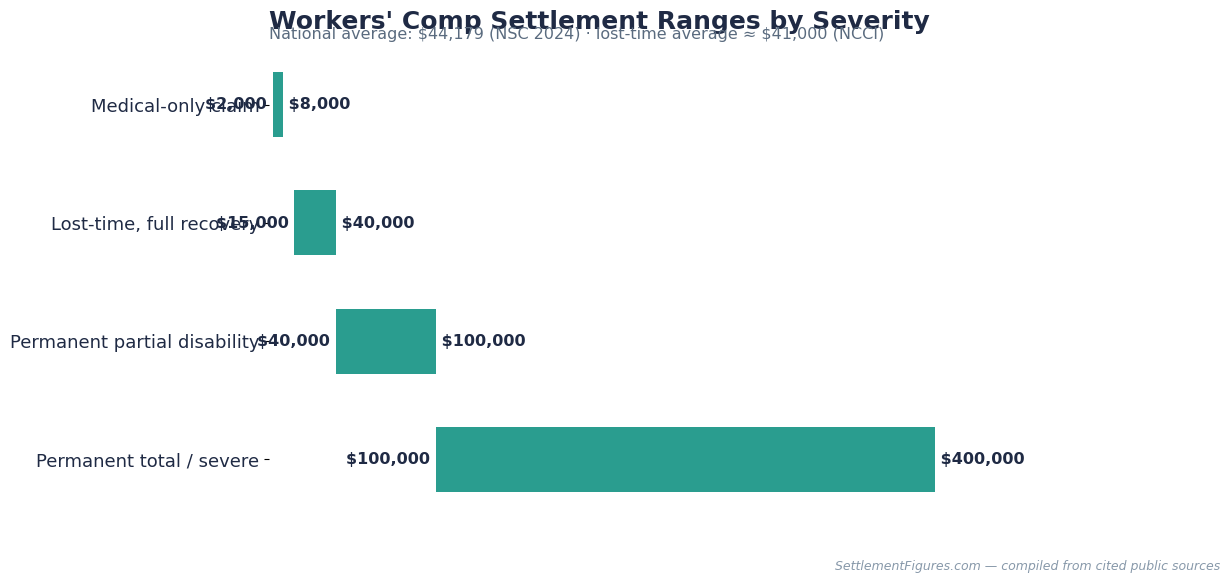
| Claim type | Typical range | Notes |
|---|---|---|
| Medical-only (no lost time) | $2,000 – $8,000 | Roughly average $3,000; most claims are this type |
| Lost-time, full recovery | $15,000 – $40,000 | Wage replacement + medical |
| Permanent partial disability (PPD) | $40,000 – $100,000 | Driven by impairment rating — how ratings work |
| Permanent total / catastrophic | $100,000 – $400,000+ | Often structured or lifetime benefits |
By body part (NCCI, 2022-2023 injuries)
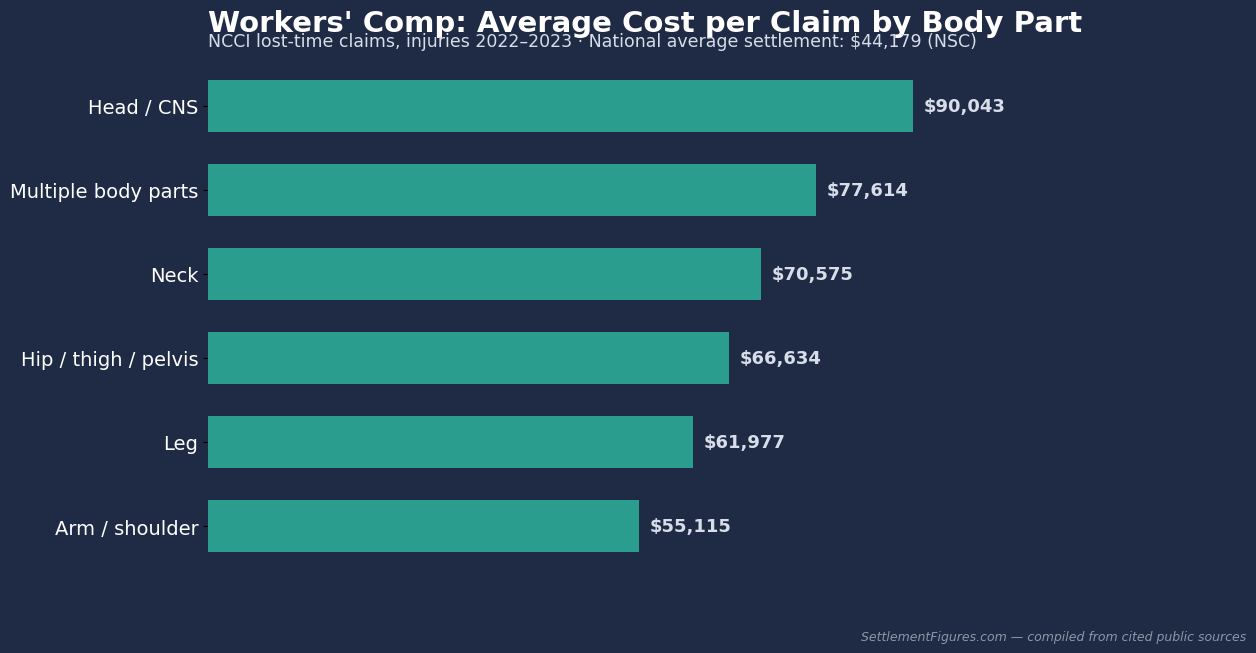
Head or central nervous system injuries average $90,043 per claim; multiple body parts $77,614; neck $70,575; hip/thigh/pelvis $66,634; leg $61,977; arm or shoulder $55,115. Settlement charts across states put typical low-back settlements near $37,000 and upper-back near $33,000. Deep dives: shoulder settlements and back settlements.
What workers’ comp actually pays (and what it never does)
Comp is no-fault: you do not prove your employer did anything wrong. In exchange, it pays medical care, roughly two-thirds of lost wages, and disability awards — but never pain and suffering. If a third party caused your injury (a negligent driver, defective machine), a separate lawsuit can add what comp excludes: comp vs. lawsuit, explained.
Settlement timing
Cases settle around Maximum Medical Improvement. Averages run about 16 months, with half of cases resolving in the 13-24 month band — full detail in our timeline guide. Fired or pressured during the process? Know your rights.
Free official help & resources
- Find your state workers’ comp board: U.S. Department of Labor directory at dol.gov/agencies/owcp
- Unsafe workplace: OSHA complaint line 1-800-321-6742 or osha.gov/workers/file-complaint (anonymous OK)
- SSDI interaction: comp can offset Social Security Disability — SSA publication (PDF)
- Free legal aid: LSC.gov — income-based, every state
- Your workplace rights portal: worker.gov (U.S. DOL)
FAQ
Is my settlement taxable?
Workers’ comp benefits are generally not taxable at the federal level (see IRS Pub 4345); the SSDI offset portion can be. Confirm with a tax professional.
Lump sum or structured payments?
Lump sums close the claim (often including future medical — be careful); structured payments keep medical open in many states. The right answer depends on future treatment risk.
Can I settle while still treating?
You can, but you are selling the unknown. Most experienced representatives wait for MMI so the impairment rating — and therefore the money — is known.
☕ This research is reader-supported. No law firm pays us. If this guide saved you time or money, you can buy the research team a coffee — it keeps the data free and updated.
This article is for informational purposes only and is not legal advice. Settlement values vary significantly by case and by state. Consult a licensed attorney in your state before making decisions about your claim.