
Last updated: July 7, 2026 · Data reviewed quarterly
Shoulder claims sit near the top of workers’ comp payouts for a reason: rotator cuff tears rarely heal on their own, surgery is common, and many workers never regain full overhead strength. NCCI puts the average arm/shoulder claim at $55,115 — and surgical cases typically run 2-4× their non-surgical equivalents.
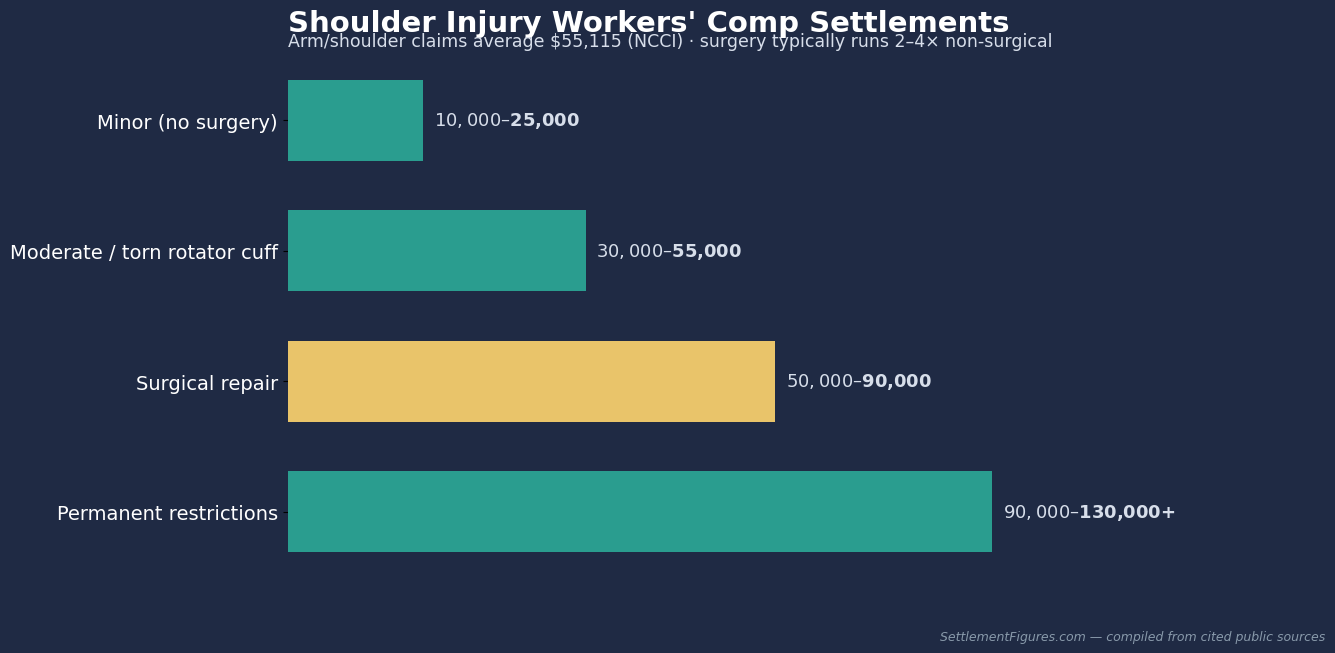
Ranges you can benchmark against
| Shoulder injury profile | Typical settlement |
|---|---|
| Strain/tendinitis, full recovery, no surgery | $10,000 – $25,000 |
| Partial rotator cuff tear, conservative care | $30,000 – $55,000 |
| Surgical repair (cuff, labrum), good outcome | $50,000 – $90,000 |
| Surgery + permanent restrictions | $90,000 – $130,000+ |
The single biggest driver is the impairment rating your doctor assigns at MMI — understand it before you talk numbers: how PPD ratings turn into money.
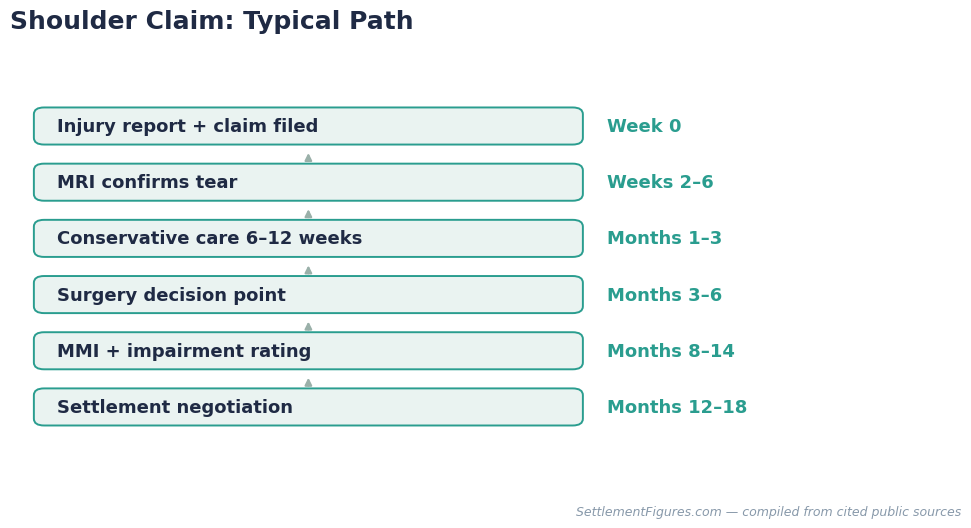
The typical shoulder claim path
Report and claim (week 0) → MRI confirms the tear (weeks 2-6) → conservative care trial (months 1-3) → surgery decision (months 3-6) → MMI and rating (months 8-14) → negotiation (months 12-18). Settling before the surgery decision means pricing the unknown — insurers love that; you should not.
What raises a shoulder settlement
MRI-documented tears (not just reported pain), a job requiring overhead work (higher wage-loss exposure), permanent lifting restrictions, dominant-arm involvement, and consistent treatment. What lowers it: degenerative findings the insurer blames on age, treatment gaps, and returning to full duty before your rating.
Free official help & resources
- State board directory: dol.gov/agencies/owcp
- Second medical opinion: most states allow an independent medical exam — ask your board how to request one
- Free legal aid: LSC.gov · ABA Find Legal Help
- Unsafe conditions caused it? OSHA 1-800-321-6742
FAQ
My MRI shows a tear but the insurer blames arthritis.
Common tactic. An aggravation of a pre-existing condition is still compensable in most states — your treating doctor’s causation opinion is the battleground, and a second opinion helps.
Do I settle before or after surgery?
After, in most cases: the outcome swings value by tens of thousands. Context: average settlements by injury.
Light duty pays less. Does comp cover the gap?
Usually yes — temporary partial disability typically pays about two-thirds of the wage difference.
☕ This research is reader-supported. No law firm pays us. If this guide saved you time or money, you can buy the research team a coffee — it keeps the data free and updated.
This article is for informational purposes only and is not legal advice. Settlement values vary significantly by case and by state. Consult a licensed attorney in your state before making decisions about your claim.